Event submissions
Published
This submission belongs to the session 4. Biodiversity Conservation at Botanical Gardens of the event The 1st International Online Conference on Zoological and Botanical Gardens
Published date
27 Nov, 2026
Academic Editor
 Marko S. Saboljevic
Contribution&Funding
Conceptualization,
[Katarina Fatrcová Šramková]
Methodology,
[Olga Grygorieva] ; [Ivan Gurnenko]
Software,
[Katarina Fatrcová Šramková] ; [Olga Grygorieva]
Validation,
[Katarina Fatrcová Šramková] ; [Vladimíra Bella] ; [Zuzana Kňažická]
Formal analysis,
[Ivan Gurnenko]
Investigation,
[Zuzana Kňažická]
Resources,
[Zuzana Kňažická]
Data curation,
[Olga Grygorieva] ; [Vladimíra Bella]
Visualization,
[Vladimíra Bella]
Funding: --
Citation
Katarina Fatrcová Šramková, Olga Grygorieva, Ivan Gurnenko, Vladimíra Bella, Zuzana Kňažická, Palynological Characterization of ×Sorbaronia fallax nothosubsp. mitschurinii Genotypes Maintained in the Collection of the M.M. Gryshko National Botanical Garden, in Proceedings of The 1st International Online Conference on Zoological and Botanical Gardens, 2 December–4 December 2026, MDPI: Basel, Switzerland
Share
Email
Facebook
Twitter
LinkedIn
Palynological Characterization of ×Sorbaronia fallax nothosubsp. mitschurinii Genotypes Maintained in the Collection of the M.M. Gryshko National Botanical Garden

Katarina Fatrcová Šramková 1

Olga Grygorieva 2
Ivan Gurnenko 3
Vladimíra Bella 4
Zuzana Kňažická 1
1. Institute of Nutrition and Genomics, Slovak University of Agriculture in Nitra, Nitra, 949 76, Slovakia
2. Department of Fruit Plants Acclimatization, M.M. Gryshko National Botanical Garden of the National Academy of Sciences of Ukraine, Kyiv, 01014, Ukraine
3. Department of Tropical and Subtropical Plants, M.M. Gryshko National Botanical Garden of the National Academy of Sciences of Ukraine, Kyiv, 01014, Ukraine
4. AgroBioTech Research Centre, Slovak University of Agriculture in Nitra , Nitra, 949 76, Slovakia
Abstract
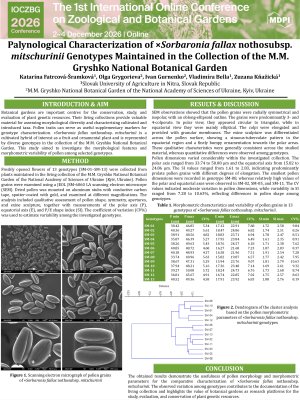
Botanical Gardens are important centres for the conservation, study, and evaluation of plant genetic resources. Their living collections provide valuable material for assessing morphological diversity and characterizing cultivated taxa. Pollen traits can serve as supplementary markers for genotype characterization. ×Sorbaronia fallax nothosubsp. mitschurinii is a cultivated hybrid of fruit and ornamental interest, represented by diverse genotypes in the collection of the M.M. Gryshko National Botanical Garden. This study aimed to characterize pollen morphology and morphometric variability among selected genotypes. Freshly opened flowers of 13 genotypes were collected from plants maintained in the living collection of the M.M. Gryshko National Botanical Garden (Kyiv, Ukraine). Pollen grains were examined using a JEOL JSM-6060 LA scanning electron microscope (SEM). The analysis included pollen shape, symmetry, apertures, exine sculpture, and measurements of the polar axis (P), equatorial axis (E), and P/E shape index (SI).
SEM observations showed that pollen grains were radially symmetrical and isopolar, with an oblong-ellipsoid outline. They were predominantly 3- and 4-colporate. In polar view, grains appeared circular to triangular, whereas in equatorial view they were mainly elliptical. The exine sculpture showed a sinuous-tuberculate pattern in the equatorial region and finely bumpy ornamentation towards the polar areas.
Pollen dimensions varied among genotypes. The polar axis ranged from 33.74 to 50.08 μm and the equatorial axis from 15.82 to 24.86 μm. SI values ranged from 1.61 to 2.83, indicating predominantly prolate pollen grains with different degrees of elongation. The smallest pollen dimensions occurred in SM-08, while relatively high values were recorded in SM-02, SM-05, and SM-11.
The results demonstrate the value of pollen morphology and morphometric parameters for genotype characterization. The observed variation enriches documentation of the living collection and highlights botanical gardens as research platforms for studying and conserving plant genetic resources.
Keywords
Botanical Garden; ×Sorbaronia fallax nothosubsp. mitschurinii; pollen morphology; palynology; scanning electron microscopy; genotype characterization.
Poster
×Sorbaronia fallax nothosubsp. mitschurinii.pdf
Comparative Pollen Morphology of Introduced Lycium Species in the Collection of the M.M. Gryshko National Botanical Garden
Excessive Rainfall Undermines Ex Situ Conservation Capacity: A Four-Year Plants Mortality Analysis from Cibodas, Indonesia