Event submissions
Published
This submission belongs to the session 4. Biodiversity Conservation at Botanical Gardens of the event The 1st International Online Conference on Zoological and Botanical Gardens
Published date
27 Nov, 2026
Academic Editor
 Marko S. Saboljevic
Contribution&Funding
Conceptualization,
[Taisiya Romanovna Bachurina]
Methodology,
[Taisiya Romanovna Bachurina]
Formal analysis,
[Taisiya Romanovna Bachurina]
Data curation,
[Taisiya Romanovna Bachurina]
Writing - original draft,
[Taisiya Romanovna Bachurina]
Writing - review,
[editing] ; [Taisiya Romanovna Bachurina]
Visualization,
[Taisiya Romanovna Bachurina]
Funding: --
Citation
Taisiya Romanovna Bachurina, Ecological Assessment of Filipendula ulmaria Populations as a Basis for In Situ and Ex Situ Conservation in the Republic of Tatarstan, in Proceedings of The 1st International Online Conference on Zoological and Botanical Gardens, 2 December–4 December 2026, MDPI: Basel, Switzerland
Share
Email
Facebook
Twitter
LinkedIn
Ecological Assessment of Filipendula ulmaria Populations as a Basis for In Situ and Ex Situ Conservation in the Republic of Tatarstan

Taisiya Romanovna Bachurina 1
1. Department of Botany and Plant Physiology, Institute of Fundamental Medicine and Biology, Kazan (Volga Region) Federal University, Kazan, 420008, Russia
Abstract
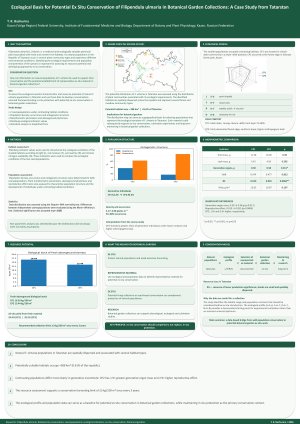
Introduction: Filipendula ulmaria (L.) Maxim. is a medicinal and ecologically valuable perennial plant associated with moist and nutrient-rich habitats. Conservation of wild plant diversity can combine in situ protection with ex situ conservation in botanical gardens. This study aimed to assess natural populations of F. ulmaria in the Republic of Tatarstan and provide an ecological basis for their conservation and potential representation in botanical garden collections.
Methods: Two coenopopulations occurring under contrasting habitat conditions were investigated. Habitat characteristics were assessed using Ellenberg indicator values for light, soil moisture, soil reaction and nitrogen availability. Population density, occurrence, ontogenetic structure, morphometric parameters and aboveground phytomass were determined. Differences between coenopopulations were evaluated using the Mann–Whitney U test. Potential distribution areas in Tatarstan were also assessed.
Results: Potential habitats suitable for F. ulmaria occupy approximately 388 km², or 0.61% of the republic's territory. The studied communities were characterized by semi-shaded conditions (L=5-6), moist soils (F=6-7), weakly acidic to neutral soil reaction (R=6-7), and relatively high nitrogen availability (N=6-8). Population density ranged from 2.17 to 3.06 plants m⁻², with a predominance of generative individuals. Generative organ mass and reproductive effort differed significantly between coenopopulations (p=0.011 and p=0.0004). Biological stocks of fresh aboveground biomass were 16.63 and 13.44 kg per 100 m².
Conclusions: The results provide criteria for conservation monitoring and future ex situ conservation. The identified habitat requirements can guide cultivation conditions in botanical garden collections. A harvesting limit of no more than 3 kg per 100 m² once every three years can reduce pressure on natural populations. Botanical garden collections may therefore complement in situ protection of F. ulmaria in Tatarstan.
Keywords
Filipendula ulmaria; biodiversity conservation; plant conservation; coenopopulation; ecological indicators.
Poster
IOCZBG_2026_Filipendula_ulmaria_poster.pdf
ENVIRONMENTAL AND ANTHROPOGENIC FACTORS INFLUENCING DAYTIME ACTIVITY BUDGETS OF MALAYAN TAPIRS (Tapirus indicus) IN CAPTIVITY
Toxoplasma gondii: From Zoo Outbreaks to Stray Cat Management – A One Health Perspective