Event submissions
Published
This submission belongs to the session 4. Biodiversity Conservation at Botanical Gardens of the event The 1st International Online Conference on Zoological and Botanical Gardens
Published date
27 Nov, 2026
Academic Editor
 Marko S. Saboljevic
Contribution&Funding
Conceptualization,
[Dzhamal Rakhmetov] ; [Nadiia Leschuk] ; [Svitlana Rakhmetova]
Methodology,
[Nadiia Shuvalova] ; [Dzhamal Rakhmetov] ; [Oleksandr Bondarchuk] ; [Nadiia Leschuk]
Software,
[Oleksandr Havryliuk]
Formal analysis,
[Oleksandr Bondarchuk]
Investigation,
[Nadiia Shuvalova] ; [Oleksandr Havryliuk]
Resources,
[Oleksandr Bondarchuk]
Data curation,
[Dzhamal Rakhmetov]
Writing - original draft,
[Nadiia Shuvalova] ; [Dzhamal Rakhmetov]
Writing - review,
[editing] ; [Svitlana Rakhmetova] ; [Oleksandr Havryliuk] ; [Oleksandr Bondarchuk] ; [Nadiia Leschuk] ; [Dzhamal Rakhmetov]
Supervision,
[Svitlana Rakhmetova] ; [Dzhamal Rakhmetov]
Project administration,
[Oleksandr Bondarchuk] ; [Dzhamal Rakhmetov]
Funding: --
Citation
Nadiia Shuvalova, Oleksandr Bondarchuk, Svitlana Rakhmetova, Oleksandr Havryliuk, Nadiia Leschuk, Dzhamal Rakhmetov, Comparative Anatomy of Nigella Species during Flowering, in Proceedings of The 1st International Online Conference on Zoological and Botanical Gardens, 2 December–4 December 2026, MDPI: Basel, Switzerland
Share
Email
Facebook
Twitter
LinkedIn
Comparative Anatomy of Nigella Species during Flowering

Nadiia Shuvalova 1
Oleksandr Bondarchuk 1
Svitlana Rakhmetova 1
Oleksandr Havryliuk 1
Nadiia Leschuk 1
Dzhamal Rakhmetov 1
1. Department of Cultural Flora, M.M. Gryshko National Botanical Garden of the National Academy of Sciences of Ukraine, Kyiv, Ukraine
Abstract
Introduction. Although many species of genus Nigella have been studied phytochemically and pharmacologically, the features of the microanatomy of many representatives of this genus have not been elucidated to date. The aim of this study was to provide the detailed anatomical description of Nigella hispanica, Nigella arvensis and Nigella nigelastrum during the flowering stage.
Materials and methods. Plant samples were collected from an experimental plot of the Department of Cultural Flora at the M.M. Gryshko National Botanical Garden of the National Academy of Sciences of Ukraine. Samples were fixed in buffered 4% formalin solution. Unstained and stained (with 0.2% methylene blue water solution) cross-sections, prepared by hand, were examined. Microscopy was performed by XZS-PW207T microscope, microphotographs taken with camera Euromex (CMEX-12f).
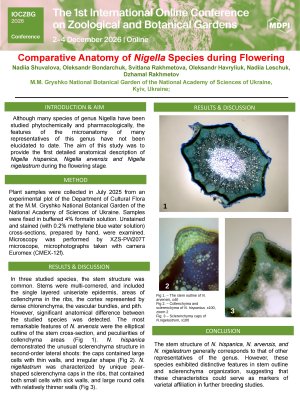
Results. We found, that in three studied species, the stem structure was common. Stems were multi-cornered, and included the single layered epidermis, areas of collenchyma in the ribs, the cortex represented by dense chlorenchyma, vascular bundles, and pith.
However, significant difference between the studied species was detected. The most remarkable features of N. arvensis were the elliptical outline of the stem cross-section, and peculiarities of collenchyma areas. N. hispanica demonstrated the unusual sclerenchyma structure in second-order lateral shoots: the caps contained large cells with thin walls, and irregular shape. N. nigellastrum was characterized by unique pear-shaped sclerenchyma caps in the ribs, that contained both small cells with sick walls, and large round cells with relatively thinner walls.
Conclusion. We found that the stem structure of N. hispanica, N. arvensis, and N. nigelastrum generally corresponds to that of other representatives of the genus. However, these species exhibited distinctive features in stem outline and sclerenchyma organization, suggesting that these characteristics could serve as markers of varietal affiliation in further breeding studies.
Keywords
Nigella
microanatomy
Poster
IOCZBG 2026_Shuvalova.pdf
INTEGRATION OF A BARCODE TECHNOLOGY FOR TREE SPECIES IDENTIFICATION, DOCUMENTATION, AND PUBLIC ENGAGEMENT IN THE UNIVERSITY OF IBADAN BOTANICAL GARDEN