Event submissions
EventsMOL2NET'16, Conference on Molecular, Biomed., Comput. & Network Science and Engineering, 2nd ed.
Published

This submission belongs to the session 05. NICEXSM-02: North-Ibero-American Congress on Exp. and Simul. Methods, Valencia, Spain-Miami, USA, 2016 of the event MOL2NET'16, Conference on Molecular, Biomed., Comput. & Network Science and Engineering, 2nd ed.
Published date
20 Dec, 2016
Citation
Luis C Fernandez-Torres, Amanda L Penton, Brandon F Gamboa, David Quesada, Belousov-Zhabotinsky Reaction: Effects of Magnetic Field Variations, in Proceedings of MOL2NET'16, Conference on Molecular, Biomed., Comput. & Network Science and Engineering, 2nd ed., 15 October–20 October 2022, MDPI: Basel, Switzerland, doi: 10.3390/mol2net-02-03838
Share
Email
Facebook
Twitter
LinkedIn
Belousov-Zhabotinsky Reaction: Effects of Magnetic Field Variations
'%3e%3cpath%20d='M12.6647%2010.9104C12.4176%2010.325%2012.0589%209.7933%2011.6088%209.34485C11.16%208.89511%2010.6283%208.53653%2010.0432%208.28891C10.038%208.28629%2010.0327%208.28498%2010.0275%208.28236C10.8437%207.69282%2011.3743%206.73252%2011.3743%205.64907C11.3743%203.85423%209.92005%202.40002%208.12522%202.40002C6.33038%202.40002%204.87618%203.85423%204.87618%205.64907C4.87618%206.73252%205.40677%207.69282%206.22296%208.28367C6.21772%208.28629%206.21248%208.2876%206.20724%208.29022C5.62031%208.53783%205.09365%208.89287%204.64167%209.34616C4.19192%209.79496%203.83334%2010.3266%203.58573%2010.9117C3.34247%2011.4846%203.21128%2012.0987%203.19925%2012.721C3.1989%2012.735%203.20135%2012.7489%203.20646%2012.7619C3.21157%2012.7749%203.21924%2012.7868%203.22901%2012.7968C3.23877%2012.8068%203.25045%2012.8148%203.26334%2012.8202C3.27623%2012.8256%203.29007%2012.8284%203.30406%2012.8284H4.09012C4.14776%2012.8284%204.19362%2012.7825%204.19493%2012.7262C4.22113%2011.7148%204.62726%2010.7676%205.34519%2010.0497C6.08802%209.30686%207.07452%208.89811%208.12522%208.89811C9.17592%208.89811%2010.1624%209.30686%2010.9052%2010.0497C11.6232%2010.7676%2012.0293%2011.7148%2012.0555%2012.7262C12.0568%2012.7839%2012.1027%2012.8284%2012.1603%2012.8284H12.9464C12.9604%2012.8284%2012.9742%2012.8256%2012.9871%2012.8202C13%2012.8148%2013.0117%2012.8068%2013.0214%2012.7968C13.0312%2012.7868%2013.0389%2012.7749%2013.044%2012.7619C13.0491%2012.7489%2013.0515%2012.735%2013.0512%2012.721C13.0381%2012.0947%2012.9084%2011.4856%2012.6647%2010.9104ZM8.12522%207.90243C7.52388%207.90243%206.95792%207.66793%206.53214%207.24215C6.10636%206.81636%205.87185%206.2504%205.87185%205.64907C5.87185%205.04773%206.10636%204.48177%206.53214%204.05599C6.95792%203.63021%207.52388%203.3957%208.12522%203.3957C8.72655%203.3957%209.29252%203.63021%209.7183%204.05599C10.1441%204.48177%2010.3786%205.04773%2010.3786%205.64907C10.3786%206.2504%2010.1441%206.81636%209.7183%207.24215C9.29252%207.66793%208.72655%207.90243%208.12522%207.90243Z'%20fill='%235D1EE1'/%3e%3c/g%3e%3c/svg%3e)
Luis C Fernandez-Torres 1
Amanda L Penton 1
Brandon F Gamboa 1
David Quesada 1
1. School of Science, Technology and Engineering Management, St. Thomas University, Miami Gardens, FL 33054, USA
Abstract
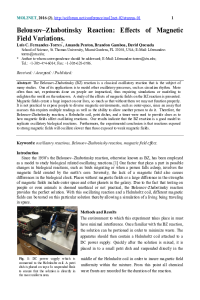
The Belousov-Zhabotinsky (BZ) reaction is a classical oscillatory reaction that is the subject of many studies. One of its applications is to model other oscillatory processes, such as circadian rhythm. More often than not, experiments done on people are impractical, thus requiring simulations or modeling to enlighten the world on the unknown. A study of the effects of magnetic fields on the BZ reaction is presented. Magnetic fields create a huge impact on our lives, so much so that without them we may not function properly. It is not practical to expose people to diverse magnetic environments, such as outer-space, since an assay that assesses this requires multiple readings as well as the ability to allow another person to do it. Therefore, the Belousov-Zhabotinsky reaction, a Helmholtz coil, petri dishes, and a timer were used to provide clues as to how magnetic fields affect oscillating reactions. Our results indicate that the BZ reaction is a good model to replicate oscillatory biological reactions. Furthermore, the experimental conclusion is that reactions exposed to strong magnetic fields will oscillate slower than those exposed to weak magnetic fields.
Keywords
Poster
mol2net-02_Penton-Gamboa-Fernandez.pdf
Assessment of the impact of micrometeorological conditions on plants growth.
Solvent Variations of the Briggs-Rauscher Reaction