Event submissions
EventsMOL2NET'16, Conference on Molecular, Biomed., Comput. & Network Science and Engineering, 2nd ed.
Published

This submission belongs to the session 06. MODECO-01: Workshop on Molecular Diversity & Ecosystems, Puyo, Ecuador-Porto, Portugal, 2016 of the event MOL2NET'16, Conference on Molecular, Biomed., Comput. & Network Science and Engineering, 2nd ed.
Published date
21 Dec, 2016
Citation
Luis C Fernandez-Torres, Jason Alvarodiaz, Jennifer J Cerda, Christine Curiac, Mighty Fruits: Antioxidant Performance of Various Fruits , in Proceedings of MOL2NET'16, Conference on Molecular, Biomed., Comput. & Network Science and Engineering, 2nd ed., 15 October–20 October 2022, MDPI: Basel, Switzerland, doi: 10.3390/mol2net-02-03840
Share
Email
Facebook
Twitter
LinkedIn
Mighty Fruits: Antioxidant Performance of Various Fruits
'%3e%3cpath%20d='M12.6647%2010.9104C12.4176%2010.325%2012.0589%209.7933%2011.6088%209.34485C11.16%208.89511%2010.6283%208.53653%2010.0432%208.28891C10.038%208.28629%2010.0327%208.28498%2010.0275%208.28236C10.8437%207.69282%2011.3743%206.73252%2011.3743%205.64907C11.3743%203.85423%209.92005%202.40002%208.12522%202.40002C6.33038%202.40002%204.87618%203.85423%204.87618%205.64907C4.87618%206.73252%205.40677%207.69282%206.22296%208.28367C6.21772%208.28629%206.21248%208.2876%206.20724%208.29022C5.62031%208.53783%205.09365%208.89287%204.64167%209.34616C4.19192%209.79496%203.83334%2010.3266%203.58573%2010.9117C3.34247%2011.4846%203.21128%2012.0987%203.19925%2012.721C3.1989%2012.735%203.20135%2012.7489%203.20646%2012.7619C3.21157%2012.7749%203.21924%2012.7868%203.22901%2012.7968C3.23877%2012.8068%203.25045%2012.8148%203.26334%2012.8202C3.27623%2012.8256%203.29007%2012.8284%203.30406%2012.8284H4.09012C4.14776%2012.8284%204.19362%2012.7825%204.19493%2012.7262C4.22113%2011.7148%204.62726%2010.7676%205.34519%2010.0497C6.08802%209.30686%207.07452%208.89811%208.12522%208.89811C9.17592%208.89811%2010.1624%209.30686%2010.9052%2010.0497C11.6232%2010.7676%2012.0293%2011.7148%2012.0555%2012.7262C12.0568%2012.7839%2012.1027%2012.8284%2012.1603%2012.8284H12.9464C12.9604%2012.8284%2012.9742%2012.8256%2012.9871%2012.8202C13%2012.8148%2013.0117%2012.8068%2013.0214%2012.7968C13.0312%2012.7868%2013.0389%2012.7749%2013.044%2012.7619C13.0491%2012.7489%2013.0515%2012.735%2013.0512%2012.721C13.0381%2012.0947%2012.9084%2011.4856%2012.6647%2010.9104ZM8.12522%207.90243C7.52388%207.90243%206.95792%207.66793%206.53214%207.24215C6.10636%206.81636%205.87185%206.2504%205.87185%205.64907C5.87185%205.04773%206.10636%204.48177%206.53214%204.05599C6.95792%203.63021%207.52388%203.3957%208.12522%203.3957C8.72655%203.3957%209.29252%203.63021%209.7183%204.05599C10.1441%204.48177%2010.3786%205.04773%2010.3786%205.64907C10.3786%206.2504%2010.1441%206.81636%209.7183%207.24215C9.29252%207.66793%208.72655%207.90243%208.12522%207.90243Z'%20fill='%235D1EE1'/%3e%3c/g%3e%3c/svg%3e)
Luis C Fernandez-Torres 1
Jason Alvarodiaz 1
Jennifer J Cerda 1
Christine Curiac 1
1. School of Science, Technology and Engineering Management, St. Thomas University, Miami Gardens, FL 33054, USA
Abstract
Mighty Fruits: Antioxidant Performance of Various Fruits
Jason Alvarodiaz, Jennifer Cerda, Christine Curiac, and Luis C. Fernandez-Torres
School of Science Technology, and Engineering Management, St. Thomas University, Miami Gardens, FL 33054
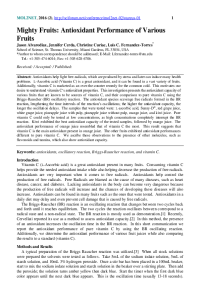
Antioxidants help fight free-radicals, which are produced by stress and later can induce many health problems. L-Ascorbic acid (Vitamin C) is a great antioxidant, and it can be found in a vast variety of fruits. Additionally, vitamin C is marketed as an over-the-counter remedy for the common cold. This motivates our desire to understand vitamin C’s antioxidant properties. This investigation presents the antioxidant capacity of various fruits that are known to be sources of vitamin C, and their comparison to pure vitamin C using the Briggs-Rauscher (BR) oscillatory reaction. The antioxidant species scavenge free radicals formed in the BR reaction, lengthening the time intervals of the reaction’s oscillations; the higher the antioxidant capacity, the longer the oscillation delays. The samples that were tested were: L- Ascorbic acid, Sunny-D®, red grape juice, white grape juice, pineapple juice with pulp, pineapple juice without pulp, mango juice, and kiwi juice. Pure vitamin C could only be tested at low concentrations, as high concentrations completely interrupt the BR reaction. Kiwi exhibited the best antioxidant capacity of the tested samples, followed by mango juice. The antioxidant performance of orange juice resembled that of vitamin C the most. This result suggests that vitamin C is the main antioxidant present in orange juice. The other fruits exhibited antioxidant performances different to pure vitamin C. We ascribe these observations to the presence of other molecules, such as flavonoids and tannins, which also show antioxidant capacity.
Keywords
Poster
Alvarodiaz-Cerda-Fernandez.pdf
Solvent Variations of the Briggs-Rauscher Reaction
Structure – Activity Relationships (SARs) of Antioxidant Molecule