Event submissions
Published
This submission belongs to the session 1. Zoo Animals Welfare of the event The 1st International Online Conference on Zoological and Botanical Gardens
Published date
27 Nov, 2026
Academic Editor
 Oriol Tallo-Parra
Contribution&Funding
Conceptualization,
[Olga A. Loginova]
Methodology,
[Olga A. Loginova]
Investigation,
[Olga A. Loginova]
Resources,
[Andrey N. Korolev]
Writing - original draft,
[Olga A. Loginova]
Writing - review,
[editing] ; [Andrey N. Korolev]
Visualization,
[Olga A. Loginova]
Funding: --
Citation
Olga A. Loginova, Andrey N. Korolev, Helminths of Reindeer (Rangifer tarandus) in Additional Zoological Collections in Russia: New Records from 2024–2025, in Proceedings of The 1st International Online Conference on Zoological and Botanical Gardens, 2 December–4 December 2026, MDPI: Basel, Switzerland
Share
Email
Facebook
Twitter
LinkedIn
Helminths of Reindeer (Rangifer tarandus) in Additional Zoological Collections in Russia: New Records from 2024–2025

Olga A. Loginova 1

Andrey N. Korolev 2
1. Parasitology Center, A. N. Seversov Institute of Ecology and Evolution of the Russian Academy of Sciences, Moscow, 119071, Russia
2. Institute of Biology, Komi Science Centre of the Ural Branch of the Russian Academy of Sciences, Syktyvkar, 167982, Russia
Abstract
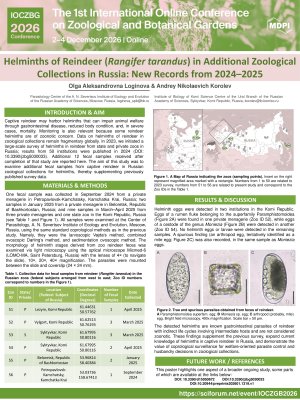
Captive reindeer may harbor helminths that can impair animal welfare through gastrointestinal disease, reduced body condition, and, in severe cases, mortality. Monitoring is also relevant because some reindeer helminths are of zoonotic concern. Data on helminths of reindeer in zoological collections remain fragmentary globally. In 2023, we initiated a large-scale survey of helminths in reindeer from state and private zoos in Russia; results from 50 institutions were published in 2024. Additional fecal samples received after completion of that study are reported here. One fecal sample was collected in September 2024 from a private menagerie in Petropavlovsk-Kamchatsky, Kamchatka Krai, Russia; two samples in January 2025 from a private menagerie in Beloretsk, Republic of Bashkortostan, Russia; and nine samples in March–April 2025 from three private menageries and one state zoo in the Komi Republic, Russia. All samples were examined at the Center of Parasitology, A.N. Severtsov Institute of Ecology and Evolution, Moscow, using the same standard coprological methods as in the previous study, including ovoscopy and larvoscopy. Helminth eggs were detected in samples from two private menageries in the Komi Republic. Eggs of a rumen fluke belonging to the superfamily Paramphistomoidea were found in one menagerie, while eggs of a cestode of the genus Moniezia were detected in another. No helminth eggs or larvae were found in the remaining samples. A spurious finding (an arthropod egg, tentatively identified as a mite egg) was also recorded in the same sample as Moniezia eggs. The helminths detected are non-zoonotic gastrointestinal parasites of reindeer with indirect life cycles involving intermediate hosts. These findings supplement the previous survey and expand current knowledge of helminths in captive reindeer in Russia.
Keywords
helminths
reindeer
zoo
Russia
Poster
Loginova & Korolev - IOCZBG poster.pdf
Vermicompost as a Bio-Modulator for Soil and Plant Health: Linking Botanical Garden Sustainability with Biodiversity Conservation
Surgical Stabilization of an L3 Vertebral Compression Fracture in a Striped Hyena (Hyaena hyaena)