Event submissions
EventsMOL2NET'16, Conference on Molecular, Biomed., Comput. & Network Science and Engineering, 2nd ed.
Published

This submission belongs to the session 01. CHEMBIOINFO-02: Chem-Bioinformatics Congress Cambridge, UK-Chapel Hill and Richmond, USA, 2016. of the event MOL2NET'16, Conference on Molecular, Biomed., Comput. & Network Science and Engineering, 2nd ed.
Published date
21 Dec, 2016
Citation
Luis C Fernandez-Torres, Luis E Castellar, Langeda Bontemps, Leslie R Robinson, Structure – Activity Relationships (SARs) of Antioxidant Molecule, in Proceedings of MOL2NET'16, Conference on Molecular, Biomed., Comput. & Network Science and Engineering, 2nd ed., 15 October–20 October 2022, MDPI: Basel, Switzerland, doi: 10.3390/mol2net-02-03841
Share
Email
Facebook
Twitter
LinkedIn
Structure – Activity Relationships (SARs) of Antioxidant Molecule
'%3e%3cpath%20d='M12.6647%2010.9104C12.4176%2010.325%2012.0589%209.7933%2011.6088%209.34485C11.16%208.89511%2010.6283%208.53653%2010.0432%208.28891C10.038%208.28629%2010.0327%208.28498%2010.0275%208.28236C10.8437%207.69282%2011.3743%206.73252%2011.3743%205.64907C11.3743%203.85423%209.92005%202.40002%208.12522%202.40002C6.33038%202.40002%204.87618%203.85423%204.87618%205.64907C4.87618%206.73252%205.40677%207.69282%206.22296%208.28367C6.21772%208.28629%206.21248%208.2876%206.20724%208.29022C5.62031%208.53783%205.09365%208.89287%204.64167%209.34616C4.19192%209.79496%203.83334%2010.3266%203.58573%2010.9117C3.34247%2011.4846%203.21128%2012.0987%203.19925%2012.721C3.1989%2012.735%203.20135%2012.7489%203.20646%2012.7619C3.21157%2012.7749%203.21924%2012.7868%203.22901%2012.7968C3.23877%2012.8068%203.25045%2012.8148%203.26334%2012.8202C3.27623%2012.8256%203.29007%2012.8284%203.30406%2012.8284H4.09012C4.14776%2012.8284%204.19362%2012.7825%204.19493%2012.7262C4.22113%2011.7148%204.62726%2010.7676%205.34519%2010.0497C6.08802%209.30686%207.07452%208.89811%208.12522%208.89811C9.17592%208.89811%2010.1624%209.30686%2010.9052%2010.0497C11.6232%2010.7676%2012.0293%2011.7148%2012.0555%2012.7262C12.0568%2012.7839%2012.1027%2012.8284%2012.1603%2012.8284H12.9464C12.9604%2012.8284%2012.9742%2012.8256%2012.9871%2012.8202C13%2012.8148%2013.0117%2012.8068%2013.0214%2012.7968C13.0312%2012.7868%2013.0389%2012.7749%2013.044%2012.7619C13.0491%2012.7489%2013.0515%2012.735%2013.0512%2012.721C13.0381%2012.0947%2012.9084%2011.4856%2012.6647%2010.9104ZM8.12522%207.90243C7.52388%207.90243%206.95792%207.66793%206.53214%207.24215C6.10636%206.81636%205.87185%206.2504%205.87185%205.64907C5.87185%205.04773%206.10636%204.48177%206.53214%204.05599C6.95792%203.63021%207.52388%203.3957%208.12522%203.3957C8.72655%203.3957%209.29252%203.63021%209.7183%204.05599C10.1441%204.48177%2010.3786%205.04773%2010.3786%205.64907C10.3786%206.2504%2010.1441%206.81636%209.7183%207.24215C9.29252%207.66793%208.72655%207.90243%208.12522%207.90243Z'%20fill='%235D1EE1'/%3e%3c/g%3e%3c/svg%3e)
Luis C Fernandez-Torres 1
Luis E Castellar 1
Langeda Bontemps 1
Leslie R Robinson 1
1. School of Science, Technology and Engineering Management, St. Thomas University, Miami Gardens, FL 33054, USA
Abstract
Structure – Activity Relationships (SARs) of Antioxidant Molecules
Luis E. Castellar, Langeda Bontemps, Leslie Robinson, and Luis C. Fernandez-Torres
School of Science, Technology, and Engineering Management, St. Thomas University, Miami Gardens, FL 33054
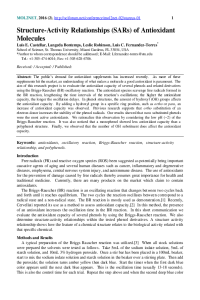
The public’s demand for antioxidant supplements has increased recently. As more of these supplements hit the market, an understanding of what makes a molecule a good antioxidant is paramount. The aim of this research project is to evaluate the antioxidant capacity of several phenols and related derivatives using the Briggs-Rauscher (BR) oscillatory reaction. The antioxidant species scavenge free radicals formed in the BR reaction, lengthening the time intervals of the reaction’s oscillations; the higher the antioxidant capacity, the longer the oscillation delays. In phenol structures, the amount of hydroxyl (OH) withdrawing groups affects the antioxidant capacity. By adding a hydroxyl group in a specific ring position, such as ortho or para, an increase of antioxidant capacity was observed. Previous research supports that ortho substitution of an electron donor increases the stability of the phenol radicals. Our results showed that meta substituted phenols were the most active antioxidants. We rationalize this observation by considering the low pH (~2) of the Briggs-Rauscher reaction. It was also noticed that a monophenol showed less antioxidant capacity than a polyphenol structure. Finally, we observed that the number of OH substituent does affect the antioxidant capacity.
Keywords
Poster
Castellar-Bontemps-Robinson-Fernandez.pdf
Mighty Fruits: Antioxidant Performance of Various Fruits
Antioxidant Capacity of Selected Teas and Cocoa