Event submissions
Published
This submission belongs to the session 6. Botanical Gardens Sustainability of the event The 1st International Online Conference on Zoological and Botanical Gardens
Published date
27 Nov, 2026
Academic Editor
 Kevin Cianfaglione
Contribution&Funding
Conceptualization,
[Marija Markovic] ; [Jelena Tomicevic Dubljevic] ; [Slavica Čepić]
Methodology,
[Marija Markovic] ; [Jelena Tomicevic Dubljevic] ; [Slavica Čepić]
Validation,
[Jelena Tomicevic Dubljevic] ; [Slavica Čepić]
Formal analysis,
[Marija Markovic]
Investigation,
[Marija Markovic]
Data curation,
[Marija Markovic]
Writing - original draft,
[Marija Markovic]
Writing - review,
[editing] ; [Jelena Tomicevic Dubljevic] ; [Slavica Čepić]
Funding: This research was supported by the Ministry of Science, Technological Development and Innovation of the Republic of Serbia (Grant No. 451–03-33/2026–03/ 200169)
Citation
Marija Markovic, Jelena Tomicevic Dubljevic, Slavica Čepić, Visitor-Oriented Programmes in European Botanical Gardens: A Cross-Sectional Web-Based Mapping of Education, Recreation and Well-Being Offers, in Proceedings of The 1st International Online Conference on Zoological and Botanical Gardens, 2 December–4 December 2026, MDPI: Basel, Switzerland
Share
Email
Facebook
Twitter
LinkedIn
Visitor-Oriented Programmes in European Botanical Gardens: A Cross-Sectional Web-Based Mapping of Education, Recreation and Well-Being Offers

Marija Markovic 1
Jelena Tomicevic Dubljevic 1
Slavica Čepić 1
1. Department of Landscape Architecture and Horticulture, Faculty of Forestry, University of Belgrade, Belgrade, 11030, Serbia
Abstract
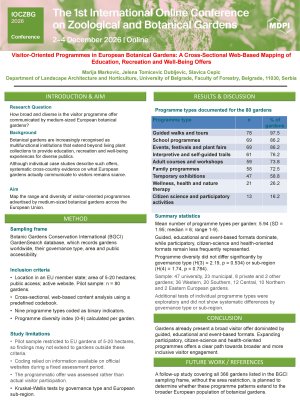
Introduction. Botanical gardens are increasingly recognised as multifunctional institutions that extend beyond living plant collections to provide education, recreation and well-being experiences for diverse publics. Although individual case studies describe such offers, systematic cross-country evidence on what European gardens actually communicate to visitors remains scarce. This study maps the range and diversity of visitor-oriented programmes advertised by medium-sized botanical gardens across the European Union.
Methods. A cross-sectional, web-based content analysis was conducted on a pilot sample of 80 botanical gardens identified through the BGCI GardenSearch database. Inclusion criteria were location in an EU member state, an area of 5–20 hectares, public access, and an active website. Nine programme types were coded as binary indicators using a predefined codebook, and a programme diversity index (0–9) was calculated for each garden. Differences by governance type and European sub-region were tested with Kruskal–Wallis tests.
Results. Guided walks and tours were near-universal (97.5%, n = 78), followed by school programmes and events or festivals (86.2% each), interpretive trails (76.2%), adult courses and workshops (73.8%) and family programmes (72.5%). Well-being, health and nature-therapy offers (26.2%) and citizen-science or participatory activities (16.2%) were markedly less common. Gardens offered on average 5.94 programme types (SD = 1.95; median = 6; range 1–9). Programme diversity did not differ significantly by governance type (H(3) = 2.19, p = 0.534) or sub-region (H(4) = 1.74, p = 0.784).
Conclusions. European botanical gardens show a consistent emphasis on guided, educational and event-based offers, while participatory, citizen-science and health-oriented formats remain less frequently represented. The limited variation across governance types and regions suggests opportunities for expanding visitor engagement through more diverse and inclusive programme models.
Keywords
botanical gardens
visitor programmes
environmental education
content analysis
Europe
institutional sustainability
BGCI
Poster
Poster Visitor-Oriented Programmes.pdf
Distribution of Macro- and Microelements and Heavy Metals among Staminate Catkins, Pollen, Fruits, Bee Pollen, and Honey of Castanea sativa Mill.
How Inclusive Are European Botanical Gardens? A Content Analysis of Visitor Programmes