Event submissions
Published
This submission belongs to the session 4. Biodiversity Conservation at Botanical Gardens of the event The 1st International Online Conference on Zoological and Botanical Gardens
Published date
27 Nov, 2026
Academic Editor
 Marko S. Saboljevic
Contribution&Funding
Conceptualization,
[Katarina Fatrcová Šramková]
Methodology,
[Ivan Gurnenko]
Software,
[Olga Grygorieva] ; [Vladimíra Bella]
Validation,
[Olga Grygorieva] ; [Zuzana Kňažická]
Formal analysis,
[Olga Grygorieva] ; [Zuzana Kňažická]
Resources,
[Olga Grygorieva]
Visualization,
[Olga Grygorieva]
Funding: --
Citation
Olga Grygorieva, Ivan Gurnenko, Vladimíra Bella, Katarina Fatrcová Šramková, Zuzana Kňažická, Pollen Morphology and Morphometry of Pseudocydonia sinensis (Thouin) C.K. Schneid. Introduced in Ukraine, in Proceedings of The 1st International Online Conference on Zoological and Botanical Gardens, 2 December–4 December 2026, MDPI: Basel, Switzerland
Share
Email
Facebook
Twitter
LinkedIn
Pollen Morphology and Morphometry of Pseudocydonia sinensis (Thouin) C.K. Schneid. Introduced in Ukraine

Olga Grygorieva 1

Ivan Gurnenko 2
Vladimíra Bella 3
Katarina Fatrcová Šramková 4
Zuzana Kňažická 4
1. Department of Fruit Plants Acclimatization , M.M. Gryshko National Botanical Garden of the National Academy of Sciences of Ukraine, Kyiv, 01014, Ukraine
2. Department of Tropical and Subtropical Plants, M.M. Gryshko National Botanical Garden of the National Academy of Sciences of Ukraine, Kyiv, 01014, Ukraine
3. AgroBioTech Research Centre, Slovak University of Agriculture in Nitra, Nitra, Slovakia
4. Institute of Nutrition and Genomics, Faculty of Agrobiology and Food Resources, Slovak University of Agriculture in Nitra, Nitra, Slovakia
Abstract
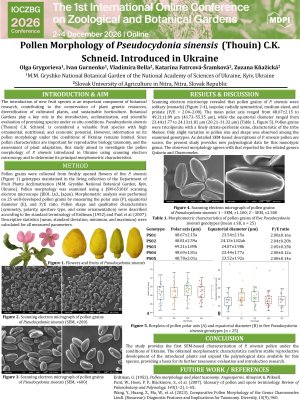
The introduction of new fruit species contributes to the conservation of plant genetic resources and diversification of cultivated plants. Pseudocydonia sinensis (Thouin) C.K. Schneid. is a valuable fruit species with high ornamental, nutritional, and economic potential, but information on its pollen morphology under the conditions of Ukraine remains limited. Since pollen characteristics are important for reproductive biology and taxonomy, this study aimed to investigate the pollen morphology of P. sinensis introduced in Ukraine using scanning electron microscopy and to determine its principal morphometric characteristics.
Pollen grains were collected from freshly opened flowers of five P. sinensis genotypes maintained in the living collection of the M.M. Gryshko National Botanical Garden (Kyiv, Ukraine). Pollen morphology was examined using a JSM-6510LV scanning electron microscope (JEOL Ltd., Japan). Morphometric analysis was performed on 25 well-developed pollen grains by measuring the polar axis (P), equatorial diameter (E), and P/E ratio.
Scanning electron microscopy revealed that pollen grains of P. sinensis were solitary (monads), isopolar, radially symmetrical, medium-sized, and prolate (P/E = 2.04–2.08). The mean polar axis ranged from 48.67±2.15 to 49.21±1.89 μm (43.73–55.35 μm), while the equatorial diameter ranged from 23.44±1.77 to 24.13±1.82 μm (20.21–31.32 μm). Pollen grains were tricolporate with a finely striate-perforate exine, characteristic of the tribe Maleae. Only slight variation in pollen size and shape was observed among the examined genotypes. As detailed SEM-based descriptions of P. sinensis pollen are scarce, the present study provides new palynological data for this monotypic genus. The observed morphology agrees with that reported for the related genera Cydonia and Chaenomeles.
The study provides the first SEM-based characterization of P. sinensis pollen under the conditions of Ukraine. The obtained morphometric characteristics confirm stable reproductive development of the introduced plants and expand the palynological data available for this species, providing a basis for its further taxonomic evaluation and introduction research.
Keywords
Pseudocydonia sinensis; pollen morphology; scanning electron microscopy; morphometric analysis; introduced species
Poster
Grygorieva.pdf
How Inclusive Are European Botanical Gardens? A Content Analysis of Visitor Programmes
Evidence-Informed Welfare and Reserve Readiness for Arabian Leopard Reintroduction in Saudi Arabia: A Systematic Review