Event submissions
Published
This submission belongs to the session 1. Zoo Animals Welfare of the event The 1st International Online Conference on Zoological and Botanical Gardens
Published date
27 Nov, 2026
Academic Editor
 Oriol Tallo-Parra
Citation
Eman Elbealy, Evidence-Informed Welfare and Reserve Readiness for Arabian Leopard Reintroduction in Saudi Arabia: A Systematic Review, in Proceedings of The 1st International Online Conference on Zoological and Botanical Gardens, 2 December–4 December 2026, MDPI: Basel, Switzerland
Share
Email
Facebook
Twitter
LinkedIn
Evidence-Informed Welfare and Reserve Readiness for Arabian Leopard Reintroduction in Saudi Arabia: A Systematic Review

Eman Elbealy 1,2
1. Department of Biology, King Khalid University, Abha, 3340, Saudi Arabia
2. College of Science, Prince Sultan Bin Abdelaziz Center for Environmental Research and Natural Resources Sustainability, Abha, 3340, Saudi Arabia
Abstract
Introduction
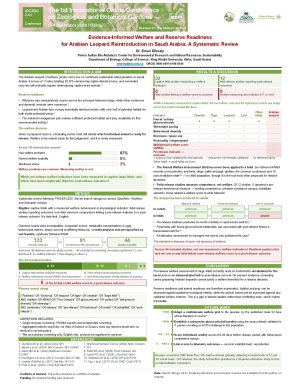
The critically endangered Arabian leopard (Panthera pardus nimr) lacks a confirmed sustainable population in Saudi Arabia, necessitating the reintroduction of captive-bred individuals. The Royal Commission for AlUla is preparing nature reserves, notably Sharaan, for wildlife releases. This systematic review evaluates the evidence linking captive large-felid welfare frameworks with ecological reserve-readiness to inform reintroduction protocols.
Methods
Following PRISMA guidelines, we searched scientific databases (e.g., Web of Science, Scopus) and institutional conservation reports through mid-2026. Search terms combined large-felid welfare (e.g., "Animal Welfare Assessment Grid," "fecal glucocorticoid metabolites") and ecological readiness ("prey density," "habitat restoration"). Eligibility required assessments of captive ex situ welfare or release-site indicators. Data on physiological stress, behavioral diversity, and ecological thresholds were extracted and synthesized to identify criteria for release readiness.
Results
Synthesis of the included literature consistently demonstrates that integrating positive reinforcement training with multidomain assessments (e.g., AWAG) effectively mitigates pre-release stress, reflected in significantly lowered baseline fecal glucocorticoid metabolites. Ecologically, comparative models of large felid rewilding universally confirm that apex predator establishment strictly depends on sustained native ungulate prey densities—a condition actively being met in Sharaan through livestock exclusion and phased gazelle and ibex releases. Crucially, the review identified a major evidence gap: no current studies have established a universally validated pre-release AWAG cutoff score that directly correlates with long-term post-release survival for Arabian leopards.
Conclusions
Integrating multidomain welfare assessments with quantifiable habitat and prey-recovery indicators provides an evidence-informed framework for Arabian leopard reintroduction. While the synthesis validates the necessity of reducing captive stress and securing prey bases prior to release, original prospective research is urgently required to establish precise pre-release welfare thresholds that predict post-release survival in Saudi Arabia’s expanding reserve network.
Keywords
Arabian leopard (Panthera pardus nimr)
Animal welfare
Reintroduction biology
Systematic review
Ecological readiness
Conservation breeding
AWAG
Poster
IOCZBG 2026 EmanElbealy Poster submitted.pdf
Pollen Morphology and Morphometry of Pseudocydonia sinensis (Thouin) C.K. Schneid. Introduced in Ukraine
Communicating Sustainability and the SDGs: A Pilot Study of How European Botanical Gardens Frame Their Visitor Programmes