Event submissions
Published
This submission belongs to the session 1. Zoo Animals Welfare of the event The 1st International Online Conference on Zoological and Botanical Gardens
Published date
27 Nov, 2026
Academic Editor
 Oriol Tallo-Parra
Contribution&Funding
Writing - original draft,
[Naiha Naeem]
Writing - review,
[editing] ; [Naiha Naeem]
Supervision,
[Farooq Ahmad]
Funding: --
Citation
Naiha Naeem, Farooq Ahmad, Impact of Stress on Plama corticosterone levels and Reproductive performance of Rock Pigeons (Columba livia), in Proceedings of The 1st International Online Conference on Zoological and Botanical Gardens, 2 December–4 December 2026, MDPI: Basel, Switzerland
Share
Email
Facebook
Twitter
LinkedIn
Impact of Stress on Plama corticosterone levels and Reproductive performance of Rock Pigeons (Columba livia)

Naiha Naeem 1
Farooq Ahmad 1
1. Department of Zoology, The Islamia University of Bahawalpur, Bahawalpur, Pakistan
Abstract
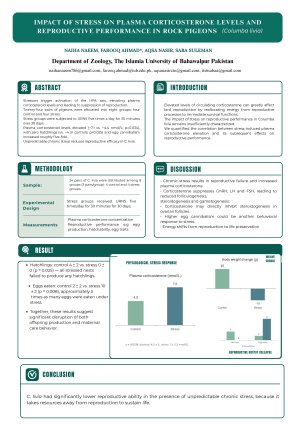
Stress is a response elicited by the perceived challenges that threaten homeostasis and exert pressure on a system. Stressors cause detrimental effects, triggering the activation of the hypothalamic-pituitary-adrenal (HPA) axis in vertebrate species, elevating plasma corticosteroid levels and leading to suppression of life activities such as growth, metabolism, and reproduction. Despite this, how stress affects the reproductive success of Columba livia remains inadequately studied. This study examined the impact of unpredictable and repeated negative stimuli (URNS) on C.livia. In C. livia, we hypothesized that chronic unpredictable stress would increase plasma corticosteroids, leading to decreased reproductive output via HPA-axis-mediated reallocation of energy. As C. livia is known to exhibit physiological and reproductive stress responses similar to other species in captivity, the results of this study may provide insight into how husbandry-related stressors such as visitor observation, handling, and alterations within the animal's enclosure can affect breeding success and welfare. Twenty-four pairs of pigeons were allocated into eight groups, each consisting of 3 pairs (control and stress groups). Three pairs of pigeons were kept in each cage with water and basal diet ad libitum. The stress groups were subjected to URNS five times a day for 30 minutes over a period of 30 days. The stressors were of different types; acoustic stressors consisted of 30 second playback recordings of hawk screeches (peak frequency≈3.2 KHz), traffic noise (broadband, 0.8-6 khz, 90 ± dBA), and conspecific alarm calls (1.5-2.8 kHz, 90± 2 dBA), randomized across five daily sessions with minimum 2-hour intervals, visual stressors i.e toy cat hanged within the cage, waving of pigeon trapping net and mechanical stressors (cage shaking, small wood stick banged on the sides of cage, cage tapping). Stress was administered for 30 min at approximately 2 h intervals. The results showed a significant decline in body weight (~13 g vs ~1 g in controls; p=0.024) and an elevation in plasma corticosteroid levels (~7.1 vs. ~4.4 nmol/L; p=0.034) in rock pigeons. These physiological reactions were correlated with zero hatchlings (vs. ~4 in controls; p=0.025), and egg cannibalism increased roughly five-fold (~10 vs. ~2 eggs; p=0.008). URNS disrupts reproductive mechanisms by reallocating energy from reproduction to survival, thereby reducing reproductive efficacy in C. livia.
The Animals Ethics Committee of Islamia University of Bahawalpur approved the animal study protocol (Approval letter number 551/ORIC, and date of approval 19.10.2025).
Keywords
Chronic stress; corticosterone; HPA-HPG axis; reproductive performance; egg quality; egg cannibalism; avian physiology
Poster
research_poster_naiha_naeem.pdf
Nocturnal rat-tapir interaction raises welfare concerns in captive settings
Assessing the Role of Selected Nigerian Botanical Gardens in the Conservation of Indigenous Antidiabetic Medicinal Plants: Evidence from Expert Survey and a Field Observation