Event submissions
Published
This submission belongs to the session 5. Collections in Botanical Gardens, Arboretum and Museums of the event The 1st International Online Conference on Zoological and Botanical Gardens
Published date
27 Nov, 2026
Academic Editor
 Kevin Cianfaglione
Contribution&Funding
Conceptualization,
[Vanja Mitić] ; [Gordana Subakov Simić] ; [Ivana Trbojević]
Methodology,
[Vanja Mitić] ; [Gordana Subakov Simić] ; [Ivana Trbojević]
Formal analysis,
[Vanja Mitić] ; [Gordana Subakov Simić]
Writing - original draft,
[Vanja Mitić] ; [Gordana Subakov Simić]
Writing - review,
[editing] ; [Gordana Subakov Simić] ; [Ivana Trbojević]
Supervision,
[Ivana Trbojević]
Project administration,
[Ivana Trbojević]
Funding acquisition,
[Ivana Trbojević]
Funding: This work was supported by the Rufford foundation (Grant nos. 25789-1 and 34213-2) and the Ministry of Science, Technological Development and Innovation of the Republic of Serbia (grant numbers 451-03-33/2026-03/200178 and 451-03-34/2026-03/200178).
Citation
Vanja Mitić, Gordana Subakov Simić, Ivana Trbojević, A journey of a thousand miles begins with a single step: toward the establishment of a charophyte reproductive structure collection in Serbia, in Proceedings of The 1st International Online Conference on Zoological and Botanical Gardens, 2 December–4 December 2026, MDPI: Basel, Switzerland
Share
Email
Facebook
Twitter
LinkedIn
A journey of a thousand miles begins with a single step: toward the establishment of a charophyte reproductive structure collection in Serbia

Vanja Mitić 1
Gordana Subakov Simić 1

Ivana Trbojević 1
1. Department of Algology and Mycology, Institute of Botany and Botanical Garden “Jevremovac”, Faculty of Biology, University of Belgrade, Belgrade, 11000, Serbia
Abstract
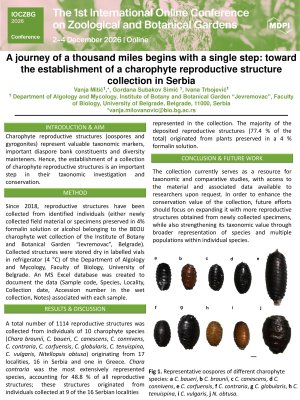
Charophyte reproductive structures (oospores and gyrogonites) represent valuable taxonomic markers, important diaspore bank constituents and diversity mainteners. Hence, the establishment of a collection of charophyte reproductive structures is an important step in their taxonomic investigation and conservation. Since 2018, reproductive structures have been collected from identified individuals (either newly collected field material or specimens preserved in 4% formalin solution or alcohol belonging to the BEOU charophyte wet collection of the Institute of Botany and Botanical Garden “Jevremovac”, Belgrade). Collected structures were stored dry in labelled vials in refrigerator (4 °C) of the Department of Algology and Mycology, Faculty of Biology, University of Belgrade. An MS Excel database was created to document the data (Sample code, Species, Locality, Collection date, Accession number in the wet collection, Notes) associated with each sample. A total number of 1114 reproductive structures was collected from individuals of 10 charophyte species (Chara braunii, C. baueri, C. canescens, C. connivens, C. contraria, C. corfuensis, C. globularis, C. tenuispina, C. vulgaris, Nitellopsis obtusa) originating from 17 localities, 16 in Serbia and one in Greece. Chara contraria was the most extensively represented species, accounting for 48.8 % of all reproductive structures; these structures originated from individuals collected at 9 of the 16 Serbian localities represented in the collection. The majority of the deposited reproductive structures (77.4 % of the total) originated from plants preserved in a 4 % formalin solution. The collection currently serves as a resource for taxonomic and comparative studies, with access to the material and associated data available to researchers upon request. In order to enhance the conservation value of the collection, future efforts should focus on expanding it with more reproductive structures obtained from newly collected specimens, while also strengthening its taxonomic value through broader representation of species and multiple populations within individual species.
Keywords
oospores
gyrogonites
taxonomic markers
conservation
Poster
IOCZBG 2026 Mitic et al. 2026.pdf
Results on space, group size and behaviour from applying the Cetacean Welfare (“C-Well”) Assessment over the past decade
Status and Strategies for the Conservation of Mulberry Genetic Resources in India: Collection, Characterization, Evaluation, Conservation, and Documentation