Event submissions
Published
This submission belongs to the session 1. Zoo Animals Welfare of the event The 1st International Online Conference on Zoological and Botanical Gardens
Published date
27 Nov, 2026
Academic Editor
 Oriol Tallo-Parra
Citation
Kimiya Asadi, Mahsa Tavangar, Neonatal Hand-Rearing and Developmental Outcomes of a Rhesus Macaque (Macaca mulatta) Infant Following Early Maternal Separation: A Case Report, in Proceedings of The 1st International Online Conference on Zoological and Botanical Gardens, 2 December–4 December 2026, MDPI: Basel, Switzerland
Share
Email
Facebook
Twitter
LinkedIn
Neonatal Hand-Rearing and Developmental Outcomes of a Rhesus Macaque (Macaca mulatta) Infant Following Early Maternal Separation: A Case Report

Kimiya Asadi 1

Mahsa Tavangar 2
1. Veterinary Department, Kish Dolphin Park, Kish Island, Iran
2. Faculty of Veterinary Medicine, Shahrekord University, Shahrekord, Iran
Abstract
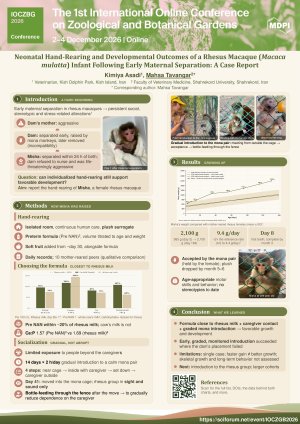
Introduction: Early maternal separation in rhesus macaques is associated with persistent social, stereotypic, and stress-related alterations. Individualized hand-rearing addressing nutritional, physical, and social needs may nevertheless support favorable development. We report the hand-rearing of Misha, a rhesus macaque (Macaca mulatta) neonate separated within 24 hours of birth, after the dam refused to nurse and displayed life-threatening aggression. The dam herself, separated early from an aggressive mother, was raised by mona monkeys (Cercopithecus mona) until incompatibility necessitated her removal after several months.
Methods: After separation, Misha was housed in an isolated room under continuous human care, with maternal contact provided by the caregiver and a plush surrogate. Lacking a rhesus-specific formula, a human preterm infant formula (PreNAN, Nestlé) was titrated to age and weight; soft fruit was added around day 30. Weight, feeding, dental eruption, and behavior were recorded daily, and growth was qualitatively compared with ten mother-reared colony peers (six males, four females) born within one month of Misha’s birth. The infant was then moved to an enclosure with limited exposure to additional people, gradually reducing isolation and caregiver dependence. Next, over 14 days, Misha was progressively introduced to a calm pair of mona monkeys as a surrogate social environment, from being held near their cage to being placed inside it as the caregiver withdrew (two 2-hour sessions daily). At 41 days of age, Misha's enclosure was moved into the mona cage. Contact with other rhesus macaques was limited to sight and sound through the adjacent cage.
Results: Body weight rose from 565 g on day 2 to 1300 g at two months and 2100 g at six months, matching or exceeding that of peers. Dental eruption began on day 8 and was complete by three months. Motor and behavioral development was age-appropriate. The mona pair accepted Misha supportively. By five to six months, Misha no longer embraced the plush surrogate, and no stereotypies or other behavioral abnormalities have been observed.
Conclusions: This protocol of formula substitution, caregiver and plush-surrogate contact, and interspecific social integration was associated with favorable growth and development. Unlike the dam's placement, which ended in incompatibility, Misha's early, graded, monitored introduction has remained successful to date. Future introduction to the rhesus group will be considered as Misha matures. As a single case without long-term behavioral assessment, it requires confirmation in larger cohorts.
Keywords
Rhesus macaque
Macaca mulatta
Neonatal hand-rearing
Maternal separation
Preterm infant formula
Primate welfare
Poster
IOCZBG2026_Misha_final.pdf
Flies in the animal world: Unmasking the Gut and Surface Microbiome of Musca domestica at the SANBI Zoological Gardens
From Provisioned Foods to Consumed Nutrients: Evaluating Zoo-Housed Gorilla Diets Using Wild Nutritional Benchmarks