Event submissions
Published
This submission belongs to the session S1. General Surgery of the event The 3rd International Online Conference on Medicine
Published date
27 Nov, 2026
Academic Editor
 Silviu Albu
Citation
Maicon Garaffa, Robotic vs. Laparoscopic Surgery for Incisional Hernia Repair: Perioperative Outcomes and Safety — A Systematic Review, in Proceedings of The 3rd International Online Conference on Medicine, 2 December–4 December 2026, MDPI: Basel, Switzerland
Share
Email
Facebook
Twitter
LinkedIn
Robotic vs. Laparoscopic Surgery for Incisional Hernia Repair: Perioperative Outcomes and Safety — A Systematic Review

Maicon Garaffa 1
1. School of Medicine (FAMED), University of Passo Fundo, Passo Fundo, 99010-080, Brazil
Abstract
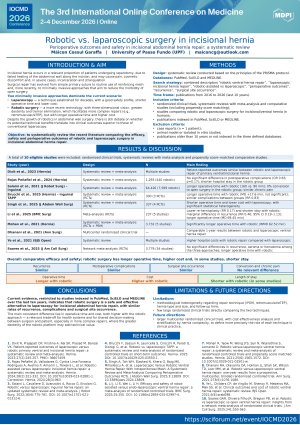
Incisional hernia is a frequent complication after laparotomy, and its surgical repair has evolved significantly with the introduction of minimally invasive techniques. Laparoscopic surgery is already well established in this setting, whereas the robotic approach has gained ground in recent years because of its greater precision, instrument dexterity, and ease of performing complex intracorporeal suturing, as in retromuscular abdominal wall repair. This systematic review aimed to compare the efficacy and safety of robotic and laparoscopic surgery for incisional abdominal hernia repair, restricting the search to studies from 2016-2026 in PubMed, SciELO, and MEDLINE and excluding case reports. A total of 10 studies were included: 1 multicenter randomized controlled trial, 8 systematic reviews with meta-analysis (3 of randomized controlled trials, 1 combining trials and propensity score-matched studies, 1 network meta-analysis of 34 studies and 3,779 patients, and 3 of comparative studies), and 1 systematic review without meta-analysis. The findings show that both techniques have similar rates of postoperative complications (OR 0.65; p = 0.17 in a meta-analysis of 1,293 patients, 440 of them in the robotic group), recurrence, and surgical site infection, with no statistically significant difference in most of the outcomes evaluated. Robotic surgery was consistently associated with longer operative time (weighted mean difference of 62.52 minutes in one of the meta-analyses) and higher cost, although some studies reported a shorter length of hospital stay in the robotic group. There was no relevant difference in conversion to open surgery or chronic pain. It is concluded that robotic surgery is a safe and effective alternative to laparoscopy for incisional hernia repair, with comparable clinical outcomes but longer operative time and higher cost, and the choice of technique depends on case complexity, resource availability, and the surgical team’s experience.
Keywords
"robotic ventral hernia repair"
"laparoscopic incisional hernia repair"
"robotic-assisted vs laparoscopic"
"perioperative outcomes"
"recurrence"
"surgical site occurrence".
Poster
poster_hernia_incisional_A0_EN.pdf
ADVANTAGES OF THE PIRS TECHNIQUE IN THE SURGICAL MANAGEMENT OF PEDIATRIC INGUINAL HERNIAS: A RETROSPECTIVE ANALYSIS OF CLINICAL OUTCOMES
Application of ERAS Nursing Pathway in Perioperative Care of Patients Undergoing General Surgery Laparoscopic Operation