Event submissions
EventsMOL2NET'16, Conference on Molecular, Biomed., Comput. & Network Science and Engineering, 2nd ed.
Published

This submission belongs to the session 06. MODECO-01: Workshop on Molecular Diversity & Ecosystems, Puyo, Ecuador-Porto, Portugal, 2016 of the event MOL2NET'16, Conference on Molecular, Biomed., Comput. & Network Science and Engineering, 2nd ed.
Published date
22 Dec, 2016
Citation
James D Hankemeyer, Kasey L Rivera, Kelnisha N Lightbourne, Luis C Fernandez-Torres, Sara N Salamah, Determination of the Antioxidant Capacity of Coffee, in Proceedings of MOL2NET'16, Conference on Molecular, Biomed., Comput. & Network Science and Engineering, 2nd ed., 15 October–20 October 2022, MDPI: Basel, Switzerland, doi: 10.3390/mol2net-02-03845
Share
Email
Facebook
Twitter
LinkedIn
Determination of the Antioxidant Capacity of Coffee
'%3e%3cpath%20d='M12.6647%2010.9104C12.4176%2010.325%2012.0589%209.7933%2011.6088%209.34485C11.16%208.89511%2010.6283%208.53653%2010.0432%208.28891C10.038%208.28629%2010.0327%208.28498%2010.0275%208.28236C10.8437%207.69282%2011.3743%206.73252%2011.3743%205.64907C11.3743%203.85423%209.92005%202.40002%208.12522%202.40002C6.33038%202.40002%204.87618%203.85423%204.87618%205.64907C4.87618%206.73252%205.40677%207.69282%206.22296%208.28367C6.21772%208.28629%206.21248%208.2876%206.20724%208.29022C5.62031%208.53783%205.09365%208.89287%204.64167%209.34616C4.19192%209.79496%203.83334%2010.3266%203.58573%2010.9117C3.34247%2011.4846%203.21128%2012.0987%203.19925%2012.721C3.1989%2012.735%203.20135%2012.7489%203.20646%2012.7619C3.21157%2012.7749%203.21924%2012.7868%203.22901%2012.7968C3.23877%2012.8068%203.25045%2012.8148%203.26334%2012.8202C3.27623%2012.8256%203.29007%2012.8284%203.30406%2012.8284H4.09012C4.14776%2012.8284%204.19362%2012.7825%204.19493%2012.7262C4.22113%2011.7148%204.62726%2010.7676%205.34519%2010.0497C6.08802%209.30686%207.07452%208.89811%208.12522%208.89811C9.17592%208.89811%2010.1624%209.30686%2010.9052%2010.0497C11.6232%2010.7676%2012.0293%2011.7148%2012.0555%2012.7262C12.0568%2012.7839%2012.1027%2012.8284%2012.1603%2012.8284H12.9464C12.9604%2012.8284%2012.9742%2012.8256%2012.9871%2012.8202C13%2012.8148%2013.0117%2012.8068%2013.0214%2012.7968C13.0312%2012.7868%2013.0389%2012.7749%2013.044%2012.7619C13.0491%2012.7489%2013.0515%2012.735%2013.0512%2012.721C13.0381%2012.0947%2012.9084%2011.4856%2012.6647%2010.9104ZM8.12522%207.90243C7.52388%207.90243%206.95792%207.66793%206.53214%207.24215C6.10636%206.81636%205.87185%206.2504%205.87185%205.64907C5.87185%205.04773%206.10636%204.48177%206.53214%204.05599C6.95792%203.63021%207.52388%203.3957%208.12522%203.3957C8.72655%203.3957%209.29252%203.63021%209.7183%204.05599C10.1441%204.48177%2010.3786%205.04773%2010.3786%205.64907C10.3786%206.2504%2010.1441%206.81636%209.7183%207.24215C9.29252%207.66793%208.72655%207.90243%208.12522%207.90243Z'%20fill='%235D1EE1'/%3e%3c/g%3e%3c/svg%3e)
James D Hankemeyer 1
Kasey L Rivera 1
Kelnisha N Lightbourne 1
Luis C Fernandez-Torres 1
Sara N Salamah 1
1. School of Science, Technology and Engineering Management, St. Thomas University, Miami Gardens, FL 33054, USA
Abstract
Determination of the Antioxidant Capacity of Coffee
Kelnisha Lightbourne, Sara Salamah, James Hankemeyer, Kasey Rivera and Luis C. Fernandez-Torres
School of Science, Technology, and Engineering Management, St. Thomas University, Miami Gardens, FL 33054
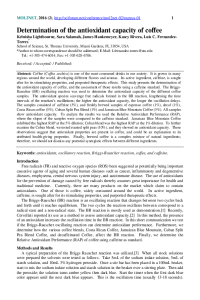
Coffee (Coffea arabica) is one of the most consumed drinks in our society. It is grown in many regions around the world, developing different flavors and aromas. Its active ingredient, caffeine, is sought after for its stimulating properties, and purported therapeutic effects. This study presents the determination of the antioxidant capacity of coffee, and the assessment of those results using a caffeine standard. The Briggs-Rauscher (BR) oscillating reaction was used to determine the antioxidant capacity of the different coffee samples. The antioxidant species scavenge free radicals formed in the BR reaction, lengthening the time intervals of the reaction’s oscillations; the higher the antioxidant capacity, the longer the oscillation delays. The samples consisted of caffeine (5%), and freshly brewed samples of espresso coffee (1%), decaf (1%), Costa Rican coffee (5%), Cuban Split Pea Blend (1%) and Jamaican Blue Mountain Coffee (5%). All samples show antioxidant capacity. To analyze the results we used the Relative Antioxidant Performance (RAP), where the slopes of the samples were compared to the caffeine standard. Jamaican Blue Mountain Coffee exhibited the highest RAP at the 5% dilution; Cuban blend was the highest RAP at the 1% dilution. To further examine the Cuban blend, we tested roasted split peas (10%), and they showed no antioxidant capacity. These observations suggest that antioxidant properties are present in coffee, and could be an explanation to its attributed health-giving properties. Finally, brewed coffee is a complex mixture of natural ingredients; therefore, we should not dismiss any potential synergistic effects between different ingredients.
Keywords
Poster
Lightbourne-Fernandez.pdf
Antioxidant Capacity of Common Dietary Supplements
Single Trajectory Learning: Exploration VS. Exploitation