Event submissions
Published
This submission belongs to the session S4. Cardiothoracic and Vascular Surgery of the event The 3rd International Online Conference on Medicine
Published date
27 Nov, 2026
Academic Editor
 Vishal G. Shelat
Citation
Maicon Garaffa, Genicular Artery Embolization for Chronic Knee Pain: Efficacy and Safety in the Treatment of Osteoarthritis — A Systematic Review, in Proceedings of The 3rd International Online Conference on Medicine, 2 December–4 December 2026, MDPI: Basel, Switzerland
Share
Email
Facebook
Twitter
LinkedIn
Genicular Artery Embolization for Chronic Knee Pain: Efficacy and Safety in the Treatment of Osteoarthritis — A Systematic Review

Maicon Garaffa 1
1. School of Medicine (FAMED), University of Passo Fundo, Passo Fundo, 99010-080, Brazil
Abstract
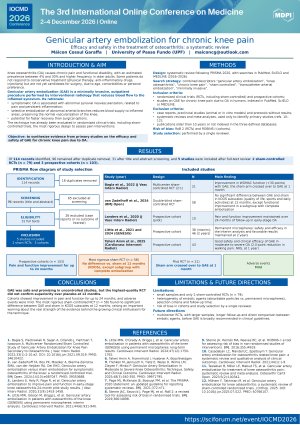
Introduction: Knee osteoarthritis (OA) causes chronic pain and disability, and some patients do not respond to conservative treatment yet are not candidates for surgery. Genicular artery embolization (GAE) is a minimally invasive procedure that reduces blood flow to the inflamed synovium.
Objective: To synthesize evidence from primary studies on the efficacy and safety of GAE for chronic knee pain due to OA.
Materials and Methods: Systematic review following PRISMA 2020, with searches in PubMed, SciELO, and MEDLINE (2016-2026). Eligible studies were randomized controlled trials (RCTs, including sham-controlled) and prospective cohorts. Case reports, preclinical studies, protocols without results, and systematic reviews/meta-analyses were excluded; the latter were used only to identify primary studies. Risk of bias was assessed with RoB 2 (RCTs) and ROBINS-I (cohorts). Study selection was performed by a single reviewer.
Results: Of 114 records identified, 96 remained after duplicate removal, 31 after title and abstract screening, and 5 studies were included after full-text review (26 excluded: case reports or no outcome of interest): 2 sham-controlled RCTs (n = 79) and 3 prospective cohorts (n = 103). Cohorts showed improvements in pain and function for up to 24 months. In the most rigorous sham-controlled RCT (n = 58), there was no significant difference between GAE and sham in KOOS subscales at 12 months, except for functional improvement in a subgroup with complete embolization. In the pilot RCT (n = 21), the sham arm crossed over to GAE at 1 month. Adverse events were mild.
Conclusion: GAE was safe and promising in uncontrolled studies, but the highest-quality RCT did not confirm superiority over placebo at 12 months. The evidence is limited by small samples, heterogeneity of embolic agents, risk of bias in cohorts, and single-reviewer selection. Multicenter RCTs with longer follow-up are needed.
Keywords
"embolização da artéria genicular"
"osteoartrite do joelho"
"dor crônica no joelho"
"controlado por simulação"
"embolisa arterial transcateter"
"minamente invasiva".
Poster
poster_embolizacao_genicular_A0_EN.pdf
Risk Stratification for Escalation to Advanced Cannulation Techniques During ERCP in a South Asian Secondary Referral Centre
Blunt Hepatic Trauma with Suspected Involvement of the Hepatocaval Confluence: How to Manage It? A Case Report