Event submissions
EventsMOL2NET'16, Conference on Molecular, Biomed., Comput. & Network Science and Engineering, 2nd ed.
Published

This submission belongs to the session 06. MODECO-01: Workshop on Molecular Diversity & Ecosystems, Puyo, Ecuador-Porto, Portugal, 2016 of the event MOL2NET'16, Conference on Molecular, Biomed., Comput. & Network Science and Engineering, 2nd ed.
Published date
25 Jan, 2017
Citation
Henrry Tuquerres, Aldo Carrera, Shirley Pomavilla, Viviana Tenemaza, Gladis Casco, Andrea Piedra, Daysi Changoluisa, Luis Bravo, Karel Diéguez-Santana, Karina Carrera, Roldan Torres, Isolation of native Aspergillus niger from Ecuadorian Amazon to produce citric acid from sugarcane bagasse.
, in Proceedings of MOL2NET'16, Conference on Molecular, Biomed., Comput. & Network Science and Engineering, 2nd ed., 15 October–20 October 2022, MDPI: Basel, Switzerland, doi: 10.3390/mol2net-02-03899
Share
Email
Facebook
Twitter
LinkedIn
Isolation of native Aspergillus niger from Ecuadorian Amazon to produce citric acid from sugarcane bagasse.
'%3e%3cpath%20d='M12.6647%2010.9104C12.4176%2010.325%2012.0589%209.7933%2011.6088%209.34485C11.16%208.89511%2010.6283%208.53653%2010.0432%208.28891C10.038%208.28629%2010.0327%208.28498%2010.0275%208.28236C10.8437%207.69282%2011.3743%206.73252%2011.3743%205.64907C11.3743%203.85423%209.92005%202.40002%208.12522%202.40002C6.33038%202.40002%204.87618%203.85423%204.87618%205.64907C4.87618%206.73252%205.40677%207.69282%206.22296%208.28367C6.21772%208.28629%206.21248%208.2876%206.20724%208.29022C5.62031%208.53783%205.09365%208.89287%204.64167%209.34616C4.19192%209.79496%203.83334%2010.3266%203.58573%2010.9117C3.34247%2011.4846%203.21128%2012.0987%203.19925%2012.721C3.1989%2012.735%203.20135%2012.7489%203.20646%2012.7619C3.21157%2012.7749%203.21924%2012.7868%203.22901%2012.7968C3.23877%2012.8068%203.25045%2012.8148%203.26334%2012.8202C3.27623%2012.8256%203.29007%2012.8284%203.30406%2012.8284H4.09012C4.14776%2012.8284%204.19362%2012.7825%204.19493%2012.7262C4.22113%2011.7148%204.62726%2010.7676%205.34519%2010.0497C6.08802%209.30686%207.07452%208.89811%208.12522%208.89811C9.17592%208.89811%2010.1624%209.30686%2010.9052%2010.0497C11.6232%2010.7676%2012.0293%2011.7148%2012.0555%2012.7262C12.0568%2012.7839%2012.1027%2012.8284%2012.1603%2012.8284H12.9464C12.9604%2012.8284%2012.9742%2012.8256%2012.9871%2012.8202C13%2012.8148%2013.0117%2012.8068%2013.0214%2012.7968C13.0312%2012.7868%2013.0389%2012.7749%2013.044%2012.7619C13.0491%2012.7489%2013.0515%2012.735%2013.0512%2012.721C13.0381%2012.0947%2012.9084%2011.4856%2012.6647%2010.9104ZM8.12522%207.90243C7.52388%207.90243%206.95792%207.66793%206.53214%207.24215C6.10636%206.81636%205.87185%206.2504%205.87185%205.64907C5.87185%205.04773%206.10636%204.48177%206.53214%204.05599C6.95792%203.63021%207.52388%203.3957%208.12522%203.3957C8.72655%203.3957%209.29252%203.63021%209.7183%204.05599C10.1441%204.48177%2010.3786%205.04773%2010.3786%205.64907C10.3786%206.2504%2010.1441%206.81636%209.7183%207.24215C9.29252%207.66793%208.72655%207.90243%208.12522%207.90243Z'%20fill='%235D1EE1'/%3e%3c/g%3e%3c/svg%3e)
Henrry Tuquerres 1
Aldo Carrera 1
Shirley Pomavilla 1
Viviana Tenemaza 1
Gladis Casco 1
Andrea Piedra 1
Daysi Changoluisa 1
Luis Bravo 1
Karel Diéguez-Santana 1
Karina Carrera 1
Roldan Torres 1
1. Universidad Estatal Amazónica
Abstract
Amazonian fungal identification is crucial to unravel their biodiversity and to elucidate their potential use in several industrial and biotechnological processes. This research aims to isolate and identify Aspergillus niger from Ecuadorian Amazon region in order to assess their capability to produce citric acid from sugar cane bagasse fermentation. Sampling point were settled to perform the distribution pattern of the fungi in the main areas of sugar cane production in Puyo municipality. For isolation, raw material was placed under humid chambers to produce sporulation. After growth, isolates were plated in Potato Dextrose Agar media for purification. Morpho-cultural characterization were assessed for isolates identification . A complete randomized experimental design was conducted under controlled conditions to search out the capability of isolates to produce citric acid. Six days fermentation at pH 2 and three levels of substrates loading (20, 30 and 40 mg bagasse L-1) were the experimental variables. Bagasse was cut into small pieces to homogenization and a concentration of 1x10⁷ spores ml-1 was inoculated. Morpho-cultural analysis threw four isolates with features related to A. niger. Black aerial mycelia, fast growth and copious sporulation matched with the main characteristics of the fungus. The citric acid assay showed the most favourable conditions were provided by the substrate loaded with 30 mg L-1 of bagasse, which yielded 9.9 g of citric acid per kilogram of bagasse. These results show the potential of native Amazonian A. niger to produce citric acid and to perform another trials with other raw material under different conditions.
Keywords
citric acid
inoculum
substratum
fermentation
Poster
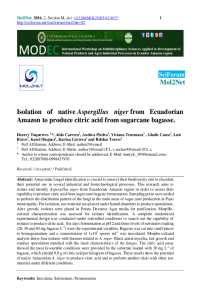
Mol2Net-AC. CITRICO HTC INGLES.pdf
Nanoparticles mutagenicity: search for matches and potential limitations of Comet assay and Ames test
Thyme and rosemary essential oils as an alternative control of plant-parasitic nematodes.