Event submissions
EventsMOL2NET'17, Conference on Molecular, Biomed., Comput. & Network Science and Engineering, 3rd ed.
Published

This submission belongs to the session 01. CHEMBIOINFO-03: Chem-Bioinformatics Congress Cambridge, UK-Chapel Hill and Richmond, USA, 2017 of the event MOL2NET'17, Conference on Molecular, Biomed., Comput. & Network Science and Engineering, 3rd ed.
Published date
14 Aug, 2017
Citation
Ramiro Corona-Jiménez, Overview of PT-QSRR models for predicting yield of reaction, in Proceedings of MOL2NET'17, Conference on Molecular, Biomed., Comput. & Network Science and Engineering, 3rd ed., 15 January–15 December 2017, MDPI: Basel, Switzerland, doi: 10.3390/mol2net-03-04597
Share
Email
Facebook
Twitter
LinkedIn
Overview of PT-QSRR models for predicting yield of reaction
'%3e%3cpath%20d='M12.6647%2010.9104C12.4176%2010.325%2012.0589%209.7933%2011.6088%209.34485C11.16%208.89511%2010.6283%208.53653%2010.0432%208.28891C10.038%208.28629%2010.0327%208.28498%2010.0275%208.28236C10.8437%207.69282%2011.3743%206.73252%2011.3743%205.64907C11.3743%203.85423%209.92005%202.40002%208.12522%202.40002C6.33038%202.40002%204.87618%203.85423%204.87618%205.64907C4.87618%206.73252%205.40677%207.69282%206.22296%208.28367C6.21772%208.28629%206.21248%208.2876%206.20724%208.29022C5.62031%208.53783%205.09365%208.89287%204.64167%209.34616C4.19192%209.79496%203.83334%2010.3266%203.58573%2010.9117C3.34247%2011.4846%203.21128%2012.0987%203.19925%2012.721C3.1989%2012.735%203.20135%2012.7489%203.20646%2012.7619C3.21157%2012.7749%203.21924%2012.7868%203.22901%2012.7968C3.23877%2012.8068%203.25045%2012.8148%203.26334%2012.8202C3.27623%2012.8256%203.29007%2012.8284%203.30406%2012.8284H4.09012C4.14776%2012.8284%204.19362%2012.7825%204.19493%2012.7262C4.22113%2011.7148%204.62726%2010.7676%205.34519%2010.0497C6.08802%209.30686%207.07452%208.89811%208.12522%208.89811C9.17592%208.89811%2010.1624%209.30686%2010.9052%2010.0497C11.6232%2010.7676%2012.0293%2011.7148%2012.0555%2012.7262C12.0568%2012.7839%2012.1027%2012.8284%2012.1603%2012.8284H12.9464C12.9604%2012.8284%2012.9742%2012.8256%2012.9871%2012.8202C13%2012.8148%2013.0117%2012.8068%2013.0214%2012.7968C13.0312%2012.7868%2013.0389%2012.7749%2013.044%2012.7619C13.0491%2012.7489%2013.0515%2012.735%2013.0512%2012.721C13.0381%2012.0947%2012.9084%2011.4856%2012.6647%2010.9104ZM8.12522%207.90243C7.52388%207.90243%206.95792%207.66793%206.53214%207.24215C6.10636%206.81636%205.87185%206.2504%205.87185%205.64907C5.87185%205.04773%206.10636%204.48177%206.53214%204.05599C6.95792%203.63021%207.52388%203.3957%208.12522%203.3957C8.72655%203.3957%209.29252%203.63021%209.7183%204.05599C10.1441%204.48177%2010.3786%205.04773%2010.3786%205.64907C10.3786%206.2504%2010.1441%206.81636%209.7183%207.24215C9.29252%207.66793%208.72655%207.90243%208.12522%207.90243Z'%20fill='%235D1EE1'/%3e%3c/g%3e%3c/svg%3e)
Ramiro Corona-Jiménez 1
1. Departamento de Ciencias de la Salud Poblacional, División de Ciencias de la Salud Universidad de Guadalajara, México.
Abstract
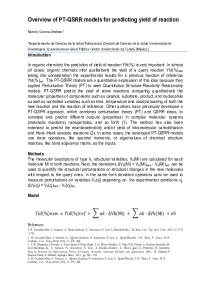
In organic chemistry the prediction of yield of reaction Yld(%) is very important. In almost all cases, organic chemists infer qualitatively the yield of a query reaction Yld(%)new taking into consideration the experimental results for a previous reaction of reference Yld(%)ref. The PT-QSRR models are a quantitative expression of this idea because they applied Perturbation Theory (PT) to seek Quantitative Structure-Reactivity Relationship models. PT-QSRR predict the yield of some reactions comparing quantitatively the molecular properties of components such as catalyst, substrate, product, and nucleophile as well as controlled variables such as time, temperature and catalyst loading of both the new reaction and the reaction of reference. Other authors have previously developed a PT-QSPR approach, which combines perturbation theory (PT) and QSRR ideas, to correlate and predict different outputs (properties) in complex molecular systems (metabolic reactions) nanoparticles, and so forth (1). The method has also been extended to predict the enantioselectivity and/or yield of intramolecular carbolithiation and Heck–Heck cascade reactions (2). In some cases, the developed PT-QSRR models use trace operators, like spectral moments, or eigenvalues of chemical structure matrices, like bond adjacency matrix, as the inputs.
Methods
The molecular descriptors of type k, structural variables, Vk(Mi) are calculated for each molecule Mi in both reactions. Next, the deviations ΔVk(Mi) = Vk(Mi)new - Vk(Mi)ref, can be used to quantify the structural perturbations or structural changes in the new molecules with respect to the query ones. In the same form deviation operators canc be used to measure perturbations on variables Vk(cj) depending on the experimental conditions cj, ΔVk(cj) = Vk(cj)new - Vk(cj)ref.
References
- H. Gonzalez-Diaz, S. Arrasate, A. Gmez-SanJuan, N. Sotomayor, E. Lete, L. Besada-Porto, J. M. Ruso, Curr. Top. Med. Chem. 2013, 13, 1713 –1741.
- H. Gonzalez-Diaz, S. Arrasate, A. Gjmez-SanJuan, N. Sotomayor, E. Lete, A. Speck-Planche, J. M. Ruso, F. Luan, M. N. Cordeiro, Curr. Drug Metab. 2014, 15, 470 –488.
- C. R. Munteanu, J. Dorado, A. Pazos Sierra, F. Prado-Prado, L. G. P8rez- Montoto, S. Vilar, F. M. Ubeira, A. S#nchez-Gonz#lez, M. Cruz Monteagu- do, S. Arrasate, N. Sotomayor, E. Lete, A. Duardo-S#nchez, A. D&az- Ljpez, G. Patlewicz, H. Gonz#lez-D&az in Towards an Information Theory of Complex Networks. Statistical Methods and Applications (Eds.: M. Dehmer, F. Emmert-Streib, A. Mehler), Springer, Basel, 2011, pp. 199 – 258
- H. Gonzalez-Diaz, S. Arrasate, A. Gjmez-SanJuan, N. Sotomayor, E. Lete, A. Speck-Planche, J. M. Ruso, F. Luan, M. N. Cordeiro, Curr. Drug Metab. 2014, 15, 470 –488.
Keywords
Perturbation Theory
QSRR models
Organic synthesis
Chemical reactivity
Poster
Abstract.pdf
Comparative Study of Invasive Candidiasis in Mexico and Spain
Editorial: EHUDW01, First EHU-DELFIN Program Workshop, Bilbao, Jul, 201