Event submissions
EventsMOL2NET'17, Conference on Molecular, Biomed., Comput. & Network Science and Engineering, 3rd ed.
Published

This submission belongs to the session 03. USEDAT-03: USA-EU Data Analysis Training Prog. Work., Cambridge, UK-Bilbao, Spain-Duluth, USA, 2017 of the event MOL2NET'17, Conference on Molecular, Biomed., Comput. & Network Science and Engineering, 3rd ed.
Published date
13 Oct, 2017
Citation
Priyanka De, Rahul B Aher, Kunal Roy, QSAR with ETA indices: Insecticidal activity of plant derived compounds against zika virus vector Aedes aegypti, in Proceedings of MOL2NET'17, Conference on Molecular, Biomed., Comput. & Network Science and Engineering, 3rd ed., 15 January–15 December 2017, MDPI: Basel, Switzerland, doi: 10.3390/mol2net-03-04622
Share
Email
Facebook
Twitter
LinkedIn
QSAR with ETA indices: Insecticidal activity of plant derived compounds against zika virus vector Aedes aegypti
'%3e%3cpath%20d='M12.6647%2010.9104C12.4176%2010.325%2012.0589%209.7933%2011.6088%209.34485C11.16%208.89511%2010.6283%208.53653%2010.0432%208.28891C10.038%208.28629%2010.0327%208.28498%2010.0275%208.28236C10.8437%207.69282%2011.3743%206.73252%2011.3743%205.64907C11.3743%203.85423%209.92005%202.40002%208.12522%202.40002C6.33038%202.40002%204.87618%203.85423%204.87618%205.64907C4.87618%206.73252%205.40677%207.69282%206.22296%208.28367C6.21772%208.28629%206.21248%208.2876%206.20724%208.29022C5.62031%208.53783%205.09365%208.89287%204.64167%209.34616C4.19192%209.79496%203.83334%2010.3266%203.58573%2010.9117C3.34247%2011.4846%203.21128%2012.0987%203.19925%2012.721C3.1989%2012.735%203.20135%2012.7489%203.20646%2012.7619C3.21157%2012.7749%203.21924%2012.7868%203.22901%2012.7968C3.23877%2012.8068%203.25045%2012.8148%203.26334%2012.8202C3.27623%2012.8256%203.29007%2012.8284%203.30406%2012.8284H4.09012C4.14776%2012.8284%204.19362%2012.7825%204.19493%2012.7262C4.22113%2011.7148%204.62726%2010.7676%205.34519%2010.0497C6.08802%209.30686%207.07452%208.89811%208.12522%208.89811C9.17592%208.89811%2010.1624%209.30686%2010.9052%2010.0497C11.6232%2010.7676%2012.0293%2011.7148%2012.0555%2012.7262C12.0568%2012.7839%2012.1027%2012.8284%2012.1603%2012.8284H12.9464C12.9604%2012.8284%2012.9742%2012.8256%2012.9871%2012.8202C13%2012.8148%2013.0117%2012.8068%2013.0214%2012.7968C13.0312%2012.7868%2013.0389%2012.7749%2013.044%2012.7619C13.0491%2012.7489%2013.0515%2012.735%2013.0512%2012.721C13.0381%2012.0947%2012.9084%2011.4856%2012.6647%2010.9104ZM8.12522%207.90243C7.52388%207.90243%206.95792%207.66793%206.53214%207.24215C6.10636%206.81636%205.87185%206.2504%205.87185%205.64907C5.87185%205.04773%206.10636%204.48177%206.53214%204.05599C6.95792%203.63021%207.52388%203.3957%208.12522%203.3957C8.72655%203.3957%209.29252%203.63021%209.7183%204.05599C10.1441%204.48177%2010.3786%205.04773%2010.3786%205.64907C10.3786%206.2504%2010.1441%206.81636%209.7183%207.24215C9.29252%207.66793%208.72655%207.90243%208.12522%207.90243Z'%20fill='%235D1EE1'/%3e%3c/g%3e%3c/svg%3e)
Priyanka De 1
Rahul B Aher 1
Kunal Roy 1
1. Drug Theoretics and Cheminformatics Laboratory, Department of Pharmaceutical Technology, Jadavpur University, Kolkata 700 032, India
Abstract
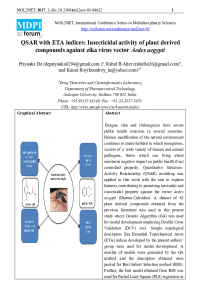
Dengue, zika and chikungunya have severe public health concerns in several countries. Human modification of the natural environment continues to create habitats in which mosquitoes, vectors of a wide variety of human and animal pathogens, thrive which can bring about enormous negative impact on public health if not controlled properly. Quantitative Structure–Activity Relationship (QSAR) modeling was applied in this work with the aim to explore features contributing to promising larvicidal and insecticidal property against the vector Aedes aegypti (Diptera:Culicidae). A dataset of 62 plant derived compounds obtained from the previous literatures was used in this present study where Genetic Algorithm (GA) was used for model development employing Double Cross Validation (DCV) tool. Simple topological descriptors like Extended Topochemical Atom (ETA) indices developed by the present authors’ group were used for model development. A number of models were generated by the GA method and the descriptors obtained were pooled for Best Subset Selection method (BSS). Further, the best model obtained from BSS was used for Partial Least Square (PLS) regression to obtain the final model. The model was validated extensively using different validation metrics to check the robustness and predictivity of the model for regulatory acceptance and enhancing confidence in QSAR predictions. Based on the insights obtained from the PLS model, we can conclude that presence of hydrogen bond acceptor atoms, presence of multiple bonds as well as sufficient lipophilicity and limited polar surface area play crucial roles in regulating the activity of the compounds.
Keywords
QSAR
Zika
Insecticidal activity
Double cross-validation
Poster
MOL2NET-2017-Priyanka.pdf
The role of excipients in neglected tropical diseases
Polyphenols extracts from (Theobroma cacao) and Chuchuhuaso (Maytenus macrocarpa) as possible natural Amazonian antioxidant