Event submissions
EventsMOL2NET'17, Conference on Molecular, Biomed., Comput. & Network Science and Engineering, 3rd ed.
Published

This submission belongs to the session 05. NANOBIOMAT-03: Nanotechnology & Biomaterials Sci. Congress, Jackson & Fargo, USA, 2017 of the event MOL2NET'17, Conference on Molecular, Biomed., Comput. & Network Science and Engineering, 3rd ed.
Published date
16 Oct, 2017
Citation
Jiao Feng, Sinda Lepetre-Mouelhi, Patrick Couvreur, Modular Squalene-based Nanosystems, in Proceedings of MOL2NET'17, Conference on Molecular, Biomed., Comput. & Network Science and Engineering, 3rd ed., 15 January–15 December 2017, MDPI: Basel, Switzerland, doi: 10.3390/mol2net-03-04624
Share
Email
Facebook
Twitter
LinkedIn
Modular Squalene-based Nanosystems
'%3e%3cpath%20d='M12.6647%2010.9104C12.4176%2010.325%2012.0589%209.7933%2011.6088%209.34485C11.16%208.89511%2010.6283%208.53653%2010.0432%208.28891C10.038%208.28629%2010.0327%208.28498%2010.0275%208.28236C10.8437%207.69282%2011.3743%206.73252%2011.3743%205.64907C11.3743%203.85423%209.92005%202.40002%208.12522%202.40002C6.33038%202.40002%204.87618%203.85423%204.87618%205.64907C4.87618%206.73252%205.40677%207.69282%206.22296%208.28367C6.21772%208.28629%206.21248%208.2876%206.20724%208.29022C5.62031%208.53783%205.09365%208.89287%204.64167%209.34616C4.19192%209.79496%203.83334%2010.3266%203.58573%2010.9117C3.34247%2011.4846%203.21128%2012.0987%203.19925%2012.721C3.1989%2012.735%203.20135%2012.7489%203.20646%2012.7619C3.21157%2012.7749%203.21924%2012.7868%203.22901%2012.7968C3.23877%2012.8068%203.25045%2012.8148%203.26334%2012.8202C3.27623%2012.8256%203.29007%2012.8284%203.30406%2012.8284H4.09012C4.14776%2012.8284%204.19362%2012.7825%204.19493%2012.7262C4.22113%2011.7148%204.62726%2010.7676%205.34519%2010.0497C6.08802%209.30686%207.07452%208.89811%208.12522%208.89811C9.17592%208.89811%2010.1624%209.30686%2010.9052%2010.0497C11.6232%2010.7676%2012.0293%2011.7148%2012.0555%2012.7262C12.0568%2012.7839%2012.1027%2012.8284%2012.1603%2012.8284H12.9464C12.9604%2012.8284%2012.9742%2012.8256%2012.9871%2012.8202C13%2012.8148%2013.0117%2012.8068%2013.0214%2012.7968C13.0312%2012.7868%2013.0389%2012.7749%2013.044%2012.7619C13.0491%2012.7489%2013.0515%2012.735%2013.0512%2012.721C13.0381%2012.0947%2012.9084%2011.4856%2012.6647%2010.9104ZM8.12522%207.90243C7.52388%207.90243%206.95792%207.66793%206.53214%207.24215C6.10636%206.81636%205.87185%206.2504%205.87185%205.64907C5.87185%205.04773%206.10636%204.48177%206.53214%204.05599C6.95792%203.63021%207.52388%203.3957%208.12522%203.3957C8.72655%203.3957%209.29252%203.63021%209.7183%204.05599C10.1441%204.48177%2010.3786%205.04773%2010.3786%205.64907C10.3786%206.2504%2010.1441%206.81636%209.7183%207.24215C9.29252%207.66793%208.72655%207.90243%208.12522%207.90243Z'%20fill='%235D1EE1'/%3e%3c/g%3e%3c/svg%3e)
Jiao Feng 1
Sinda Lepetre-Mouelhi 1
Patrick Couvreur 1
1. Institut Galien Paris-Sud, UMR CNRS 8612, Université Paris-Sud, Université Paris Saclay, 5 Rue J.B. Clément, 92296, Châtenay-Malabry Cedex, France
Abstract
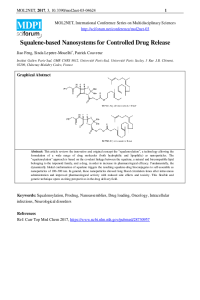
In a recent paper we have discussed the innovative and original concept the “squalenoylation” of nanoparticles. This method may be used in the nanoparticle-based formulation of a wide range of drug molecules (both hydrophilic and lipophilic). The "squalenoylation" approach is based on the covalent linkage between the squalene, a natural and biocompatible lipid belonging to the terpenoid family, and a drug, in order to increase its pharmacological efficacy. Fundamentally, the dynamically folded conformation of squalene triggers the resulting squalene-drug bioconjugates to self-assemble as nanoparticles of 100–300 nm. In general, these nanoparticles showed long blood circulation times after intravenous administration and improved pharmacological activity with reduced side effects and toxicity. This flexible and generic technique opens exciting perspectives in the drug delivery field.
Ref: Curr Top Med Chem 2017, https://www.ncbi.nlm.nih.gov/pubmed/28730957
Keywords
Squalenoylation
Prodrug
Nanoassemblies
Drug loading
Oncology
Intracellular infections
Neurological disorders
Poster
MOL2NET-2017-sinda.pdf
Polyphenols extracts from (Theobroma cacao) and Chuchuhuaso (Maytenus macrocarpa) as possible natural Amazonian antioxidant
An Overview on Cyclopentenyl Fatty Acids