Event submissions
EventsMOL2NET'17, Conference on Molecular, Biomed., Comput. & Network Science and Engineering, 3rd ed.
Published

This submission belongs to the session 05. NANOBIOMAT-03: Nanotechnology & Biomaterials Sci. Congress, Jackson & Fargo, USA, 2017 of the event MOL2NET'17, Conference on Molecular, Biomed., Comput. & Network Science and Engineering, 3rd ed.
Published date
27 Oct, 2017
Citation
Ariagna Laritza-Rivera-Briso, Belén Frígols-Garrido, Miguel Martí-Jiménez, Ángel Serrano-Aroca, Enhancement of Poly(3-hydroxybutyrate-co-3-hydroxyvalerate)’s properties for advanced industrial applications , in Proceedings of MOL2NET'17, Conference on Molecular, Biomed., Comput. & Network Science and Engineering, 3rd ed., 15 January–15 December 2017, MDPI: Basel, Switzerland, doi: 10.3390/mol2net-03-04633
Share
Email
Facebook
Twitter
LinkedIn
Enhancement of Poly(3-hydroxybutyrate-co-3-hydroxyvalerate)’s properties for advanced industrial applications
'%3e%3cpath%20d='M12.6647%2010.9104C12.4176%2010.325%2012.0589%209.7933%2011.6088%209.34485C11.16%208.89511%2010.6283%208.53653%2010.0432%208.28891C10.038%208.28629%2010.0327%208.28498%2010.0275%208.28236C10.8437%207.69282%2011.3743%206.73252%2011.3743%205.64907C11.3743%203.85423%209.92005%202.40002%208.12522%202.40002C6.33038%202.40002%204.87618%203.85423%204.87618%205.64907C4.87618%206.73252%205.40677%207.69282%206.22296%208.28367C6.21772%208.28629%206.21248%208.2876%206.20724%208.29022C5.62031%208.53783%205.09365%208.89287%204.64167%209.34616C4.19192%209.79496%203.83334%2010.3266%203.58573%2010.9117C3.34247%2011.4846%203.21128%2012.0987%203.19925%2012.721C3.1989%2012.735%203.20135%2012.7489%203.20646%2012.7619C3.21157%2012.7749%203.21924%2012.7868%203.22901%2012.7968C3.23877%2012.8068%203.25045%2012.8148%203.26334%2012.8202C3.27623%2012.8256%203.29007%2012.8284%203.30406%2012.8284H4.09012C4.14776%2012.8284%204.19362%2012.7825%204.19493%2012.7262C4.22113%2011.7148%204.62726%2010.7676%205.34519%2010.0497C6.08802%209.30686%207.07452%208.89811%208.12522%208.89811C9.17592%208.89811%2010.1624%209.30686%2010.9052%2010.0497C11.6232%2010.7676%2012.0293%2011.7148%2012.0555%2012.7262C12.0568%2012.7839%2012.1027%2012.8284%2012.1603%2012.8284H12.9464C12.9604%2012.8284%2012.9742%2012.8256%2012.9871%2012.8202C13%2012.8148%2013.0117%2012.8068%2013.0214%2012.7968C13.0312%2012.7868%2013.0389%2012.7749%2013.044%2012.7619C13.0491%2012.7489%2013.0515%2012.735%2013.0512%2012.721C13.0381%2012.0947%2012.9084%2011.4856%2012.6647%2010.9104ZM8.12522%207.90243C7.52388%207.90243%206.95792%207.66793%206.53214%207.24215C6.10636%206.81636%205.87185%206.2504%205.87185%205.64907C5.87185%205.04773%206.10636%204.48177%206.53214%204.05599C6.95792%203.63021%207.52388%203.3957%208.12522%203.3957C8.72655%203.3957%209.29252%203.63021%209.7183%204.05599C10.1441%204.48177%2010.3786%205.04773%2010.3786%205.64907C10.3786%206.2504%2010.1441%206.81636%209.7183%207.24215C9.29252%207.66793%208.72655%207.90243%208.12522%207.90243Z'%20fill='%235D1EE1'/%3e%3c/g%3e%3c/svg%3e)
Ariagna Laritza-Rivera-Briso 1
Belén Frígols-Garrido 1

Miguel Martí-Jiménez 1

Ángel Serrano-Aroca 1
1. Biomaterials and Bioengineering Lab, Centro de Investigación Traslacional San Alberto Magno, Universidad Católica de Valencia San Vicente Mártir, c/Guillem de Castro 94, 46001 Valencia, Spain
Abstract
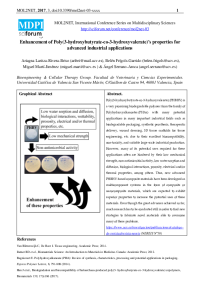
Poly(3-hydroxybutyrate-co-3-hydroxyvalerate) (PHBHV) is a very promising biodegradable polymer from the family of Polyhydroxyalkanoates (PHAs) with many potential applications in many important industrial fields such as biodegradable packaging, synthetic prosthesis, therapeutic delivery, wound dressing, 3D tissue scaffolds for tissue engineering, etc. due to their excellent biocompatibility, non-toxicity, and suitable large-scale industrial production. However, many of its potential uses required for these applications often are hindered by their low mechanical strength, non-antimicrobial activity, low water sorption and diffusion, biological interactions, porosity, electrical and/or thermal properties, among others. Thus, new advanced PHBHV-based composite materials have been developed as multicomponent systems in the form of composite or nanocomposite materials, which are expected to exhibit superior properties to increase the potential uses of these materials. Even though the great advances achieved so far, much research has to be conducted still in order to find new strategies to fabricate novel materials able to overcome many of these problems.
https://www.ucv.es/investigacion/publicaciones/catalogo-de-revistas/revista-nereis (NEREIS Nº10)
Keywords
Poly(3-hydroxybutyrate-co-3-hydroxyvalerate)
enhancement of properties
advanced materials,biodegradable materials
biocompatible biomaterials
Poster
PHBV_mol2net-03-MOL2NET-2017-template.pdf
Direct spectrophotometric method to determine cell density of Isochrysis galbana in serial batch cultures from a larger scale fed-batch culture in exponential phase
Stochastic model on the mobility of petroleum in the soils of the Ecuadorian Amazon