Event submissions
Published

This submission belongs to the session B. Posters of the event 3rd International Electronic Conference on Medicinal Chemistry
Published date
01 Nov, 2017
Citation
Emilie Hequet, Synthesis and Physicochemical Characterizations of a Fluorinated Paramagnetic Contrast Agent, in Proceedings of 3rd International Electronic Conference on Medicinal Chemistry, 1 November–30 November 2017, MDPI: Basel, Switzerland, doi: 10.3390/ecmc-3-04642
Share
Email
Facebook
Twitter
LinkedIn
Synthesis and Physicochemical Characterizations of a Fluorinated Paramagnetic Contrast Agent
'%3e%3cpath%20d='M12.6647%2010.9104C12.4176%2010.325%2012.0589%209.7933%2011.6088%209.34485C11.16%208.89511%2010.6283%208.53653%2010.0432%208.28891C10.038%208.28629%2010.0327%208.28498%2010.0275%208.28236C10.8437%207.69282%2011.3743%206.73252%2011.3743%205.64907C11.3743%203.85423%209.92005%202.40002%208.12522%202.40002C6.33038%202.40002%204.87618%203.85423%204.87618%205.64907C4.87618%206.73252%205.40677%207.69282%206.22296%208.28367C6.21772%208.28629%206.21248%208.2876%206.20724%208.29022C5.62031%208.53783%205.09365%208.89287%204.64167%209.34616C4.19192%209.79496%203.83334%2010.3266%203.58573%2010.9117C3.34247%2011.4846%203.21128%2012.0987%203.19925%2012.721C3.1989%2012.735%203.20135%2012.7489%203.20646%2012.7619C3.21157%2012.7749%203.21924%2012.7868%203.22901%2012.7968C3.23877%2012.8068%203.25045%2012.8148%203.26334%2012.8202C3.27623%2012.8256%203.29007%2012.8284%203.30406%2012.8284H4.09012C4.14776%2012.8284%204.19362%2012.7825%204.19493%2012.7262C4.22113%2011.7148%204.62726%2010.7676%205.34519%2010.0497C6.08802%209.30686%207.07452%208.89811%208.12522%208.89811C9.17592%208.89811%2010.1624%209.30686%2010.9052%2010.0497C11.6232%2010.7676%2012.0293%2011.7148%2012.0555%2012.7262C12.0568%2012.7839%2012.1027%2012.8284%2012.1603%2012.8284H12.9464C12.9604%2012.8284%2012.9742%2012.8256%2012.9871%2012.8202C13%2012.8148%2013.0117%2012.8068%2013.0214%2012.7968C13.0312%2012.7868%2013.0389%2012.7749%2013.044%2012.7619C13.0491%2012.7489%2013.0515%2012.735%2013.0512%2012.721C13.0381%2012.0947%2012.9084%2011.4856%2012.6647%2010.9104ZM8.12522%207.90243C7.52388%207.90243%206.95792%207.66793%206.53214%207.24215C6.10636%206.81636%205.87185%206.2504%205.87185%205.64907C5.87185%205.04773%206.10636%204.48177%206.53214%204.05599C6.95792%203.63021%207.52388%203.3957%208.12522%203.3957C8.72655%203.3957%209.29252%203.63021%209.7183%204.05599C10.1441%204.48177%2010.3786%205.04773%2010.3786%205.64907C10.3786%206.2504%2010.1441%206.81636%209.7183%207.24215C9.29252%207.66793%208.72655%207.90243%208.12522%207.90243Z'%20fill='%235D1EE1'/%3e%3c/g%3e%3c/svg%3e)
Emilie Hequet 1
1. UMONS
Abstract
Introduction
Medical imaging is a dynamic area of research whose one of the goal is the elaboration of more efficient contrast agents. Those agents need to be improved to optimize the detection of affected tissues such as cancers or tumours while decreasing the injected quantity of agents. The paramagnetic contrast agents containing fluorine atoms can be used both on proton and fluorine MRI.
This research field is therefore promising thanks to the ability to map the anatomy by 1H MRI and locate exactly the agents by 19F MRI. In this domain, one of the challenges is to synthesize a molecule containing several chemically equivalent fluorine atoms characterized by a short relaxation time to allow the record of fluorine MR images in good conditions.
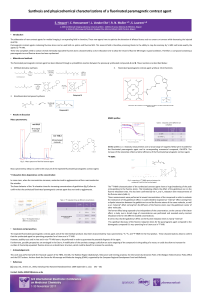
In that aim, we propose to synthesize a compound containing a paramagnetic ion and nine chemically equivalent fluorine atoms by a cycloaddition reaction between two previously synthesized products.
Methods
In a first time, a derivative of DOTAGA macrocyclic ligand has been synthesized. This macrocycle has been obtained by a multistep synthesis during which an azide function was added. Then, the ligand has been complexed with GdCl3.
In a second time, a nonafluorinated compound containing an alkyne function has been synthesized in order to allow the use of the contrast agent in fluorine MRI. Finally, these two molecules were combined via a click chemistry reaction.
Results
The fluorinated paramagnetic contrast agent has been characterized by relaxometry which shows an increase of the agent efficiency in comparison with the parent compound Gd-DOTA.
A 19F NMR study has also shown a significant decrease of the fluorine-19 relaxation times (from about 2 s for the single molecule to about 10 ms for the molecule conjugated to the paramagnetic macrocycle) which is promising for a future use in 19F MRI.
Conclusions
The targeted compound has been successfully synthesized and the preliminary characterizations are very promising. It will be now essential to perform 19F MRI in vitro and in vivo tests to evaluate the diagnosis potential of the synthesized contrast agent.
Furthermore, possible perspectives are envisaged. A modification of the synthesis strategy will allow an active targeting of the compound via the grafting of a biovector, or will also allow to increase the number of chemically equivalent fluorine atoms via a dendrimeric structure, which could be benefit to increase the sensitivity.
Keywords
Agents de contraste
paramagnétique
fluor
IRM
Click Chemistry
Poster
ecmc-3_Poster_template_2017.01.pdf
Targeting the Trypanosome Alternative Oxidase (TAO) as Promising Chemotherapeutic Approach for African Trypanosomiasis
Application of a Multilevel Factorial Design to the Formulation of Indomethacin-loaded Nanoparticles