Event submissions
Published

This submission belongs to the session B. Posters of the event 3rd International Electronic Conference on Medicinal Chemistry
Published date
01 Nov, 2017
Citation
Danay Dupeyrón, Monique Kawakami, Adriana Ferreira, Jacques Rieumont, Ricardo Bentes Azevedo, José Carlos Carvalho, Application of a Multilevel Factorial Design to the Formulation of Indomethacin-loaded Nanoparticles, in Proceedings of 3rd International Electronic Conference on Medicinal Chemistry, 1 November–30 November 2017, MDPI: Basel, Switzerland, doi: 10.3390/ecmc-3-04643
Share
Email
Facebook
Twitter
LinkedIn
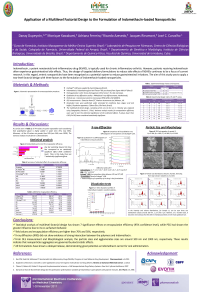
Application of a Multilevel Factorial Design to the Formulation of Indomethacin-loaded Nanoparticles
'%3e%3cpath%20d='M12.6647%2010.9104C12.4176%2010.325%2012.0589%209.7933%2011.6088%209.34485C11.16%208.89511%2010.6283%208.53653%2010.0432%208.28891C10.038%208.28629%2010.0327%208.28498%2010.0275%208.28236C10.8437%207.69282%2011.3743%206.73252%2011.3743%205.64907C11.3743%203.85423%209.92005%202.40002%208.12522%202.40002C6.33038%202.40002%204.87618%203.85423%204.87618%205.64907C4.87618%206.73252%205.40677%207.69282%206.22296%208.28367C6.21772%208.28629%206.21248%208.2876%206.20724%208.29022C5.62031%208.53783%205.09365%208.89287%204.64167%209.34616C4.19192%209.79496%203.83334%2010.3266%203.58573%2010.9117C3.34247%2011.4846%203.21128%2012.0987%203.19925%2012.721C3.1989%2012.735%203.20135%2012.7489%203.20646%2012.7619C3.21157%2012.7749%203.21924%2012.7868%203.22901%2012.7968C3.23877%2012.8068%203.25045%2012.8148%203.26334%2012.8202C3.27623%2012.8256%203.29007%2012.8284%203.30406%2012.8284H4.09012C4.14776%2012.8284%204.19362%2012.7825%204.19493%2012.7262C4.22113%2011.7148%204.62726%2010.7676%205.34519%2010.0497C6.08802%209.30686%207.07452%208.89811%208.12522%208.89811C9.17592%208.89811%2010.1624%209.30686%2010.9052%2010.0497C11.6232%2010.7676%2012.0293%2011.7148%2012.0555%2012.7262C12.0568%2012.7839%2012.1027%2012.8284%2012.1603%2012.8284H12.9464C12.9604%2012.8284%2012.9742%2012.8256%2012.9871%2012.8202C13%2012.8148%2013.0117%2012.8068%2013.0214%2012.7968C13.0312%2012.7868%2013.0389%2012.7749%2013.044%2012.7619C13.0491%2012.7489%2013.0515%2012.735%2013.0512%2012.721C13.0381%2012.0947%2012.9084%2011.4856%2012.6647%2010.9104ZM8.12522%207.90243C7.52388%207.90243%206.95792%207.66793%206.53214%207.24215C6.10636%206.81636%205.87185%206.2504%205.87185%205.64907C5.87185%205.04773%206.10636%204.48177%206.53214%204.05599C6.95792%203.63021%207.52388%203.3957%208.12522%203.3957C8.72655%203.3957%209.29252%203.63021%209.7183%204.05599C10.1441%204.48177%2010.3786%205.04773%2010.3786%205.64907C10.3786%206.2504%2010.1441%206.81636%209.7183%207.24215C9.29252%207.66793%208.72655%207.90243%208.12522%207.90243Z'%20fill='%235D1EE1'/%3e%3c/g%3e%3c/svg%3e)
Danay Dupeyrón 1,2
Monique Kawakami 2
Adriana Ferreira 2
Jacques Rieumont 3
Ricardo Bentes Azevedo 4
José Carlos Carvalho 2
1. Curso de Farmácia, Instituto Macapaense do Melhor Ensino Superior (IMMES), Brazil
2. Laboratório de Pesquisa em Fármacos, Centro de Ciências Biológicas e da Saúde, Colegiado de Farmácia, Universidade Federal do Amapá, Brazil
3. Departamento de Química-Física, Facultad de Química, Universidad de la Habana, Cuba
4. Departamento de Genética e Morfologia, Instituto de Ciências Biológicas, Universidade de Brasília, Brazil
Abstract
Indomethacin, a potent nonsteroidal anti-inflammatory drug (NSAID), is typically used for chronic inflammatory arthritis. However, patients receiving Indomethacin often experience gastrointestinal side effects. Thus, the design of targeted delivery formulations to reduce side effects of NSAIDs continues to be a focus of current research. In this regard, enteric nanoparticles have been recognized as a potential system to reduce gastrointestinal irritations. The aim of this study was to apply a two-level factorial design with three factors to the formulation of indomethacin-loaded nanoparticles. The effect of the polymer matrix and the surfactant on encapsulation efficiency was estimated. Statistical analysis of multilevel factorial design has shown 7 significance effects on evaluated response (95% confidence level), while PEG had shown the greater influence due to its co-surfactant behavior. Moreover, the process yield, particle morphology, and in vitro dissolution profile of the nanoparticles have been evaluated.
Keywords
multilevel factorial design
NSAID
polymer matrix
surfactant
nanoparticles.
Poster
ecmc-3_Poster_Dupeyron et al.pdf
Synthesis and Physicochemical Characterizations of a Fluorinated Paramagnetic Contrast Agent
Small Molecule Analogues of the Immunomodulatory Protein, ES-62: Potential Anti-inflammatory Compounds and Mechanism of Action