Event submissions
Published

This submission belongs to the session B. Posters of the event 3rd International Electronic Conference on Medicinal Chemistry
Published date
01 Nov, 2017
Citation
Aneta Pogorzelska, Jarosław Sławiński, Anna Kawiak, Joanna Jasińska, Novel N-(2-Mercaptobenzenesulfonyl)guanidine Derivatives Modified by Nitrogen-containing Heterocycles – Synthesis and Antiproliferative Activity Against Human Cancer Cell Lines, in Proceedings of 3rd International Electronic Conference on Medicinal Chemistry, 1 November–30 November 2017, MDPI: Basel, Switzerland, doi: 10.3390/ecmc-3-04675
Share
Email
Facebook
Twitter
LinkedIn
Novel N-(2-Mercaptobenzenesulfonyl)guanidine Derivatives Modified by Nitrogen-containing Heterocycles – Synthesis and Antiproliferative Activity Against Human Cancer Cell Lines
'%3e%3cpath%20d='M12.6647%2010.9104C12.4176%2010.325%2012.0589%209.7933%2011.6088%209.34485C11.16%208.89511%2010.6283%208.53653%2010.0432%208.28891C10.038%208.28629%2010.0327%208.28498%2010.0275%208.28236C10.8437%207.69282%2011.3743%206.73252%2011.3743%205.64907C11.3743%203.85423%209.92005%202.40002%208.12522%202.40002C6.33038%202.40002%204.87618%203.85423%204.87618%205.64907C4.87618%206.73252%205.40677%207.69282%206.22296%208.28367C6.21772%208.28629%206.21248%208.2876%206.20724%208.29022C5.62031%208.53783%205.09365%208.89287%204.64167%209.34616C4.19192%209.79496%203.83334%2010.3266%203.58573%2010.9117C3.34247%2011.4846%203.21128%2012.0987%203.19925%2012.721C3.1989%2012.735%203.20135%2012.7489%203.20646%2012.7619C3.21157%2012.7749%203.21924%2012.7868%203.22901%2012.7968C3.23877%2012.8068%203.25045%2012.8148%203.26334%2012.8202C3.27623%2012.8256%203.29007%2012.8284%203.30406%2012.8284H4.09012C4.14776%2012.8284%204.19362%2012.7825%204.19493%2012.7262C4.22113%2011.7148%204.62726%2010.7676%205.34519%2010.0497C6.08802%209.30686%207.07452%208.89811%208.12522%208.89811C9.17592%208.89811%2010.1624%209.30686%2010.9052%2010.0497C11.6232%2010.7676%2012.0293%2011.7148%2012.0555%2012.7262C12.0568%2012.7839%2012.1027%2012.8284%2012.1603%2012.8284H12.9464C12.9604%2012.8284%2012.9742%2012.8256%2012.9871%2012.8202C13%2012.8148%2013.0117%2012.8068%2013.0214%2012.7968C13.0312%2012.7868%2013.0389%2012.7749%2013.044%2012.7619C13.0491%2012.7489%2013.0515%2012.735%2013.0512%2012.721C13.0381%2012.0947%2012.9084%2011.4856%2012.6647%2010.9104ZM8.12522%207.90243C7.52388%207.90243%206.95792%207.66793%206.53214%207.24215C6.10636%206.81636%205.87185%206.2504%205.87185%205.64907C5.87185%205.04773%206.10636%204.48177%206.53214%204.05599C6.95792%203.63021%207.52388%203.3957%208.12522%203.3957C8.72655%203.3957%209.29252%203.63021%209.7183%204.05599C10.1441%204.48177%2010.3786%205.04773%2010.3786%205.64907C10.3786%206.2504%2010.1441%206.81636%209.7183%207.24215C9.29252%207.66793%208.72655%207.90243%208.12522%207.90243Z'%20fill='%235D1EE1'/%3e%3c/g%3e%3c/svg%3e)
Aneta Pogorzelska 1
Jarosław Sławiński 1

Anna Kawiak 2,3
Joanna Jasińska 1
1. Medical University of Gdansk, Department of Organic Chemistry
2. Intercollegiate Faculty of Biotechnology UG-MUG, Department of Biotechnology
3. Medical University of Gdansk, Department of Human Physiology
Abstract
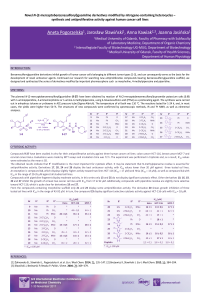
Benzenesulfonylguanidine derivatives have been known to inhibit growth of different types of human cancer cell lines. According to this fact, new compounds with structures based on benzenesulfonylguanidine scaffold and modified by important pharmacophores such as morpholine, 4-methylpiperazine or piperidine, have been designed and synthesized. The planned
N-(2-mercaptobenzenesulfonyl)guanidine derivatives have been obtained by reaction of the appropriate N-(2-mercaptobenzenesulfonyl)cyanamide potassium salt with
1-aminopiperidine, 4-aminomorpholine or 1-amino-4-methylpiperazine; p-toluenesulfonic acid has been used as a protonating agent. The obtained compounds have been evaluated in MTT assay for an antiproliferative activity against human cancer cell lines HCT-116 (colon carcinoma), MCF-7 (breast cancer) and HeLa (cervical cancer). The results indicated that compounds containing the 4-methylpiperazine ring were the most potent growth inhibitors. The obtained IC50 values for these derivatives were lower than 35 μM against all tested cancer cell lines, with the best activity at level of IC50 ≤ 15 μM for compound with a methyl group at the position 5, and a (2-fluorophenyl)methylthio group at the position 2 of benzenesulfonyl scaffold. Moderate antiproliferative effect (IC50 ~ 40 μM) was observed for derivatives containing a piperidine residue. Compounds with a morpholine fragment, in contrast, did not show significant growth inhibition.
Keywords
Benzenesulfonylguanidine
anticancer activity
breast cancer
colon cancer
cervical cancer
2-mercaptobenzenesulfonamides
Poster
Pogorzelska_poster.pdf
Looking for Novel p24 Multimerization Inhibitors of FIV
Chiral Liquid Chromatography in Analysis of the Stereochemistry of Marine Natural Compounds: Contribution for Medicinal Chemistry