Event submissions
Published

This submission belongs to the session B. Posters of the event 3rd International Electronic Conference on Medicinal Chemistry
Published date
01 Nov, 2017
Citation
Niamh M O'Boyle, Daniela M Zisterer, Mary J Meegan, Lead Optimization of Benzoxepin-Type Selective Estrogen Receptor (ER) Modulators and Downregulators with Subtype-Specific ERα and ERβ Activity , in Proceedings of 3rd International Electronic Conference on Medicinal Chemistry, 1 November–30 November 2017, MDPI: Basel, Switzerland, doi: 10.3390/ecmc-3-04681
Share
Email
Facebook
Twitter
LinkedIn
Lead Optimization of Benzoxepin-Type Selective Estrogen Receptor (ER) Modulators and Downregulators with Subtype-Specific ERα and ERβ Activity
'%3e%3cpath%20d='M12.6647%2010.9104C12.4176%2010.325%2012.0589%209.7933%2011.6088%209.34485C11.16%208.89511%2010.6283%208.53653%2010.0432%208.28891C10.038%208.28629%2010.0327%208.28498%2010.0275%208.28236C10.8437%207.69282%2011.3743%206.73252%2011.3743%205.64907C11.3743%203.85423%209.92005%202.40002%208.12522%202.40002C6.33038%202.40002%204.87618%203.85423%204.87618%205.64907C4.87618%206.73252%205.40677%207.69282%206.22296%208.28367C6.21772%208.28629%206.21248%208.2876%206.20724%208.29022C5.62031%208.53783%205.09365%208.89287%204.64167%209.34616C4.19192%209.79496%203.83334%2010.3266%203.58573%2010.9117C3.34247%2011.4846%203.21128%2012.0987%203.19925%2012.721C3.1989%2012.735%203.20135%2012.7489%203.20646%2012.7619C3.21157%2012.7749%203.21924%2012.7868%203.22901%2012.7968C3.23877%2012.8068%203.25045%2012.8148%203.26334%2012.8202C3.27623%2012.8256%203.29007%2012.8284%203.30406%2012.8284H4.09012C4.14776%2012.8284%204.19362%2012.7825%204.19493%2012.7262C4.22113%2011.7148%204.62726%2010.7676%205.34519%2010.0497C6.08802%209.30686%207.07452%208.89811%208.12522%208.89811C9.17592%208.89811%2010.1624%209.30686%2010.9052%2010.0497C11.6232%2010.7676%2012.0293%2011.7148%2012.0555%2012.7262C12.0568%2012.7839%2012.1027%2012.8284%2012.1603%2012.8284H12.9464C12.9604%2012.8284%2012.9742%2012.8256%2012.9871%2012.8202C13%2012.8148%2013.0117%2012.8068%2013.0214%2012.7968C13.0312%2012.7868%2013.0389%2012.7749%2013.044%2012.7619C13.0491%2012.7489%2013.0515%2012.735%2013.0512%2012.721C13.0381%2012.0947%2012.9084%2011.4856%2012.6647%2010.9104ZM8.12522%207.90243C7.52388%207.90243%206.95792%207.66793%206.53214%207.24215C6.10636%206.81636%205.87185%206.2504%205.87185%205.64907C5.87185%205.04773%206.10636%204.48177%206.53214%204.05599C6.95792%203.63021%207.52388%203.3957%208.12522%203.3957C8.72655%203.3957%209.29252%203.63021%209.7183%204.05599C10.1441%204.48177%2010.3786%205.04773%2010.3786%205.64907C10.3786%206.2504%2010.1441%206.81636%209.7183%207.24215C9.29252%207.66793%208.72655%207.90243%208.12522%207.90243Z'%20fill='%235D1EE1'/%3e%3c/g%3e%3c/svg%3e)
Niamh M O'Boyle 1
Daniela M Zisterer 2

Mary J Meegan 1
1. School of Pharmacy and Pharmaceutical Sciences, University of Dublin, Trinity College, Dublin 2, Ireland
2. School of Biochemistry and Immunology, Trinity Biomedical Sciences Institute, University of Dublin, Trinity College, Dublin 2, Ireland
Abstract
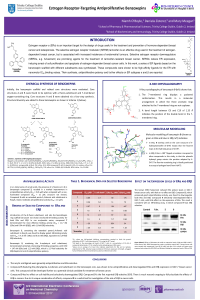
Estrogen receptor a (ERa) is an important target for the design of drugs such as tamoxifen and fulvestrant. Three series of ER-ligands based on the benzoxepin scaffold structure were synthesised – series I containing an acrylic acid, series II with an acrylamide and series III with a saturated carboxylic acid substituent. These compounds were shown to be high affinity ligands for the ER with nanomolar IC50 binding values. Series I acrylic acid ligands were generally ERa selective. In particular, a compound (1) featuring a phenylpenta-2,4-dienoic acid substituent was shown to be antiproliferative and downregulated ERa and ERb expression in MCF-7 breast cancer cells. Interestingly, from series III, a phenoxybutyric acid derivative compound (2) was not antiproliferative and selectively downregulated ERb. A docking study of the benzoxepin ligands was undertaken. Compound 1 is a promising lead for development as a clinically relevant SERD, whilst compound 2 will be a useful experimental probe for helping to elucidate the role of ERβ in cancer cells.
Keywords
Estrogen receptor
antiproliferative
benzoxepin
acrylic acid
Poster
ecmc-3-Poster_benzoxepin.pdf
Microtubule-Destabilising Actions of Piperlongumine and Analogues
Synthesis, Characterization, Molecular docking and Structure-Activity Relationships of Novel 2-Arylidene- and 2-Aminomethylenethiazolo[3,2-a]pyrimidines as Prospective Acetylcholinesterase Inhibitors