Event submissions
Published

This submission belongs to the session B. Posters of the event 3rd International Electronic Conference on Medicinal Chemistry
Published date
01 Nov, 2017
Citation
Krzysztof Szafrański, Jarosław Sławiński, Anna Kawiak, Synthesis of Novel N-{[4-(1,2,3-Triazol)pyridin-3-yl]sulfonyl}urea Derivatives With Potential Anticancer Activity, in Proceedings of 3rd International Electronic Conference on Medicinal Chemistry, 1 November–30 November 2017, MDPI: Basel, Switzerland, doi: 10.3390/ecmc-3-04684
Share
Email
Facebook
Twitter
LinkedIn
Synthesis of Novel N-{[4-(1,2,3-Triazol)pyridin-3-yl]sulfonyl}urea Derivatives With Potential Anticancer Activity
'%3e%3cpath%20d='M12.6647%2010.9104C12.4176%2010.325%2012.0589%209.7933%2011.6088%209.34485C11.16%208.89511%2010.6283%208.53653%2010.0432%208.28891C10.038%208.28629%2010.0327%208.28498%2010.0275%208.28236C10.8437%207.69282%2011.3743%206.73252%2011.3743%205.64907C11.3743%203.85423%209.92005%202.40002%208.12522%202.40002C6.33038%202.40002%204.87618%203.85423%204.87618%205.64907C4.87618%206.73252%205.40677%207.69282%206.22296%208.28367C6.21772%208.28629%206.21248%208.2876%206.20724%208.29022C5.62031%208.53783%205.09365%208.89287%204.64167%209.34616C4.19192%209.79496%203.83334%2010.3266%203.58573%2010.9117C3.34247%2011.4846%203.21128%2012.0987%203.19925%2012.721C3.1989%2012.735%203.20135%2012.7489%203.20646%2012.7619C3.21157%2012.7749%203.21924%2012.7868%203.22901%2012.7968C3.23877%2012.8068%203.25045%2012.8148%203.26334%2012.8202C3.27623%2012.8256%203.29007%2012.8284%203.30406%2012.8284H4.09012C4.14776%2012.8284%204.19362%2012.7825%204.19493%2012.7262C4.22113%2011.7148%204.62726%2010.7676%205.34519%2010.0497C6.08802%209.30686%207.07452%208.89811%208.12522%208.89811C9.17592%208.89811%2010.1624%209.30686%2010.9052%2010.0497C11.6232%2010.7676%2012.0293%2011.7148%2012.0555%2012.7262C12.0568%2012.7839%2012.1027%2012.8284%2012.1603%2012.8284H12.9464C12.9604%2012.8284%2012.9742%2012.8256%2012.9871%2012.8202C13%2012.8148%2013.0117%2012.8068%2013.0214%2012.7968C13.0312%2012.7868%2013.0389%2012.7749%2013.044%2012.7619C13.0491%2012.7489%2013.0515%2012.735%2013.0512%2012.721C13.0381%2012.0947%2012.9084%2011.4856%2012.6647%2010.9104ZM8.12522%207.90243C7.52388%207.90243%206.95792%207.66793%206.53214%207.24215C6.10636%206.81636%205.87185%206.2504%205.87185%205.64907C5.87185%205.04773%206.10636%204.48177%206.53214%204.05599C6.95792%203.63021%207.52388%203.3957%208.12522%203.3957C8.72655%203.3957%209.29252%203.63021%209.7183%204.05599C10.1441%204.48177%2010.3786%205.04773%2010.3786%205.64907C10.3786%206.2504%2010.1441%206.81636%209.7183%207.24215C9.29252%207.66793%208.72655%207.90243%208.12522%207.90243Z'%20fill='%235D1EE1'/%3e%3c/g%3e%3c/svg%3e)
Krzysztof Szafrański 1
Jarosław Sławiński 1
Anna Kawiak 2
1. Department of Organic Chemistry, Medical University of Gdańsk
2. Intercollegiate Faculty of Biotechnology, University of Gdańsk and Medical University of Gdańsk
Abstract
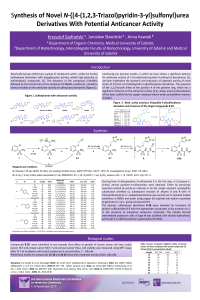
Sulfonylureas have been commonly used since the 1950s as antihypoglycemic (e.g., tolbutamide, glipizide, glimepiride) and diuretics drugs (torasemide). Preclinical studies towards antineoplastic activity of sulfonyloureas led to recognize among them a group of diarylsulfonylureas (DSU) (e.g. LY-181984, Sulofenur and LY‑295501) with activity against a broad spectrum of syngeneic rodent solid tumors and human tumor xenografts [1].
Continuing our previous studies, in which we have shown a significant potential for antitumor activity of 1-(4-substituted pyridine-3-sulfonyl)-3-phenylureas [2], we have undertaken the synthesis and evaluation of cytostatic activity of novel series of N-{[4-(1,2,3-triazol)pyridin-3-yl]sulfonyl}urea derivatives.
To provide easy functionalization of substituent at the position 4 of the pyridinesulfonamide scaffold, which have a significant influence on the antitumor activity [2.3], we started from 4-(2-propyn-1-ylthio/amino)pyridine-3-sulfonamides and, using the copper-catalyzed azide-alkyne cycloaddition (CuAAC), introduced 1,4-disubstituted 1,2,3-triazole ring. The primary sulfonamides thus obtained were next treated with various isocyanates to give a series of desired sulfonylurea derivatives. The structures of all compounds were confirmed with IR and NMR spectroscopy and elemental analyses.
All compounds were submitted to test their effects on growth of human cancer cell lines: colon cancer HCT-116, breast cancer MCF-7 and cervical cancer HeLa. Cell viability was measured using MTT assay after 72 h of incubation with tested compound in concentration 1 – 100 μM.
References:
- Pasello G, et al. Oncologist 2013; 18: 1118–1125.
- Szafrański K, Sławiński J. Molecules. 2015; 20; 12029–12044.
- Sławiński J, et al. Eur J Med Chem. 2013;69:701–10.
Keywords
sulfonamides
pyridine-3-sulfonamides
sulfonylureas
anticancer activity
Poster
Poster K Szafrański pp .pdf
Research on Prospective Pharmacorrection Medications for First-degree Obesity Treatment among Non-natural Substances Containing Chalcogenamido Groups
Identification of a Novel Potent and SelectiveAnti-Trichomonas vaginalis Agent among Libraries of Bisbenzimidazoles