Event submissions
Published

This submission belongs to the session A. ECMC-3 of the event 3rd International Electronic Conference on Medicinal Chemistry
Published date
01 Nov, 2017
Citation
Marcos Tassano, Mirel Cabrera, Pablo Cabral, Hugo Cerecetto, Radiolabeling Optimization and Characterization of Three 67Ga DOTA Conjugated Peptides, in Proceedings of 3rd International Electronic Conference on Medicinal Chemistry, 1 November–30 November 2017, MDPI: Basel, Switzerland, doi: 10.3390/ecmc-3-04691
Share
Email
Facebook
Twitter
LinkedIn
Radiolabeling Optimization and Characterization of Three 67Ga DOTA Conjugated Peptides
'%3e%3cpath%20d='M12.6647%2010.9104C12.4176%2010.325%2012.0589%209.7933%2011.6088%209.34485C11.16%208.89511%2010.6283%208.53653%2010.0432%208.28891C10.038%208.28629%2010.0327%208.28498%2010.0275%208.28236C10.8437%207.69282%2011.3743%206.73252%2011.3743%205.64907C11.3743%203.85423%209.92005%202.40002%208.12522%202.40002C6.33038%202.40002%204.87618%203.85423%204.87618%205.64907C4.87618%206.73252%205.40677%207.69282%206.22296%208.28367C6.21772%208.28629%206.21248%208.2876%206.20724%208.29022C5.62031%208.53783%205.09365%208.89287%204.64167%209.34616C4.19192%209.79496%203.83334%2010.3266%203.58573%2010.9117C3.34247%2011.4846%203.21128%2012.0987%203.19925%2012.721C3.1989%2012.735%203.20135%2012.7489%203.20646%2012.7619C3.21157%2012.7749%203.21924%2012.7868%203.22901%2012.7968C3.23877%2012.8068%203.25045%2012.8148%203.26334%2012.8202C3.27623%2012.8256%203.29007%2012.8284%203.30406%2012.8284H4.09012C4.14776%2012.8284%204.19362%2012.7825%204.19493%2012.7262C4.22113%2011.7148%204.62726%2010.7676%205.34519%2010.0497C6.08802%209.30686%207.07452%208.89811%208.12522%208.89811C9.17592%208.89811%2010.1624%209.30686%2010.9052%2010.0497C11.6232%2010.7676%2012.0293%2011.7148%2012.0555%2012.7262C12.0568%2012.7839%2012.1027%2012.8284%2012.1603%2012.8284H12.9464C12.9604%2012.8284%2012.9742%2012.8256%2012.9871%2012.8202C13%2012.8148%2013.0117%2012.8068%2013.0214%2012.7968C13.0312%2012.7868%2013.0389%2012.7749%2013.044%2012.7619C13.0491%2012.7489%2013.0515%2012.735%2013.0512%2012.721C13.0381%2012.0947%2012.9084%2011.4856%2012.6647%2010.9104ZM8.12522%207.90243C7.52388%207.90243%206.95792%207.66793%206.53214%207.24215C6.10636%206.81636%205.87185%206.2504%205.87185%205.64907C5.87185%205.04773%206.10636%204.48177%206.53214%204.05599C6.95792%203.63021%207.52388%203.3957%208.12522%203.3957C8.72655%203.3957%209.29252%203.63021%209.7183%204.05599C10.1441%204.48177%2010.3786%205.04773%2010.3786%205.64907C10.3786%206.2504%2010.1441%206.81636%209.7183%207.24215C9.29252%207.66793%208.72655%207.90243%208.12522%207.90243Z'%20fill='%235D1EE1'/%3e%3c/g%3e%3c/svg%3e)
Marcos Tassano 1
Mirel Cabrera 1
Pablo Cabral 1
Hugo Cerecetto 1
1. 1- Área de Radiofarmacia, Facultad de Ciencias, Universidad de la República, Iguá 4225, Montevideo, 11400, Uruguay.
Abstract
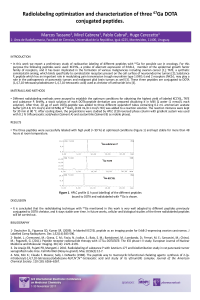
In this work we report a preliminary study of radioactive labeling of different peptides for possible use in oncology. For this purpose the following peptides were used: KCCYSL, a probe of aberrant expression of ErbB-2, member of the epidermal growth factor family of receptors, and it has been implicated in the formation of various malignancies including ovarian cancer; TATE, a synthetic somatostatin analog, which binds specifically to somatostatin receptors present on the cell surface of neuroendocrine tumors; Substance P, peptide which has an important role in modulating pain transmission trough neurokinin type 1 (NK1r) and 2 receptors (NK2r), may play a role in the pathogenesis of pancreatic tumors and malignant glial brain tumors as well. These three peptides are conjugated to DOTA (1,4,7,10-tetraazacyclododecane-1,4,7,10-tetraacetic acid) used as chelator of lanthanide ions. Different radiolabeling methods were assayed to establish the optimum conditions for obtaining the highest yield of labeled KCCYSL, TATE and substance P. Briefly, a stock solution of the three different peptides was prepared dissolving the peptides in Milli Q water (1 mmol/L each solution). After that, 20 µg of each peptide was added to three different eppendorf tubes containing 0.2 mL ammonium acetate buffer (pH 4.8, 0.5 mol/L) and 10 MBq of 67GaCl3 (0.02 mL/0.1 mol/l HCl) was added to a reaction solution. The reaction mixtures were kept for 30 min at 80 °C. After cooling down, the preparations were studied by HPLC (C18 reversed phase column with gradient system was used with 0.1 % trifluoroacetic acid/water (Solvent A) and acetonitrile (Solvent B) as mobile phase). The three peptides were successfully labeled with high yield (> 99 %) at optimized conditions and kept stable for more than 48 hours at room temperature.
Acknowledgement:
The authors want to thank ANII, PEDECIBA-Quimica and PROINBIO for financial support.
Keywords
67Ga
KCCYSL
substance P
TATE
radiolabeling
Manuscript
resumen Marcos HC.pdf
Poster
ecmc-3-Poster_template_2017.01.pdf
99m Tc-Tricarbonyl- (2-amino- 5,10-dioxide- 7(8)-fluorophenazine) as Probe for Mammary Hypoxic-tumors Imaging
First Advances in the Asymmetric Synthesis of Biologically Active 2-Amino-3-cyano-4H-chromen-4yl Phosphonates