Event submissions
Published

This submission belongs to the session B. Posters of the event 3rd International Electronic Conference on Medicinal Chemistry
Published date
01 Nov, 2017
Citation
Isaac G. Sonsona, Sandra Muñiz-Bustín, Eugenia Marqués-López, Raquel P. Herrera, First Advances in the Asymmetric Synthesis of Biologically Active 2-Amino-3-cyano-4H-chromen-4yl Phosphonates, in Proceedings of 3rd International Electronic Conference on Medicinal Chemistry, 1 November–30 November 2017, MDPI: Basel, Switzerland, doi: 10.3390/ecmc-3-04692
Share
Email
Facebook
Twitter
LinkedIn
First Advances in the Asymmetric Synthesis of Biologically Active 2-Amino-3-cyano-4H-chromen-4yl Phosphonates
'%3e%3cpath%20d='M12.6647%2010.9104C12.4176%2010.325%2012.0589%209.7933%2011.6088%209.34485C11.16%208.89511%2010.6283%208.53653%2010.0432%208.28891C10.038%208.28629%2010.0327%208.28498%2010.0275%208.28236C10.8437%207.69282%2011.3743%206.73252%2011.3743%205.64907C11.3743%203.85423%209.92005%202.40002%208.12522%202.40002C6.33038%202.40002%204.87618%203.85423%204.87618%205.64907C4.87618%206.73252%205.40677%207.69282%206.22296%208.28367C6.21772%208.28629%206.21248%208.2876%206.20724%208.29022C5.62031%208.53783%205.09365%208.89287%204.64167%209.34616C4.19192%209.79496%203.83334%2010.3266%203.58573%2010.9117C3.34247%2011.4846%203.21128%2012.0987%203.19925%2012.721C3.1989%2012.735%203.20135%2012.7489%203.20646%2012.7619C3.21157%2012.7749%203.21924%2012.7868%203.22901%2012.7968C3.23877%2012.8068%203.25045%2012.8148%203.26334%2012.8202C3.27623%2012.8256%203.29007%2012.8284%203.30406%2012.8284H4.09012C4.14776%2012.8284%204.19362%2012.7825%204.19493%2012.7262C4.22113%2011.7148%204.62726%2010.7676%205.34519%2010.0497C6.08802%209.30686%207.07452%208.89811%208.12522%208.89811C9.17592%208.89811%2010.1624%209.30686%2010.9052%2010.0497C11.6232%2010.7676%2012.0293%2011.7148%2012.0555%2012.7262C12.0568%2012.7839%2012.1027%2012.8284%2012.1603%2012.8284H12.9464C12.9604%2012.8284%2012.9742%2012.8256%2012.9871%2012.8202C13%2012.8148%2013.0117%2012.8068%2013.0214%2012.7968C13.0312%2012.7868%2013.0389%2012.7749%2013.044%2012.7619C13.0491%2012.7489%2013.0515%2012.735%2013.0512%2012.721C13.0381%2012.0947%2012.9084%2011.4856%2012.6647%2010.9104ZM8.12522%207.90243C7.52388%207.90243%206.95792%207.66793%206.53214%207.24215C6.10636%206.81636%205.87185%206.2504%205.87185%205.64907C5.87185%205.04773%206.10636%204.48177%206.53214%204.05599C6.95792%203.63021%207.52388%203.3957%208.12522%203.3957C8.72655%203.3957%209.29252%203.63021%209.7183%204.05599C10.1441%204.48177%2010.3786%205.04773%2010.3786%205.64907C10.3786%206.2504%2010.1441%206.81636%209.7183%207.24215C9.29252%207.66793%208.72655%207.90243%208.12522%207.90243Z'%20fill='%235D1EE1'/%3e%3c/g%3e%3c/svg%3e)
Isaac G. Sonsona 1
Sandra Muñiz-Bustín 2

Eugenia Marqués-López 2

Raquel P. Herrera 1
1. Instituto de Síntesis Química y Catálisis Homogénea (ISQCH) - CSIC
2. Universidad de Zaragoza
Abstract
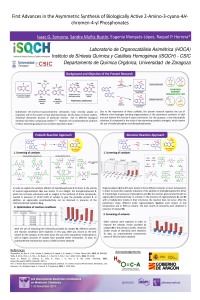
2-Amino-3-cyanochromene is a privileged scaffold and it can be found in pharmacological agents as the antitumor Crolibulin and the pro-apoptotic HA14-1. Recent studies have also shown that chromene phosphonyl derivatives exhibit different biological activities including antifungal, antimicrobial, antioxidant and anticancer ones. Since it is known that each enantiomer could present distinct biological properties, the development of an asymmetric catalytic procedure to obtain these enantioenriched products is still desirable. Following this idea, the present research explores the use of chiral organocatalysts in several reactions for the synthesis of these interesting derivatives. To date, preliminary results obtained following two organocatalytic strategies using diarylphosphonates (Pudovik reaction) and trialkylphosphites (Abramov reaction) showed an adequate chiral induction, providing the first examples of enantioselective synthesis of chromene phosphonyl derivatives.
Keywords
organocatalysis
asymmetric organocatalysis
chromene
privileged scaffold
Poster
ecmc-3_Poster _SONSONA.pdf
Radiolabeling Optimization and Characterization of Three 67Ga DOTA Conjugated Peptides
Effect of Interaction with Micellar Media on Spectral Properties of some Amphiphilic Porphyrins