Event submissions
Published

This submission belongs to the session B. Posters of the event 3rd International Electronic Conference on Medicinal Chemistry
Published date
01 Nov, 2017
Citation
Estela Guardado, Amaury Pérez, Lianne León, Enrique Molina, Lourdes Santana, Eugenio Uriarte, Maria João Matos, QSAR Model: Prediction of the Clastogenic Potential of 3-Arylcoumarins, in Proceedings of 3rd International Electronic Conference on Medicinal Chemistry, 1 November–30 November 2017, MDPI: Basel, Switzerland, doi: 10.3390/ecmc-3-04696
Share
Email
Facebook
Twitter
LinkedIn
QSAR Model: Prediction of the Clastogenic Potential of 3-Arylcoumarins
'%3e%3cpath%20d='M12.6647%2010.9104C12.4176%2010.325%2012.0589%209.7933%2011.6088%209.34485C11.16%208.89511%2010.6283%208.53653%2010.0432%208.28891C10.038%208.28629%2010.0327%208.28498%2010.0275%208.28236C10.8437%207.69282%2011.3743%206.73252%2011.3743%205.64907C11.3743%203.85423%209.92005%202.40002%208.12522%202.40002C6.33038%202.40002%204.87618%203.85423%204.87618%205.64907C4.87618%206.73252%205.40677%207.69282%206.22296%208.28367C6.21772%208.28629%206.21248%208.2876%206.20724%208.29022C5.62031%208.53783%205.09365%208.89287%204.64167%209.34616C4.19192%209.79496%203.83334%2010.3266%203.58573%2010.9117C3.34247%2011.4846%203.21128%2012.0987%203.19925%2012.721C3.1989%2012.735%203.20135%2012.7489%203.20646%2012.7619C3.21157%2012.7749%203.21924%2012.7868%203.22901%2012.7968C3.23877%2012.8068%203.25045%2012.8148%203.26334%2012.8202C3.27623%2012.8256%203.29007%2012.8284%203.30406%2012.8284H4.09012C4.14776%2012.8284%204.19362%2012.7825%204.19493%2012.7262C4.22113%2011.7148%204.62726%2010.7676%205.34519%2010.0497C6.08802%209.30686%207.07452%208.89811%208.12522%208.89811C9.17592%208.89811%2010.1624%209.30686%2010.9052%2010.0497C11.6232%2010.7676%2012.0293%2011.7148%2012.0555%2012.7262C12.0568%2012.7839%2012.1027%2012.8284%2012.1603%2012.8284H12.9464C12.9604%2012.8284%2012.9742%2012.8256%2012.9871%2012.8202C13%2012.8148%2013.0117%2012.8068%2013.0214%2012.7968C13.0312%2012.7868%2013.0389%2012.7749%2013.044%2012.7619C13.0491%2012.7489%2013.0515%2012.735%2013.0512%2012.721C13.0381%2012.0947%2012.9084%2011.4856%2012.6647%2010.9104ZM8.12522%207.90243C7.52388%207.90243%206.95792%207.66793%206.53214%207.24215C6.10636%206.81636%205.87185%206.2504%205.87185%205.64907C5.87185%205.04773%206.10636%204.48177%206.53214%204.05599C6.95792%203.63021%207.52388%203.3957%208.12522%203.3957C8.72655%203.3957%209.29252%203.63021%209.7183%204.05599C10.1441%204.48177%2010.3786%205.04773%2010.3786%205.64907C10.3786%206.2504%2010.1441%206.81636%209.7183%207.24215C9.29252%207.66793%208.72655%207.90243%208.12522%207.90243Z'%20fill='%235D1EE1'/%3e%3c/g%3e%3c/svg%3e)
Estela Guardado 1,2
Amaury Pérez 3
Lianne León 1
Enrique Molina 1,2
Lourdes Santana 2
Eugenio Uriarte 2

Maria João Matos 2
1. Universidad de Camagüey “Ignacio Agramonte Loynaz”, Facultad de Química, Departamento de Ciencia y Tecnología de los alimentos, Camagüey – Cuba
2. Universidad de Santiago de Compostela, Facultad de Farmacia, Departamento de Química Orgánica, Santiago de Compostela – España
3. Universidad Estatal Amazónica, Facultad de Ciencias de la Tierra, Km 2 1/2 vía Puyo a Tena (Paso Lateral), Puyo, Ecuador
Abstract
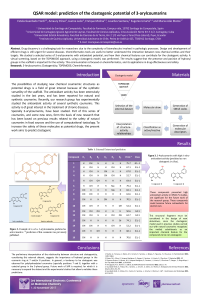
Drug discovery is a challenging task for researchers due to the complexity of biomolecules involved in pathologic processes. Design and development of efficient drugs is still urgent for several diseases. Cheminformatics tools are useful to better understand the interaction between new chemical entities and their targets. We studied a selected series of 3-arylcoumarins with antioxidant potential, and determined how their chemical features can contribute for the clastogenic activity. A virtual screening, based on the TOPSMODE approach, using a clastogenic model, was performed. The results suggested that the presence and position of hydroxyl groups in the scaffold is important for the activity. This communication is focused on cheminformatics, and its applications in drug effectiveness and safety.
Keywords
3-Arylcoumarins
Clastogenicity
TOPSMODE
Cheminformatics
Manuscript
ECMEC3 Matos et al.pdf
Poster
ECMEC3 Matos et al presentation.pdf
Hepatoprotective Effect of Oligoribonucleotides-D-mannitol Complexes under Thioacetamide-induced Hepatotoxicity
Analysis of the Binding Site of αS1-Casein to its Cellular Receptor TLR4 by Selective Inhibitors and Microscale Thermophoresis