Event submissions
EventsMOL2NET'17, Conference on Molecular, Biomed., Comput. & Network Science and Engineering, 3rd ed.
Published

This submission belongs to the session 09. NATMODECO-02: Nat. Prod., Molec. Sci., Develop. Sust., Environ., Eco., and Econ. Congress, Puyo, Ecuador-Porto, Portugal, 2017. of the event MOL2NET'17, Conference on Molecular, Biomed., Comput. & Network Science and Engineering, 3rd ed.
Published date
09 Nov, 2017
Citation
Jiménez-Gutierrez Santiago, Martín Germán, Jose Tena, Patterns of scuba diver behaviour to assess environmental impact on marine benthic communities: a suitable tool for management of recreational diving on Benidorm island (Western Mediterranean sea)., in Proceedings of MOL2NET'17, Conference on Molecular, Biomed., Comput. & Network Science and Engineering, 3rd ed., 15 January–15 December 2017, MDPI: Basel, Switzerland, doi: 10.3390/mol2net-03-04868
Share
Email
Facebook
Twitter
LinkedIn
Patterns of scuba diver behaviour to assess environmental impact on marine benthic communities: a suitable tool for management of recreational diving on Benidorm island (Western Mediterranean sea).
'%3e%3cpath%20d='M12.6647%2010.9104C12.4176%2010.325%2012.0589%209.7933%2011.6088%209.34485C11.16%208.89511%2010.6283%208.53653%2010.0432%208.28891C10.038%208.28629%2010.0327%208.28498%2010.0275%208.28236C10.8437%207.69282%2011.3743%206.73252%2011.3743%205.64907C11.3743%203.85423%209.92005%202.40002%208.12522%202.40002C6.33038%202.40002%204.87618%203.85423%204.87618%205.64907C4.87618%206.73252%205.40677%207.69282%206.22296%208.28367C6.21772%208.28629%206.21248%208.2876%206.20724%208.29022C5.62031%208.53783%205.09365%208.89287%204.64167%209.34616C4.19192%209.79496%203.83334%2010.3266%203.58573%2010.9117C3.34247%2011.4846%203.21128%2012.0987%203.19925%2012.721C3.1989%2012.735%203.20135%2012.7489%203.20646%2012.7619C3.21157%2012.7749%203.21924%2012.7868%203.22901%2012.7968C3.23877%2012.8068%203.25045%2012.8148%203.26334%2012.8202C3.27623%2012.8256%203.29007%2012.8284%203.30406%2012.8284H4.09012C4.14776%2012.8284%204.19362%2012.7825%204.19493%2012.7262C4.22113%2011.7148%204.62726%2010.7676%205.34519%2010.0497C6.08802%209.30686%207.07452%208.89811%208.12522%208.89811C9.17592%208.89811%2010.1624%209.30686%2010.9052%2010.0497C11.6232%2010.7676%2012.0293%2011.7148%2012.0555%2012.7262C12.0568%2012.7839%2012.1027%2012.8284%2012.1603%2012.8284H12.9464C12.9604%2012.8284%2012.9742%2012.8256%2012.9871%2012.8202C13%2012.8148%2013.0117%2012.8068%2013.0214%2012.7968C13.0312%2012.7868%2013.0389%2012.7749%2013.044%2012.7619C13.0491%2012.7489%2013.0515%2012.735%2013.0512%2012.721C13.0381%2012.0947%2012.9084%2011.4856%2012.6647%2010.9104ZM8.12522%207.90243C7.52388%207.90243%206.95792%207.66793%206.53214%207.24215C6.10636%206.81636%205.87185%206.2504%205.87185%205.64907C5.87185%205.04773%206.10636%204.48177%206.53214%204.05599C6.95792%203.63021%207.52388%203.3957%208.12522%203.3957C8.72655%203.3957%209.29252%203.63021%209.7183%204.05599C10.1441%204.48177%2010.3786%205.04773%2010.3786%205.64907C10.3786%206.2504%2010.1441%206.81636%209.7183%207.24215C9.29252%207.66793%208.72655%207.90243%208.12522%207.90243Z'%20fill='%235D1EE1'/%3e%3c/g%3e%3c/svg%3e)
Jiménez-Gutierrez Santiago 1
Martín Germán 2
Jose Tena 2
1. Institut d'Ecologia Litoral, El Campello (Alicante)
2. IMEDMAR-Research Institute of Environment and Marine Science Research Catholic University of Valencia
Abstract
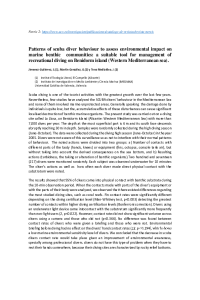
Scuba diving is one of the tourist activities with the greatest growth over the last few years. Nevertheless, few studies have analyzed the SCUBA divers’ behaviour in the Mediterranean Sea and none of them involved marine unprotected areas. Generally speaking the damage done by individuals is quite low, but the, accumulative effects of these disturbances can cause significant localised destruction of benthic marine organisms. The present study was carried out during the year 2005 on a diving site called La Llosa, on Benidorm Island (Alicante: Western Mediterranean Sea) with more than 7,000 dives per year. Two hundred and seventeen (217) divers were monitored randomly. Each subject was observed underwater for 10 minutes (according to the methods proposed by Rouphael & Inglis, 2001). The diver’s actions as well as how often each diver made direct physical contact with the substratum were noted.
Samples were randomly collected during the high diving season (June-October). Divers were not aware of this surveillance so as not to interfere with their normal patterns of behaviour. The results showed that 95% of divers came into physical contact with benthic substrata during the 10-min observation period. Fin contact rates were significantly different depending on the diving certification level (Man-Whitney test, p<0.003) detecting the greatest number of contacts within higher diving certification levels (Bonferroni correction). Divers using an underwater light device came intocontact with the substratum significantly more frequently than non-light users (2, p<0.022). However, contact rate did not show significant variance across divers using a camera and those who did not (p<0.366). No difference was found between contact rates of divers who were given a briefing and those who were not. Environmental briefing before diving had no effect on the divers’ hand contact rates (2, p< 0.194), which shows a low marine environmental sensitivity level of divers. We concluded that the decrease in scuba divers contact rate would take place given an improvement of environmental awareness, specially among professional divers.
Keywords
Scuba diving
Impact
Management
Benthic environment
Divers behaviour
Poster
WS Diving17.pdf
Application of molecular topology to the prediction and optimization of mosquito repellent activity of N-acyl-piperidine derivatives
Comunidad de poliquetos de los fondos blandos de la playa de Canet d’en Berenguer (Valencia-Spain).