Event submissions
Published

This submission belongs to the session A. Biosensors of the event 4th International Electronic Conference on Sensors and Applications
Published date
14 Nov, 2017
Citation
Carlo Camerlingo, Alessandro Verde, Sonia Errico, Lorenzo Manti, Maria Lepore, Micro sensing of pH levels in biological samples by graphene-based Raman spectroscopy, in Proceedings of 4th International Electronic Conference on Sensors and Applications, 15 November–30 November 2017, MDPI: Basel, Switzerland, doi: 10.3390/ecsa-4-04913
Share
Email
Facebook
Twitter
LinkedIn
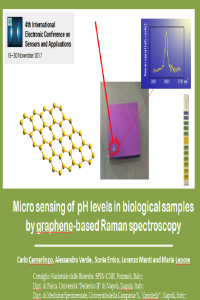
Micro sensing of pH levels in biological samples by graphene-based Raman spectroscopy
'%3e%3cpath%20d='M12.6647%2010.9104C12.4176%2010.325%2012.0589%209.7933%2011.6088%209.34485C11.16%208.89511%2010.6283%208.53653%2010.0432%208.28891C10.038%208.28629%2010.0327%208.28498%2010.0275%208.28236C10.8437%207.69282%2011.3743%206.73252%2011.3743%205.64907C11.3743%203.85423%209.92005%202.40002%208.12522%202.40002C6.33038%202.40002%204.87618%203.85423%204.87618%205.64907C4.87618%206.73252%205.40677%207.69282%206.22296%208.28367C6.21772%208.28629%206.21248%208.2876%206.20724%208.29022C5.62031%208.53783%205.09365%208.89287%204.64167%209.34616C4.19192%209.79496%203.83334%2010.3266%203.58573%2010.9117C3.34247%2011.4846%203.21128%2012.0987%203.19925%2012.721C3.1989%2012.735%203.20135%2012.7489%203.20646%2012.7619C3.21157%2012.7749%203.21924%2012.7868%203.22901%2012.7968C3.23877%2012.8068%203.25045%2012.8148%203.26334%2012.8202C3.27623%2012.8256%203.29007%2012.8284%203.30406%2012.8284H4.09012C4.14776%2012.8284%204.19362%2012.7825%204.19493%2012.7262C4.22113%2011.7148%204.62726%2010.7676%205.34519%2010.0497C6.08802%209.30686%207.07452%208.89811%208.12522%208.89811C9.17592%208.89811%2010.1624%209.30686%2010.9052%2010.0497C11.6232%2010.7676%2012.0293%2011.7148%2012.0555%2012.7262C12.0568%2012.7839%2012.1027%2012.8284%2012.1603%2012.8284H12.9464C12.9604%2012.8284%2012.9742%2012.8256%2012.9871%2012.8202C13%2012.8148%2013.0117%2012.8068%2013.0214%2012.7968C13.0312%2012.7868%2013.0389%2012.7749%2013.044%2012.7619C13.0491%2012.7489%2013.0515%2012.735%2013.0512%2012.721C13.0381%2012.0947%2012.9084%2011.4856%2012.6647%2010.9104ZM8.12522%207.90243C7.52388%207.90243%206.95792%207.66793%206.53214%207.24215C6.10636%206.81636%205.87185%206.2504%205.87185%205.64907C5.87185%205.04773%206.10636%204.48177%206.53214%204.05599C6.95792%203.63021%207.52388%203.3957%208.12522%203.3957C8.72655%203.3957%209.29252%203.63021%209.7183%204.05599C10.1441%204.48177%2010.3786%205.04773%2010.3786%205.64907C10.3786%206.2504%2010.1441%206.81636%209.7183%207.24215C9.29252%207.66793%208.72655%207.90243%208.12522%207.90243Z'%20fill='%235D1EE1'/%3e%3c/g%3e%3c/svg%3e)
Carlo Camerlingo 1
Alessandro Verde 2
Sonia Errico 3

Lorenzo Manti 2

Maria Lepore 3
1. CNR-SPIN, Istituto superconduttori, materiali innovativi e dispositivi, via Campi Flegrei 34 , 80078 Pozzuoli, Italy;
2. Dipt. di Fisica, Università di Napoli "Federico II", Napoli, Italy
3. Dipt. di Medicina Sperimentale, Università della Campania "L. Vanvitelli", Napoli, Italy
Abstract
Graphene provides a unique way for sensing local pH level of substances, with important implications in the monitoring of cellular metabolic activities where protonic excretion occurs in suitable conditions [1]. Doping modifications of graphene, induced by the contact of the graphene sheet with different pH solutions were investigated by micro-Raman spectroscopy in order to develop a pH biosensor. A small amount of liquid (of the order of few microliters) was dropped on a graphene surface and the Raman response collected by using He-Ne laser light excitation. Depending on the doping level, the energy of the Raman G mode of graphene significantly changes in the range of 1580-1610 cm-1. The Raman response of graphene exposed to known pH aqueous solutions was investigated in order to provide a calibration curve for the sensor. In the aim to test the developed biosensor with real biological systems, the pH values of cell culture media in different conditions were evaluated. The obtained results suggested that the proposed biosensing scheme could be adopted also for monitoring more complex biological systems as a single cell at the micrometer scale.
[1] G. L. C. Paulus et al. “A graphene-based physiometer array for the analysis of single biological cells” Sci. Reports 4 (2014) 6865.
Keywords
biosensors
Raman spectroscopy
graphene.
Manuscript
sciforum-014374-done.pdf
Poster
ECSA4_Camerlingo_slides.pdf
Hyperspectral survey method to detect the titanium dioxide percentage in the coatings applied to the Cultural Heritage
Ambient temperature effects on data logging IC’s power consumption: monitoring ready meal delivery services