Event submissions
Published

This submission belongs to the session S2. Smart Sensing Systems and Structures of the event 4th International Electronic Conference on Sensors and Applications
Published date
14 Nov, 2017
Citation
Stefan Bosse, Daniel Schmidt, Michael Koerdt, Robust and Adaptive Image Segmentation for Structural Monitoring using Autonomous Agents, in Proceedings of 4th International Electronic Conference on Sensors and Applications, 15 November–30 November 2017, MDPI: Basel, Switzerland, doi: 10.3390/ecsa-4-04917
Share
Email
Facebook
Twitter
LinkedIn
Robust and Adaptive Image Segmentation for Structural Monitoring using Autonomous Agents

Stefan Bosse 1
'%3e%3cpath%20d='M12.6647%2010.9104C12.4176%2010.325%2012.0589%209.7933%2011.6088%209.34485C11.16%208.89511%2010.6283%208.53653%2010.0432%208.28891C10.038%208.28629%2010.0327%208.28498%2010.0275%208.28236C10.8437%207.69282%2011.3743%206.73252%2011.3743%205.64907C11.3743%203.85423%209.92005%202.40002%208.12522%202.40002C6.33038%202.40002%204.87618%203.85423%204.87618%205.64907C4.87618%206.73252%205.40677%207.69282%206.22296%208.28367C6.21772%208.28629%206.21248%208.2876%206.20724%208.29022C5.62031%208.53783%205.09365%208.89287%204.64167%209.34616C4.19192%209.79496%203.83334%2010.3266%203.58573%2010.9117C3.34247%2011.4846%203.21128%2012.0987%203.19925%2012.721C3.1989%2012.735%203.20135%2012.7489%203.20646%2012.7619C3.21157%2012.7749%203.21924%2012.7868%203.22901%2012.7968C3.23877%2012.8068%203.25045%2012.8148%203.26334%2012.8202C3.27623%2012.8256%203.29007%2012.8284%203.30406%2012.8284H4.09012C4.14776%2012.8284%204.19362%2012.7825%204.19493%2012.7262C4.22113%2011.7148%204.62726%2010.7676%205.34519%2010.0497C6.08802%209.30686%207.07452%208.89811%208.12522%208.89811C9.17592%208.89811%2010.1624%209.30686%2010.9052%2010.0497C11.6232%2010.7676%2012.0293%2011.7148%2012.0555%2012.7262C12.0568%2012.7839%2012.1027%2012.8284%2012.1603%2012.8284H12.9464C12.9604%2012.8284%2012.9742%2012.8256%2012.9871%2012.8202C13%2012.8148%2013.0117%2012.8068%2013.0214%2012.7968C13.0312%2012.7868%2013.0389%2012.7749%2013.044%2012.7619C13.0491%2012.7489%2013.0515%2012.735%2013.0512%2012.721C13.0381%2012.0947%2012.9084%2011.4856%2012.6647%2010.9104ZM8.12522%207.90243C7.52388%207.90243%206.95792%207.66793%206.53214%207.24215C6.10636%206.81636%205.87185%206.2504%205.87185%205.64907C5.87185%205.04773%206.10636%204.48177%206.53214%204.05599C6.95792%203.63021%207.52388%203.3957%208.12522%203.3957C8.72655%203.3957%209.29252%203.63021%209.7183%204.05599C10.1441%204.48177%2010.3786%205.04773%2010.3786%205.64907C10.3786%206.2504%2010.1441%206.81636%209.7183%207.24215C9.29252%207.66793%208.72655%207.90243%208.12522%207.90243Z'%20fill='%235D1EE1'/%3e%3c/g%3e%3c/svg%3e)
Daniel Schmidt 2
Michael Koerdt 3
1. University of Bremen, Dept. of Mathematics and Computer Science, Robert Hooke Str. 5, 28359 Bremen, Germany
2. Deutsches Zentrum für Luft- und Raumfahrt e. V. (DLR), Institut für Faserverbundleichtbau und Adaptronik / Multifunktionswerkstoffe, Lilienthalplatz 7, 38108 Braunschweig
3. Faserinstitut Bremen e. V., Simulation / Structuremechanics (SIM), Am Biologischen Garten 2, Bremen, Germany
Abstract
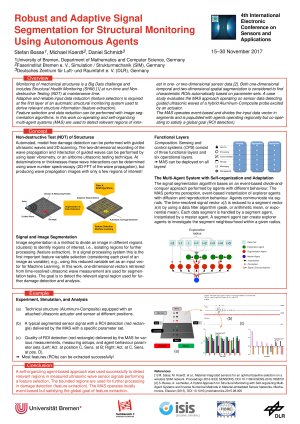
Monitoring of mechanical structures is a Big Data challenge and includes Structural Health Monitoring (SHM) and Non-destructive Testing (NDT). The sensor data produced by common measuring techniques, e.g., guided wave propagation analysis, is characterized by a high dimensionality in the temporal and spatial domain. There are off- and on-line methods applied at maintenance- or run-time, respectively. On-line methods (SHM) usually are constrained by low-resource processing platforms, sensor noise, unreliability, and real-time operation requiring advanced and efficient sensor data processing. Commonly, structural monitoring is a task that maps high-dimensional input data on low-dimensional output data (information, that is feature extraction), e.g., in the simplest case a Boolean output variable “Damaged”. Machine Learning (ML), e.g., supervised learning, can be used to derive such a mapping function. But ML quality and performance depends strongly on the input data size. Therefore, adaptive and reliable input data reduction (that is feature selection) is required at the first layer of an automatic structural monitoring system. Assuming some kind of two-dimensional sensor data (or n-dimensional data in general), image segmentation can be used to identify Regions of Interest (ROI), e.g., of wave propagation fields. Wave propagation in materials underlie reflections that must be distinguished, especially in hybrid materials (e.g., combining metal and fibre-plastic composites) there are complex wave propagation fields. The image segmentation is one of the most crucial part of image processing (Mishra, 2011). Major difficulties in image segmentation are noise and the differing homogeneity (fuzziness and signal gradients) of regions, complicating the definition of suitable threshold conditions for the edge detection or region splitting/clustering. Many traditional image segmentation algorithms are constrained by this issue. Artificial Intelligence can aid to overcome this limitation by using autonomous agents as an adaptive and self-organizing software architecture, presented in this work. Using a collection of co-operating agents decomposes a large and complex problem in smaller and simpler problems with a Divide-and-Conquer approach. Related to the image segmentation scenario, agents are working mostly autonomous (de-coupled) on dynamic bounded data from different regions of an image (i.e., distributed with simulated mobility), adapted to the locality, being reliable and less sensitive to noisy sensor data. In this work, different agent behaviour and segmentation approaches are introduced and evaluated with measured high-dimensional data from piezo-electric acusto-ultrasonic sensors recording wave propagation in plate-like structures. Commonly, SHM deploys only a small set of sensors and actuators at static positions delivering only a few temporal resolved sensor signals (1D), whereas NDT methods additionally can use spatial scanning to create images of wave signals (2D). Both one-dimensional temporal and two-dimensional spatial segmentation is considered to find characteristic ROI.
Keywords
Adaptive Image Segmentation
Feature extraction
Autonomous Agents
Self-organizing systems
Machine Learning and Clustering
Manuscript
ecsa2017_publ-final.pdf
Poster
ecsa2017_poster.pdf
Novel food-safe spin-lattice relaxation time calibration samples for use in magnetic resonance sensor development
Recent Applications of Electronic-nose Technologies for the Noninvasive Early Diagnosis of Gastrointestinal Diseases