Event submissions
Published

This submission belongs to the session E. Applications of the event 4th International Electronic Conference on Sensors and Applications
Published date
14 Nov, 2017
Citation
Viviana Piermattei, Alice Madonia, Simone Bonamano, Riccardo Martellucci, Gabriele Bruzzone, Roberta Ferretti, Angelo Odetti, Maurizio Azzaro, Giuseppe Zappalà, Marco Marcelli, Application of a low cost instrumentation in Arctic extreme conditions, in Proceedings of 4th International Electronic Conference on Sensors and Applications, 15 November–30 November 2017, MDPI: Basel, Switzerland, doi: 10.3390/ecsa-4-04920
Share
Email
Facebook
Twitter
LinkedIn
Application of a low cost instrumentation in Arctic extreme conditions

Viviana Piermattei 1

Alice Madonia 1
'%3e%3cpath%20d='M12.6647%2010.9104C12.4176%2010.325%2012.0589%209.7933%2011.6088%209.34485C11.16%208.89511%2010.6283%208.53653%2010.0432%208.28891C10.038%208.28629%2010.0327%208.28498%2010.0275%208.28236C10.8437%207.69282%2011.3743%206.73252%2011.3743%205.64907C11.3743%203.85423%209.92005%202.40002%208.12522%202.40002C6.33038%202.40002%204.87618%203.85423%204.87618%205.64907C4.87618%206.73252%205.40677%207.69282%206.22296%208.28367C6.21772%208.28629%206.21248%208.2876%206.20724%208.29022C5.62031%208.53783%205.09365%208.89287%204.64167%209.34616C4.19192%209.79496%203.83334%2010.3266%203.58573%2010.9117C3.34247%2011.4846%203.21128%2012.0987%203.19925%2012.721C3.1989%2012.735%203.20135%2012.7489%203.20646%2012.7619C3.21157%2012.7749%203.21924%2012.7868%203.22901%2012.7968C3.23877%2012.8068%203.25045%2012.8148%203.26334%2012.8202C3.27623%2012.8256%203.29007%2012.8284%203.30406%2012.8284H4.09012C4.14776%2012.8284%204.19362%2012.7825%204.19493%2012.7262C4.22113%2011.7148%204.62726%2010.7676%205.34519%2010.0497C6.08802%209.30686%207.07452%208.89811%208.12522%208.89811C9.17592%208.89811%2010.1624%209.30686%2010.9052%2010.0497C11.6232%2010.7676%2012.0293%2011.7148%2012.0555%2012.7262C12.0568%2012.7839%2012.1027%2012.8284%2012.1603%2012.8284H12.9464C12.9604%2012.8284%2012.9742%2012.8256%2012.9871%2012.8202C13%2012.8148%2013.0117%2012.8068%2013.0214%2012.7968C13.0312%2012.7868%2013.0389%2012.7749%2013.044%2012.7619C13.0491%2012.7489%2013.0515%2012.735%2013.0512%2012.721C13.0381%2012.0947%2012.9084%2011.4856%2012.6647%2010.9104ZM8.12522%207.90243C7.52388%207.90243%206.95792%207.66793%206.53214%207.24215C6.10636%206.81636%205.87185%206.2504%205.87185%205.64907C5.87185%205.04773%206.10636%204.48177%206.53214%204.05599C6.95792%203.63021%207.52388%203.3957%208.12522%203.3957C8.72655%203.3957%209.29252%203.63021%209.7183%204.05599C10.1441%204.48177%2010.3786%205.04773%2010.3786%205.64907C10.3786%206.2504%2010.1441%206.81636%209.7183%207.24215C9.29252%207.66793%208.72655%207.90243%208.12522%207.90243Z'%20fill='%235D1EE1'/%3e%3c/g%3e%3c/svg%3e)
Simone Bonamano 1
Riccardo Martellucci 1
Gabriele Bruzzone 2

Roberta Ferretti 2

Angelo Odetti 2
Maurizio Azzaro 3
Giuseppe Zappalà 3
Marco Marcelli 1
1. Univ. of Tuscia - Lab.of Experimental Oceanology and Marine Ecology
2. CNR-ISSIA
3. CNR-IAMC
Abstract
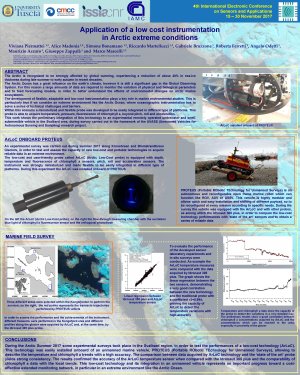
The Arctic is recognized to be strongly affected by global warming, experiencing a reduction of about 40% in sea-ice thickness during late summer to early autumn in recent decades. The Arctic Ocean has a great influence on the earth’s climate, however it is still a significant gap in the Global Observing System. For this reason a large amounts of data are required to monitor the variation of physical and biological parameters and to feed forecasting models, in order to better understand the effects of environmental changes on arctic marine ecosystems. The development of flexible, adaptable and low-cost instrumentation plays a key role in marine environmental studies. This is particularly true if we consider an extreme environment like the Arctic Ocean, where oceanographic instrumentation has to solve a series of technical challenges and barriers. Within this scenario a miniaturized and flexible probe was developed to be easily integrated in different type of platforms. This probe is able to acquire temperature, pressure, fluorescence of chlorophyll a, beyond pitch, roll and acceleration. This work shows the preliminary integration of this technology to an experimental remotely operated underwater and semi-submersible vehicle in the Svalbard area, during survey carried out in the framework of the UVASS (Unmanned Vehicles for Autonomous Sensing and Sampling) research project.
Keywords
arctic ocean
low-cost technology
fluorescence of chlorophyll a
Manuscript
sciforum-014482-done.pdf
Poster
ECSA_2017_VPiermattei.pdf
The Analysis of Compressed Sensing for Total Variation Minimization and Bregman
How to define the Urban Comfort in the era of smart cities through the use of the Do-It-Yourself approach and new pervasive technologies.