Event submissions
Published

This submission belongs to the session P. Posters of the event 4th International Electronic Conference on Sensors and Applications
Published date
15 Nov, 2017
Citation
Stephen Reece, Ron Williams, Maribel Colón, Evelyn Huertas, Marie O’Shea, Pat Sheridan, David Southgate, Gladys Portuondo, Noel Díaz, Barbara Wyrzykowska, Low Cost Air Quality Sensor Deployment and Citizen Science: The Peñuelas Project, in Proceedings of 4th International Electronic Conference on Sensors and Applications, 15 November–30 November 2017, MDPI: Basel, Switzerland, doi: 10.3390/ecsa-4-04937
Share
Email
Facebook
Twitter
LinkedIn
Low Cost Air Quality Sensor Deployment and Citizen Science: The Peñuelas Project
'%3e%3cpath%20d='M12.6647%2010.9104C12.4176%2010.325%2012.0589%209.7933%2011.6088%209.34485C11.16%208.89511%2010.6283%208.53653%2010.0432%208.28891C10.038%208.28629%2010.0327%208.28498%2010.0275%208.28236C10.8437%207.69282%2011.3743%206.73252%2011.3743%205.64907C11.3743%203.85423%209.92005%202.40002%208.12522%202.40002C6.33038%202.40002%204.87618%203.85423%204.87618%205.64907C4.87618%206.73252%205.40677%207.69282%206.22296%208.28367C6.21772%208.28629%206.21248%208.2876%206.20724%208.29022C5.62031%208.53783%205.09365%208.89287%204.64167%209.34616C4.19192%209.79496%203.83334%2010.3266%203.58573%2010.9117C3.34247%2011.4846%203.21128%2012.0987%203.19925%2012.721C3.1989%2012.735%203.20135%2012.7489%203.20646%2012.7619C3.21157%2012.7749%203.21924%2012.7868%203.22901%2012.7968C3.23877%2012.8068%203.25045%2012.8148%203.26334%2012.8202C3.27623%2012.8256%203.29007%2012.8284%203.30406%2012.8284H4.09012C4.14776%2012.8284%204.19362%2012.7825%204.19493%2012.7262C4.22113%2011.7148%204.62726%2010.7676%205.34519%2010.0497C6.08802%209.30686%207.07452%208.89811%208.12522%208.89811C9.17592%208.89811%2010.1624%209.30686%2010.9052%2010.0497C11.6232%2010.7676%2012.0293%2011.7148%2012.0555%2012.7262C12.0568%2012.7839%2012.1027%2012.8284%2012.1603%2012.8284H12.9464C12.9604%2012.8284%2012.9742%2012.8256%2012.9871%2012.8202C13%2012.8148%2013.0117%2012.8068%2013.0214%2012.7968C13.0312%2012.7868%2013.0389%2012.7749%2013.044%2012.7619C13.0491%2012.7489%2013.0515%2012.735%2013.0512%2012.721C13.0381%2012.0947%2012.9084%2011.4856%2012.6647%2010.9104ZM8.12522%207.90243C7.52388%207.90243%206.95792%207.66793%206.53214%207.24215C6.10636%206.81636%205.87185%206.2504%205.87185%205.64907C5.87185%205.04773%206.10636%204.48177%206.53214%204.05599C6.95792%203.63021%207.52388%203.3957%208.12522%203.3957C8.72655%203.3957%209.29252%203.63021%209.7183%204.05599C10.1441%204.48177%2010.3786%205.04773%2010.3786%205.64907C10.3786%206.2504%2010.1441%206.81636%209.7183%207.24215C9.29252%207.66793%208.72655%207.90243%208.12522%207.90243Z'%20fill='%235D1EE1'/%3e%3c/g%3e%3c/svg%3e)
Stephen Reece 1
Ron Williams 2
Maribel Colón 2
Evelyn Huertas 3
Marie O’Shea 4
Pat Sheridan 5
David Southgate 6
Gladys Portuondo 6
Noel Díaz 6
Barbara Wyrzykowska 7
1. ORISE Intern hosted by US EPA Air, Climate, and Energy (ACE) Research Program.
2. US EPA National Exposure Research Laboratory (NERL), Research Triangle Park, NC
3. US EPA Region 2 Caribbean Environmental Protection Division, Guaynabo, PR
4. US EPA Region 2, New York, NY
5. US EPA Region 2, Edison, NJ
6. Desarrollo Integral del Sur, Inc. (DISUR), Ponce, PR
7. Jacobs Technology, Inc, Research Triangle Park, NC
Abstract
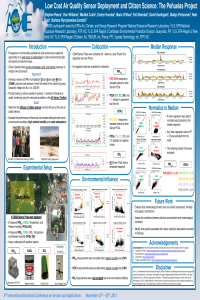
The U.S. Environmental Protection Agency (EPA) and Desarrollo Integral del Sur, Inc (DISUR), a Puerto Rico-based community action group, collaborated to determine the efficacy of citizen science involving the use of low cost air quality sensors. The EPA developed a unique low cost AC powered multi-pollutant Citizen Science Air Monitor (CSAM) that was provided to the community group along with the training/tools needed for its operation. The citizens self-organized a community effort to conduct approximately five months of intensive air quality monitoring in an area of Puerto Rico (Tallaboa-Encarnación, Peñuelas) having little historical data on spatial variability (Ponce). Real-time measurements of the particulate matter size fraction 2.5 micron (PM2.5), nitrogen dioxide (NO2), total volatile organic compounds (tVOCs), and meteorological parameters (wind speed, wind directions, temperature, relative humidity) were obtained. The study provided the Peñuelas and surrounding communities an in-depth investigation of local air quality and opportunities for citizen scientists to gain extensive experience in the use of emerging sensor technologies. The collaboration also provided the EPA an opportunity to evaluate low cost sensor performance under harsh environmental conditions (high relative humidity in a coastal environment). We present the approach and preliminary environmental findings of the EPA’s efforts the deploy a low cost multi-pollutant sensor pod associated with a citizen science research study.
Keywords
air quality
sensors
low cost
citizen science
EPA
Manuscript
sciforum-015248-done.pdf
Poster
ECSA_2017_Poster_Reece.pdf
The Alignment Method for Linear Scale Projection Lithography Based on CCD Image Analysis
An Overview of Medium Access Control Protocols for Cognitive Radio Sensor Networks