Event submissions
Published

This submission belongs to the session D. Pathogens in Water of the event The 2nd International Electronic Conference on Water Sciences
Published date
16 Nov, 2017
Citation
Fides Izdori, Andrea Semiao, Paolo Perona, Empirical characterization of particle settling spatial dynamics in waste stabilization ponds for detection of parasite cysts, in Proceedings of The 2nd International Electronic Conference on Water Sciences, 16 November–30 November 2017, MDPI: Basel, Switzerland, doi: 10.3390/ecws-2-04947
Share
Email
Facebook
Twitter
LinkedIn
Empirical characterization of particle settling spatial dynamics in waste stabilization ponds for detection of parasite cysts
'%3e%3cpath%20d='M12.6647%2010.9104C12.4176%2010.325%2012.0589%209.7933%2011.6088%209.34485C11.16%208.89511%2010.6283%208.53653%2010.0432%208.28891C10.038%208.28629%2010.0327%208.28498%2010.0275%208.28236C10.8437%207.69282%2011.3743%206.73252%2011.3743%205.64907C11.3743%203.85423%209.92005%202.40002%208.12522%202.40002C6.33038%202.40002%204.87618%203.85423%204.87618%205.64907C4.87618%206.73252%205.40677%207.69282%206.22296%208.28367C6.21772%208.28629%206.21248%208.2876%206.20724%208.29022C5.62031%208.53783%205.09365%208.89287%204.64167%209.34616C4.19192%209.79496%203.83334%2010.3266%203.58573%2010.9117C3.34247%2011.4846%203.21128%2012.0987%203.19925%2012.721C3.1989%2012.735%203.20135%2012.7489%203.20646%2012.7619C3.21157%2012.7749%203.21924%2012.7868%203.22901%2012.7968C3.23877%2012.8068%203.25045%2012.8148%203.26334%2012.8202C3.27623%2012.8256%203.29007%2012.8284%203.30406%2012.8284H4.09012C4.14776%2012.8284%204.19362%2012.7825%204.19493%2012.7262C4.22113%2011.7148%204.62726%2010.7676%205.34519%2010.0497C6.08802%209.30686%207.07452%208.89811%208.12522%208.89811C9.17592%208.89811%2010.1624%209.30686%2010.9052%2010.0497C11.6232%2010.7676%2012.0293%2011.7148%2012.0555%2012.7262C12.0568%2012.7839%2012.1027%2012.8284%2012.1603%2012.8284H12.9464C12.9604%2012.8284%2012.9742%2012.8256%2012.9871%2012.8202C13%2012.8148%2013.0117%2012.8068%2013.0214%2012.7968C13.0312%2012.7868%2013.0389%2012.7749%2013.044%2012.7619C13.0491%2012.7489%2013.0515%2012.735%2013.0512%2012.721C13.0381%2012.0947%2012.9084%2011.4856%2012.6647%2010.9104ZM8.12522%207.90243C7.52388%207.90243%206.95792%207.66793%206.53214%207.24215C6.10636%206.81636%205.87185%206.2504%205.87185%205.64907C5.87185%205.04773%206.10636%204.48177%206.53214%204.05599C6.95792%203.63021%207.52388%203.3957%208.12522%203.3957C8.72655%203.3957%209.29252%203.63021%209.7183%204.05599C10.1441%204.48177%2010.3786%205.04773%2010.3786%205.64907C10.3786%206.2504%2010.1441%206.81636%209.7183%207.24215C9.29252%207.66793%208.72655%207.90243%208.12522%207.90243Z'%20fill='%235D1EE1'/%3e%3c/g%3e%3c/svg%3e)
Fides Izdori 1
Andrea Semiao 1
Paolo Perona 1
1. University of Edinburgh
Abstract
Wastewater contains a mixture of particles with sizes ranging from 0.001 to more than 1000 microns, which include pathogens, organic and inorganic contaminants. Parasites eggs and cysts present among these particles are removed by sedimentation in Waste Stabilization Ponds (WSP). However, their settling properties are influenced by other wastewater particles which may explain their presence in some effluents even after provision of recommended retention times. Therefore, understanding how wastewater particles behave inside a reactor will enable the understanding of how they influence sedimentation of parasite eggs and how to improve the process. This study assesses and models spatial and seasonal particle size distribution (PSD) dynamics inside a WSP (Buguruni, Tanzania). The 90 m X 183 m X 1.1 m pond was gridded in 30 X 30 m cells and water samples were collected at top and bottom of the cell nodes for dry and rainfall seasons, and the PSD obtained by Malvern mastersizer2000. Results indicate that particles coming into the pond are mainly supracolloidal and settleables with 52.9% and 45.6 % contribution respectively in dry season and 48.9 % and 49.9 % respectively in wet season. Inflow PSD is a unimodal distribution that separates into bimodal PSD of suspended particles and a unimodal PSD of settling particles inside the pond. Stokes equation gives poor estimation of average particle sizes at different locations but results improve when using the modified formula for flocs. Up to 61.5 % and 45.2 % of particles that falls within the size range of helminths eggs (20-80 microns) are found suspended in water during dry and wet seasons respectively, which may account for their presence in some municipal effluents. Studies in spatial characterization of both size and density of primary particles at different location will enable tracing of different pollutants based on their characteristics.
Keywords
WSP
PSD
helminth
sedimentation
Manuscript
Fides_2017_Empirical characterization of particle size distribution spatial dynamics for Helminth Eggs detection in Waste Stabilization Ponds (WSP).pdf
Poster
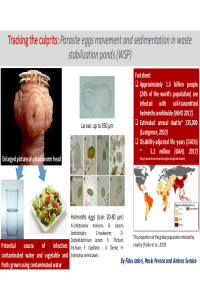
Fides_2017_Empirical characterization of particle size distribution spatial dynamics for Helminth Eggs detection in Waste Stabilization Ponds (WSP)_Presentation.pdf
Determination of micropollutants in solid and liquid samples from swimming pool systems
SPATIAL DROUGHT MONITORING IN THAR DESERT USING SATELLITE BASED DROUGHT INDICES AND GEO-INFORMATICS TECHNIQUES