Event submissions
Published

This submission belongs to the session b. Information and Complexity of the event 4th International Electronic Conference on Entropy and Its Applications
Published date
20 Nov, 2017
Citation
Edgar Parker, The Relationship between the US Economy’s Information Processing and Absorption Ratios, in Proceedings of 4th International Electronic Conference on Entropy and Its Applications, 21 November–1 December 2017, MDPI: Basel, Switzerland, doi: 10.3390/ecea-4-05013
Share
Email
Facebook
Twitter
LinkedIn
The Relationship between the US Economy’s Information Processing and Absorption Ratios
'%3e%3cpath%20d='M12.6647%2010.9104C12.4176%2010.325%2012.0589%209.7933%2011.6088%209.34485C11.16%208.89511%2010.6283%208.53653%2010.0432%208.28891C10.038%208.28629%2010.0327%208.28498%2010.0275%208.28236C10.8437%207.69282%2011.3743%206.73252%2011.3743%205.64907C11.3743%203.85423%209.92005%202.40002%208.12522%202.40002C6.33038%202.40002%204.87618%203.85423%204.87618%205.64907C4.87618%206.73252%205.40677%207.69282%206.22296%208.28367C6.21772%208.28629%206.21248%208.2876%206.20724%208.29022C5.62031%208.53783%205.09365%208.89287%204.64167%209.34616C4.19192%209.79496%203.83334%2010.3266%203.58573%2010.9117C3.34247%2011.4846%203.21128%2012.0987%203.19925%2012.721C3.1989%2012.735%203.20135%2012.7489%203.20646%2012.7619C3.21157%2012.7749%203.21924%2012.7868%203.22901%2012.7968C3.23877%2012.8068%203.25045%2012.8148%203.26334%2012.8202C3.27623%2012.8256%203.29007%2012.8284%203.30406%2012.8284H4.09012C4.14776%2012.8284%204.19362%2012.7825%204.19493%2012.7262C4.22113%2011.7148%204.62726%2010.7676%205.34519%2010.0497C6.08802%209.30686%207.07452%208.89811%208.12522%208.89811C9.17592%208.89811%2010.1624%209.30686%2010.9052%2010.0497C11.6232%2010.7676%2012.0293%2011.7148%2012.0555%2012.7262C12.0568%2012.7839%2012.1027%2012.8284%2012.1603%2012.8284H12.9464C12.9604%2012.8284%2012.9742%2012.8256%2012.9871%2012.8202C13%2012.8148%2013.0117%2012.8068%2013.0214%2012.7968C13.0312%2012.7868%2013.0389%2012.7749%2013.044%2012.7619C13.0491%2012.7489%2013.0515%2012.735%2013.0512%2012.721C13.0381%2012.0947%2012.9084%2011.4856%2012.6647%2010.9104ZM8.12522%207.90243C7.52388%207.90243%206.95792%207.66793%206.53214%207.24215C6.10636%206.81636%205.87185%206.2504%205.87185%205.64907C5.87185%205.04773%206.10636%204.48177%206.53214%204.05599C6.95792%203.63021%207.52388%203.3957%208.12522%203.3957C8.72655%203.3957%209.29252%203.63021%209.7183%204.05599C10.1441%204.48177%2010.3786%205.04773%2010.3786%205.64907C10.3786%206.2504%2010.1441%206.81636%209.7183%207.24215C9.29252%207.66793%208.72655%207.90243%208.12522%207.90243Z'%20fill='%235D1EE1'/%3e%3c/g%3e%3c/svg%3e)
Edgar Parker 1
1. New York Life Insurance Company, 51 Madison Avenue, New York, NY 10010
Abstract
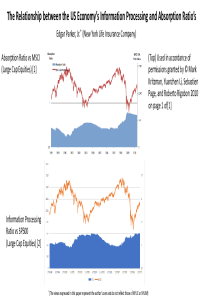
After the 2008 financial collapse, (Kritzman et al 2011) introduced the now popular measure of implied systemic risk called the absorption ratio. This statistic is constructed from a fixed number of eigenvectors, and measures how closely the economy’s markets are coupled. The more closely financial markets are coupled the more susceptible they are to systemic collapse. (Parker 2017) utilized information theory to develop the concept of the entropic yield curve. From this equation, the implied information processing ratio or entropic efficiency of the economy can be derived. This entropic measure can also be useful in predicting economic downturns. In the current work, the relationship between these two ratios is explored.
Keywords
Shannon entropy
Kullback-Leibler divergence
yield curve
volatility
Absorption Ratio
Entropic Yield Curve
Manuscript
sciforum-014674-done.pdf
Poster
Slides -4th International Electronic Conference on Entropy Edgar Parker final.pdf
Sustainability Enhancement of a Biomass Boiler through Exergy Analysis
The irreversibility of the direct and counterflow impinging jet onto profiled heated cavity