Event submissions
EventsMOL2NET'17, Conference on Molecular, Biomed., Comput. & Network Science and Engineering, 3rd ed.
Published

This submission belongs to the session 01. CHEMBIOINFO-03: Chem-Bioinformatics Congress Cambridge, UK-Chapel Hill and Richmond, USA, 2017 of the event MOL2NET'17, Conference on Molecular, Biomed., Comput. & Network Science and Engineering, 3rd ed.
Published date
27 Nov, 2017
Citation
Jose I. Bueso-Bordils, Pedro A. Alemán-López, Sara Costa-Piles, Maria J. Duart, Luis Lahuerta-Zamora, Rafael Martín-Algarra, Gerardo M. Antón-Fos, New Microbiological and Pharmacokinetic models, in Proceedings of MOL2NET'17, Conference on Molecular, Biomed., Comput. & Network Science and Engineering, 3rd ed., 15 January–15 December 2017, MDPI: Basel, Switzerland, doi: 10.3390/mol2net-03-05043
Share
Email
Facebook
Twitter
LinkedIn
New Microbiological and Pharmacokinetic models

Jose I. Bueso-Bordils 1
'%3e%3cpath%20d='M12.6647%2010.9104C12.4176%2010.325%2012.0589%209.7933%2011.6088%209.34485C11.16%208.89511%2010.6283%208.53653%2010.0432%208.28891C10.038%208.28629%2010.0327%208.28498%2010.0275%208.28236C10.8437%207.69282%2011.3743%206.73252%2011.3743%205.64907C11.3743%203.85423%209.92005%202.40002%208.12522%202.40002C6.33038%202.40002%204.87618%203.85423%204.87618%205.64907C4.87618%206.73252%205.40677%207.69282%206.22296%208.28367C6.21772%208.28629%206.21248%208.2876%206.20724%208.29022C5.62031%208.53783%205.09365%208.89287%204.64167%209.34616C4.19192%209.79496%203.83334%2010.3266%203.58573%2010.9117C3.34247%2011.4846%203.21128%2012.0987%203.19925%2012.721C3.1989%2012.735%203.20135%2012.7489%203.20646%2012.7619C3.21157%2012.7749%203.21924%2012.7868%203.22901%2012.7968C3.23877%2012.8068%203.25045%2012.8148%203.26334%2012.8202C3.27623%2012.8256%203.29007%2012.8284%203.30406%2012.8284H4.09012C4.14776%2012.8284%204.19362%2012.7825%204.19493%2012.7262C4.22113%2011.7148%204.62726%2010.7676%205.34519%2010.0497C6.08802%209.30686%207.07452%208.89811%208.12522%208.89811C9.17592%208.89811%2010.1624%209.30686%2010.9052%2010.0497C11.6232%2010.7676%2012.0293%2011.7148%2012.0555%2012.7262C12.0568%2012.7839%2012.1027%2012.8284%2012.1603%2012.8284H12.9464C12.9604%2012.8284%2012.9742%2012.8256%2012.9871%2012.8202C13%2012.8148%2013.0117%2012.8068%2013.0214%2012.7968C13.0312%2012.7868%2013.0389%2012.7749%2013.044%2012.7619C13.0491%2012.7489%2013.0515%2012.735%2013.0512%2012.721C13.0381%2012.0947%2012.9084%2011.4856%2012.6647%2010.9104ZM8.12522%207.90243C7.52388%207.90243%206.95792%207.66793%206.53214%207.24215C6.10636%206.81636%205.87185%206.2504%205.87185%205.64907C5.87185%205.04773%206.10636%204.48177%206.53214%204.05599C6.95792%203.63021%207.52388%203.3957%208.12522%203.3957C8.72655%203.3957%209.29252%203.63021%209.7183%204.05599C10.1441%204.48177%2010.3786%205.04773%2010.3786%205.64907C10.3786%206.2504%2010.1441%206.81636%209.7183%207.24215C9.29252%207.66793%208.72655%207.90243%208.12522%207.90243Z'%20fill='%235D1EE1'/%3e%3c/g%3e%3c/svg%3e)
Pedro A. Alemán-López 1
Sara Costa-Piles 1
Maria J. Duart 1
Luis Lahuerta-Zamora 1
Rafael Martín-Algarra 1

Gerardo M. Antón-Fos 1
1. Departamento de Farmacia, Universidad Cardenal Herrera-CEU, CEU
Universities C/ Ramón y Cajal s/n, 46115 Alfara del Patriarca (Valencia), Spain
Abstract
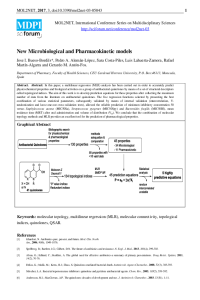
In this paper, a multilinear regression (MLR) analysis has been carried out in order to accurately predict physicochemical properties and biological activities on a group of antibacterial quinolones by means of a set of structural descriptors called topological indices. The aim of this work is to develop prediction equations for these properties after collecting the maximum number of data from the literature on antibacterial quinolones.
The five regression functions selected by presenting the best combination of various statistical parameters, subsequently validated by means of internal validation (intercorrelation, Y-randomization and leave-one-out cross-validation tests), allowed the reliable prediction of minimum inhibitory concentration 50 versus Staphylococcus aureus (MIC50Sa), Streptococcus pyogenes (MIC50Spy) and Bacteroides fragilis (MIC50Bf), mean residence time (MRT) after oral administration and volume of distribution (VD).
We conclude that the combination of molecular topology methods and MLR provides an excellent tool for the prediction of pharmacological properties.
Keywords
molecular topology
multilinear regression (MLR)
molecular connectivity
topological indices
quinolones
QSAR.
Poster
MOL2NET-2017-template.pdf
Affectation of thrips palmi in the quality and production of the naranjilla in the Ecuadorian Amazon.
FRAMA 1.0: Framework for Moving Average Operators Calculation in Data Analysis