Event submissions
EventsMOL2NET'17, Conference on Molecular, Biomed., Comput. & Network Science and Engineering, 3rd ed.
Published

This submission belongs to the session 01. CHEMBIOINFO-03: Chem-Bioinformatics Congress Cambridge, UK-Chapel Hill and Richmond, USA, 2017 of the event MOL2NET'17, Conference on Molecular, Biomed., Comput. & Network Science and Engineering, 3rd ed.
Published date
13 Dec, 2017
Citation
Carla S. Silva Teixeira, Maria João Ramos, Nuno M. F. Sousa A. Cerqueira, Computational studies addressed to the catalytic mechanism of the alpha sub-unit of Tryptophan Synthase, in Proceedings of MOL2NET'17, Conference on Molecular, Biomed., Comput. & Network Science and Engineering, 3rd ed., 15 January–15 December 2017, MDPI: Basel, Switzerland, doi: 10.3390/mol2net-03-05074
Share
Email
Facebook
Twitter
LinkedIn
Computational studies addressed to the catalytic mechanism of the alpha sub-unit of Tryptophan Synthase
'%3e%3cpath%20d='M12.6647%2010.9104C12.4176%2010.325%2012.0589%209.7933%2011.6088%209.34485C11.16%208.89511%2010.6283%208.53653%2010.0432%208.28891C10.038%208.28629%2010.0327%208.28498%2010.0275%208.28236C10.8437%207.69282%2011.3743%206.73252%2011.3743%205.64907C11.3743%203.85423%209.92005%202.40002%208.12522%202.40002C6.33038%202.40002%204.87618%203.85423%204.87618%205.64907C4.87618%206.73252%205.40677%207.69282%206.22296%208.28367C6.21772%208.28629%206.21248%208.2876%206.20724%208.29022C5.62031%208.53783%205.09365%208.89287%204.64167%209.34616C4.19192%209.79496%203.83334%2010.3266%203.58573%2010.9117C3.34247%2011.4846%203.21128%2012.0987%203.19925%2012.721C3.1989%2012.735%203.20135%2012.7489%203.20646%2012.7619C3.21157%2012.7749%203.21924%2012.7868%203.22901%2012.7968C3.23877%2012.8068%203.25045%2012.8148%203.26334%2012.8202C3.27623%2012.8256%203.29007%2012.8284%203.30406%2012.8284H4.09012C4.14776%2012.8284%204.19362%2012.7825%204.19493%2012.7262C4.22113%2011.7148%204.62726%2010.7676%205.34519%2010.0497C6.08802%209.30686%207.07452%208.89811%208.12522%208.89811C9.17592%208.89811%2010.1624%209.30686%2010.9052%2010.0497C11.6232%2010.7676%2012.0293%2011.7148%2012.0555%2012.7262C12.0568%2012.7839%2012.1027%2012.8284%2012.1603%2012.8284H12.9464C12.9604%2012.8284%2012.9742%2012.8256%2012.9871%2012.8202C13%2012.8148%2013.0117%2012.8068%2013.0214%2012.7968C13.0312%2012.7868%2013.0389%2012.7749%2013.044%2012.7619C13.0491%2012.7489%2013.0515%2012.735%2013.0512%2012.721C13.0381%2012.0947%2012.9084%2011.4856%2012.6647%2010.9104ZM8.12522%207.90243C7.52388%207.90243%206.95792%207.66793%206.53214%207.24215C6.10636%206.81636%205.87185%206.2504%205.87185%205.64907C5.87185%205.04773%206.10636%204.48177%206.53214%204.05599C6.95792%203.63021%207.52388%203.3957%208.12522%203.3957C8.72655%203.3957%209.29252%203.63021%209.7183%204.05599C10.1441%204.48177%2010.3786%205.04773%2010.3786%205.64907C10.3786%206.2504%2010.1441%206.81636%209.7183%207.24215C9.29252%207.66793%208.72655%207.90243%208.12522%207.90243Z'%20fill='%235D1EE1'/%3e%3c/g%3e%3c/svg%3e)
Carla S. Silva Teixeira 1
Maria João Ramos 1
Nuno M. F. Sousa A. Cerqueira 1
1. UCIBIO@REQUIMTE, Faculdade de Ciências da Universidade do Porto, Rua do Campo Alegre s/n 4169-007 Porto, Portugal .
Abstract
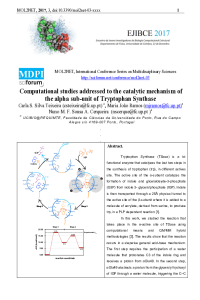
Tryptophan Synthase (TSase) is a bi-functional enzyme that catalyzes the last two steps in the synthesis of tryptophan (trp), in different actives site. The active site of the α-subunit catalyzes the formation of indole and gliceraldeyde-3-phosphate (G3P) from indole 3- glycerolphosphate (IGP). Indole is then transported through a 25Å physical tunnel to the active site of the β-subunit where it is added to a molecule of acrylate, derived from serine, to produce trp, in a PLP dependent reaction [1].
In this work, we studied the reaction that takes place in the α-active site of TSase using computational means and QM/MM hybrid methodologies [2]. The results show that the reaction occurs in a stepwise general acid-base mechanism. The first step requires the participation of a water molecule that protonates C3 of the indole ring and receives a proton from αGlu49. In the second step, αGlu49 abstracts a proton from the glycerolyl hydroxyl of IGP through a water molecule, triggering the C–C bond cleavage to give indole and G3P. The rate-limiting step of this reaction is the first one that requires an activation free energy of 17.74 kcal/mol. This result agrees extremely well with the available experimental data that predicts reaction rate of 3.0-3.7 s-1, which corresponds to a free energy barrier of 17.37-17.50 kcal/mol.
The results obtained in this work provide important details about TSase that can now be used for the development of new transition state analogues inhibitors targeting TSase – an important drug target used in the treatment and prophylaxis of tuberculosis that is caused by the Mycobacterium tuberculosis pathogene.
Keywords
Tryptophan Synthase
QM/MM
tuberculose
Poster
EJIBCE_MOL2NET-2017.pdf
Development of computational tools to enhance the study of catalytic mechanisms
T4 Lysozyme/Halobenzene: A Test System for Modeling Biomolecular Halogen Bonds