Event submissions
EventsMOL2NET'17, Conference on Molecular, Biomed., Comput. & Network Science and Engineering, 3rd ed.
Published

This submission belongs to the session 02. CHEMBIOMOL-03: Chem. Biol. & Med. Chem. Workshop, Rostock, Germany-Bilbao, Spain-Galveston, Texas, USA, 2017 of the event MOL2NET'17, Conference on Molecular, Biomed., Comput. & Network Science and Engineering, 3rd ed.
Published date
15 Dec, 2017
Citation
Erik Aostri, Joseba Pineda, Aitziber Mendiguren, Electrophysiological study of the effect of cannabidiol on the dorsal raphe nucleus serotonergic neurons, in Proceedings of MOL2NET'17, Conference on Molecular, Biomed., Comput. & Network Science and Engineering, 3rd ed., 15 January–15 December 2017, MDPI: Basel, Switzerland, doi: 10.3390/mol2net-03-05083
Share
Email
Facebook
Twitter
LinkedIn
Electrophysiological study of the effect of cannabidiol on the dorsal raphe nucleus serotonergic neurons
'%3e%3cpath%20d='M12.6647%2010.9104C12.4176%2010.325%2012.0589%209.7933%2011.6088%209.34485C11.16%208.89511%2010.6283%208.53653%2010.0432%208.28891C10.038%208.28629%2010.0327%208.28498%2010.0275%208.28236C10.8437%207.69282%2011.3743%206.73252%2011.3743%205.64907C11.3743%203.85423%209.92005%202.40002%208.12522%202.40002C6.33038%202.40002%204.87618%203.85423%204.87618%205.64907C4.87618%206.73252%205.40677%207.69282%206.22296%208.28367C6.21772%208.28629%206.21248%208.2876%206.20724%208.29022C5.62031%208.53783%205.09365%208.89287%204.64167%209.34616C4.19192%209.79496%203.83334%2010.3266%203.58573%2010.9117C3.34247%2011.4846%203.21128%2012.0987%203.19925%2012.721C3.1989%2012.735%203.20135%2012.7489%203.20646%2012.7619C3.21157%2012.7749%203.21924%2012.7868%203.22901%2012.7968C3.23877%2012.8068%203.25045%2012.8148%203.26334%2012.8202C3.27623%2012.8256%203.29007%2012.8284%203.30406%2012.8284H4.09012C4.14776%2012.8284%204.19362%2012.7825%204.19493%2012.7262C4.22113%2011.7148%204.62726%2010.7676%205.34519%2010.0497C6.08802%209.30686%207.07452%208.89811%208.12522%208.89811C9.17592%208.89811%2010.1624%209.30686%2010.9052%2010.0497C11.6232%2010.7676%2012.0293%2011.7148%2012.0555%2012.7262C12.0568%2012.7839%2012.1027%2012.8284%2012.1603%2012.8284H12.9464C12.9604%2012.8284%2012.9742%2012.8256%2012.9871%2012.8202C13%2012.8148%2013.0117%2012.8068%2013.0214%2012.7968C13.0312%2012.7868%2013.0389%2012.7749%2013.044%2012.7619C13.0491%2012.7489%2013.0515%2012.735%2013.0512%2012.721C13.0381%2012.0947%2012.9084%2011.4856%2012.6647%2010.9104ZM8.12522%207.90243C7.52388%207.90243%206.95792%207.66793%206.53214%207.24215C6.10636%206.81636%205.87185%206.2504%205.87185%205.64907C5.87185%205.04773%206.10636%204.48177%206.53214%204.05599C6.95792%203.63021%207.52388%203.3957%208.12522%203.3957C8.72655%203.3957%209.29252%203.63021%209.7183%204.05599C10.1441%204.48177%2010.3786%205.04773%2010.3786%205.64907C10.3786%206.2504%2010.1441%206.81636%209.7183%207.24215C9.29252%207.66793%208.72655%207.90243%208.12522%207.90243Z'%20fill='%235D1EE1'/%3e%3c/g%3e%3c/svg%3e)
Erik Aostri 1
Joseba Pineda 1
Aitziber Mendiguren 1
1. University of the Basque Country
Abstract
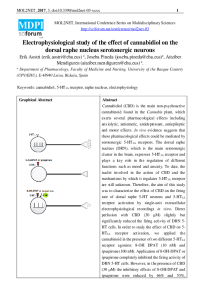
Cannabidiol (CBD) is the main non-psychoactive cannabinoid found in the Cannabis plant, which exerts several pharmacological effects including anxiolytic, antiemetic, antidepressant, antiepileptic and motor effects. In vivo evidence suggests that these pharmacological effects could be mediated by serotonergic 5-HT1A receptors. The dorsal raphe nucleus (DRN), which is the main serotonergic cluster in the brain, expresses 5-HT1A receptor and plays a key role in the regulation of different functions such as mood and anxiety. To date, the nuclei involved in the action of CBD and the mechanisms by which it regulates 5-HT1A receptor are still unknown. Therefore, the aim of this study was to characterize the effect of CBD on the firing rate of dorsal raphe 5-HT neurons and 5-HT1A receptor activation by single-unit extracellular electrophysiological recordings in vitro. Direct perfusion with CBD (30 mM) slightly but significantly reduced the firing activity of DRN 5-HT cells. In order to study the effect of CBD on 5-HT1A receptor activation, we applied the cannabinoid in the presence of two different 5-HT1A receptor agonists: 8-OH DPAT (10 nM) and ipsapirone (100 nM). Application of 8-OH-DPAT or ipsapirone completely inhibited the firing activity of DRN 5-HT cells. However, in the presence of CBD (30 mM) the inhibitory effects of 8-OH-DPAT and ipsapirone were reduced by 66% and 53%, respectively. Finally, to discard the possible role of CBD as a competitive 5-HT1A receptor antagonist, we administrated CBD once the cells had been totally inhibited with ipsapirone. Perfusion with CBD (30 mM) failed to recover the firing activity of inhibited 5-HT cells, whereas 5-HT1A antagonist WAY 100635 (30 nM) recovered the firing rate of all 5-HT cells. In conclusion, these results suggest that CBD regulates the activity of 5-HT1A receptor in an indirect manner since it does not displace the agonist from the binding site.
Keywords
cannabidiol
5-HT1A receptor
raphe nucleus
electrophysiology
Poster
Abstract Mol2net 2017.pdf
Functional characterization of α1 adrenergic receptor in the rat locus coeruleus in vitro
Structural mechanism of HER2-antibodies complexes by molecular dynamics studies