Event submissions
EventsMOL2NET'17, Conference on Molecular, Biomed., Comput. & Network Science and Engineering, 3rd ed.
Published

This submission belongs to the session 01. CHEMBIOINFO-03: Chem-Bioinformatics Congress Cambridge, UK-Chapel Hill and Richmond, USA, 2017 of the event MOL2NET'17, Conference on Molecular, Biomed., Comput. & Network Science and Engineering, 3rd ed.
Published date
15 Dec, 2017
Citation
Pedro b. p. s. Reis, Diogo Vila-Viçosa, Miguel Machuqueiro, Improving pKa calculations of membrane inserting amino acids using replica exchange CpHMD simulations, in Proceedings of MOL2NET'17, Conference on Molecular, Biomed., Comput. & Network Science and Engineering, 3rd ed., 15 January–15 December 2017, MDPI: Basel, Switzerland, doi: 10.3390/mol2net-03-05085
Share
Email
Facebook
Twitter
LinkedIn
Improving pKa calculations of membrane inserting amino acids using replica exchange CpHMD simulations
'%3e%3cpath%20d='M12.6647%2010.9104C12.4176%2010.325%2012.0589%209.7933%2011.6088%209.34485C11.16%208.89511%2010.6283%208.53653%2010.0432%208.28891C10.038%208.28629%2010.0327%208.28498%2010.0275%208.28236C10.8437%207.69282%2011.3743%206.73252%2011.3743%205.64907C11.3743%203.85423%209.92005%202.40002%208.12522%202.40002C6.33038%202.40002%204.87618%203.85423%204.87618%205.64907C4.87618%206.73252%205.40677%207.69282%206.22296%208.28367C6.21772%208.28629%206.21248%208.2876%206.20724%208.29022C5.62031%208.53783%205.09365%208.89287%204.64167%209.34616C4.19192%209.79496%203.83334%2010.3266%203.58573%2010.9117C3.34247%2011.4846%203.21128%2012.0987%203.19925%2012.721C3.1989%2012.735%203.20135%2012.7489%203.20646%2012.7619C3.21157%2012.7749%203.21924%2012.7868%203.22901%2012.7968C3.23877%2012.8068%203.25045%2012.8148%203.26334%2012.8202C3.27623%2012.8256%203.29007%2012.8284%203.30406%2012.8284H4.09012C4.14776%2012.8284%204.19362%2012.7825%204.19493%2012.7262C4.22113%2011.7148%204.62726%2010.7676%205.34519%2010.0497C6.08802%209.30686%207.07452%208.89811%208.12522%208.89811C9.17592%208.89811%2010.1624%209.30686%2010.9052%2010.0497C11.6232%2010.7676%2012.0293%2011.7148%2012.0555%2012.7262C12.0568%2012.7839%2012.1027%2012.8284%2012.1603%2012.8284H12.9464C12.9604%2012.8284%2012.9742%2012.8256%2012.9871%2012.8202C13%2012.8148%2013.0117%2012.8068%2013.0214%2012.7968C13.0312%2012.7868%2013.0389%2012.7749%2013.044%2012.7619C13.0491%2012.7489%2013.0515%2012.735%2013.0512%2012.721C13.0381%2012.0947%2012.9084%2011.4856%2012.6647%2010.9104ZM8.12522%207.90243C7.52388%207.90243%206.95792%207.66793%206.53214%207.24215C6.10636%206.81636%205.87185%206.2504%205.87185%205.64907C5.87185%205.04773%206.10636%204.48177%206.53214%204.05599C6.95792%203.63021%207.52388%203.3957%208.12522%203.3957C8.72655%203.3957%209.29252%203.63021%209.7183%204.05599C10.1441%204.48177%2010.3786%205.04773%2010.3786%205.64907C10.3786%206.2504%2010.1441%206.81636%209.7183%207.24215C9.29252%207.66793%208.72655%207.90243%208.12522%207.90243Z'%20fill='%235D1EE1'/%3e%3c/g%3e%3c/svg%3e)
Pedro b. p. s. Reis 1
Diogo Vila-Viçosa 1

Miguel Machuqueiro 1
1. Centro de Química e Bioquímica, Departamento de Química e Bioquímica, Faculdade de Ciências, Universidade de Lisboa, 1749-016 Lisboa, Portugal
Abstract
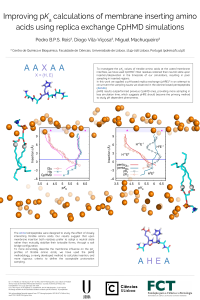
pH is one of the most important solution parameters. It plays a major role in most biochemical processes by, among other, inducing protein conformational changes and influencing protein-lipid interactions. These systems have been modeled using constant-pH molecular dynamics (CpHMD) methods since they are able to correctly capture the conformational/protonation coupling. In a previous CpHMD study, we have shown that, upon membrane insertion, the titrable amino acids are prone to adopt a neutral state. In that work, CpHMD experienced difficulties sampling ionized conformations in inserted regions, since in the time scale of our simulations most residues retained their neutral state upon insertion/desolvation.
Enhanced sampling techniques are a widely used solution to deal with kinetic traps in molecular dynamics simulations. Since our sampling problems are related with protonation, we have implemented a pH-based replica exchange (pHRE). In this method, each simulation replica is assigned a unique pH value and attempts to exchange the simulated pH value of simulations pairs are periodically performed. The acceptance criterion is influenced by the exchanging simulations pH values and protonation states of the titrable sites.
In this work, a more accurate description of the membrane influence on the pKa profiles of titrable amino acids is provided by using the pHRE methodology, a newly developed method to calculate insertion, and more rigorous criteria to define the acceptable protonation sampling. Since in pHRE, due to replica mixing, all pH values sample similar insertion regions, a larger amount of inserted conformations in the ionized state are obtained. Our efficient pHRE results outperformed previous CpHMD ones, granting more sampling in less simulation time. In the future, pHRE will replace CpHMD as our go-to method to study pH-dependent phenomena.
Keywords
replica exchange
CpHMD
pKa calculations
amino acids
membrane
Poster
Poster EJIBCE 2017.pdf
Structural mechanism of HER2-antibodies complexes by molecular dynamics studies
Effect of protonation state on the interaction of Hoechst 33342 with lipid membranes – An experimental and computational study.