Event submissions
EventsMOL2NET'17, Conference on Molecular, Biomed., Comput. & Network Science and Engineering, 3rd ed.
Published

This submission belongs to the session 01. CHEMBIOINFO-03: Chem-Bioinformatics Congress Cambridge, UK-Chapel Hill and Richmond, USA, 2017 of the event MOL2NET'17, Conference on Molecular, Biomed., Comput. & Network Science and Engineering, 3rd ed.
Published date
16 Dec, 2017
Citation
Carlos A.V. Barreto, Miguel Machuqueiro, Alexandre M.J.J. Bonvin, Irina S. Moreira, Structural and dynamic understanding of the ghrelin receptor high constitutive activity , in Proceedings of MOL2NET'17, Conference on Molecular, Biomed., Comput. & Network Science and Engineering, 3rd ed., 15 January–15 December 2017, MDPI: Basel, Switzerland, doi: 10.3390/mol2net-03-05089
Share
Email
Facebook
Twitter
LinkedIn
Structural and dynamic understanding of the ghrelin receptor high constitutive activity
'%3e%3cpath%20d='M12.6647%2010.9104C12.4176%2010.325%2012.0589%209.7933%2011.6088%209.34485C11.16%208.89511%2010.6283%208.53653%2010.0432%208.28891C10.038%208.28629%2010.0327%208.28498%2010.0275%208.28236C10.8437%207.69282%2011.3743%206.73252%2011.3743%205.64907C11.3743%203.85423%209.92005%202.40002%208.12522%202.40002C6.33038%202.40002%204.87618%203.85423%204.87618%205.64907C4.87618%206.73252%205.40677%207.69282%206.22296%208.28367C6.21772%208.28629%206.21248%208.2876%206.20724%208.29022C5.62031%208.53783%205.09365%208.89287%204.64167%209.34616C4.19192%209.79496%203.83334%2010.3266%203.58573%2010.9117C3.34247%2011.4846%203.21128%2012.0987%203.19925%2012.721C3.1989%2012.735%203.20135%2012.7489%203.20646%2012.7619C3.21157%2012.7749%203.21924%2012.7868%203.22901%2012.7968C3.23877%2012.8068%203.25045%2012.8148%203.26334%2012.8202C3.27623%2012.8256%203.29007%2012.8284%203.30406%2012.8284H4.09012C4.14776%2012.8284%204.19362%2012.7825%204.19493%2012.7262C4.22113%2011.7148%204.62726%2010.7676%205.34519%2010.0497C6.08802%209.30686%207.07452%208.89811%208.12522%208.89811C9.17592%208.89811%2010.1624%209.30686%2010.9052%2010.0497C11.6232%2010.7676%2012.0293%2011.7148%2012.0555%2012.7262C12.0568%2012.7839%2012.1027%2012.8284%2012.1603%2012.8284H12.9464C12.9604%2012.8284%2012.9742%2012.8256%2012.9871%2012.8202C13%2012.8148%2013.0117%2012.8068%2013.0214%2012.7968C13.0312%2012.7868%2013.0389%2012.7749%2013.044%2012.7619C13.0491%2012.7489%2013.0515%2012.735%2013.0512%2012.721C13.0381%2012.0947%2012.9084%2011.4856%2012.6647%2010.9104ZM8.12522%207.90243C7.52388%207.90243%206.95792%207.66793%206.53214%207.24215C6.10636%206.81636%205.87185%206.2504%205.87185%205.64907C5.87185%205.04773%206.10636%204.48177%206.53214%204.05599C6.95792%203.63021%207.52388%203.3957%208.12522%203.3957C8.72655%203.3957%209.29252%203.63021%209.7183%204.05599C10.1441%204.48177%2010.3786%205.04773%2010.3786%205.64907C10.3786%206.2504%2010.1441%206.81636%209.7183%207.24215C9.29252%207.66793%208.72655%207.90243%208.12522%207.90243Z'%20fill='%235D1EE1'/%3e%3c/g%3e%3c/svg%3e)
Carlos A.V. Barreto 1
Miguel Machuqueiro 2
Alexandre M.J.J. Bonvin 3

Irina S. Moreira 1,3
1. Structural, Computational and Chemical Biology, CNC - Center for Neuroscience and Cell Biology, University of Coimbra.
2. Centro de Química e Bioquímica, Departamento de Química e Bioquímica, Faculdade de Ciências, Universidade de Lisboa.
3. Bijvoet Center for Biomolecular Research, Faculty of Science—Chemistry, Utrecht University, Utrecht, The Netherlands
Abstract
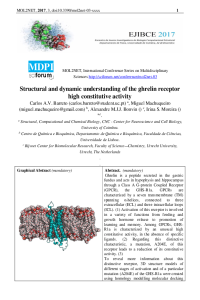
Ghrelin is a peptide secreted in the gastric fundus and acts in hypophysis and hippocampus through a Class A G-protein Coupled Receptor (GPCR), the GHS-R1a. GPCRs are characterized by a seven transmembrane (TM) spanning α-helices, connected to three extracellular (ECL) and three intracellular loops (ICL). (1) Activation of this receptor is involved in a variety of functions from feeding and growth hormone release to promotion of learning and memory. Among GPCRs, GHS-R1a is characterized by an unusual high constitutive activity, in the absence of specific ligands. (2) Regarding this distinctive characteristic, a mutation, A204E, of this receptor leads to a reduction of its constitutive activity. (3)
To reveal more information about this distinctive receptor, 3D structure models of different stages of activation and of a particular mutation (A204E) of the GHS-R1a were created using homology modelling molecular docking and their differences analysed. Fully-atomistic molecular dynamics simulations are being performed initially with the pre-active model and the mutant, and will be followed by the remaining activation states. These simulations will give atomic detail to the necessary conformation rearrangements responsible for receptor activity. The structural and functional characterization of GHSR1a is an important step towards the design of specific drugs.
Keywords
GHSR1a
Molecular Dynamics
GPCR
Poster
MOL2NET_CB_Abstract.pdf
Creating a valid in silico Dopamine D2-receptor model for small molecular docking studies
Diyne formation from alkynes in the presence of palladium pincer complexes