Event submissions
EventsMOL2NET'17, Conference on Molecular, Biomed., Comput. & Network Science and Engineering, 3rd ed.
Published

This submission belongs to the session 02. CHEMBIOMOL-03: Chem. Biol. & Med. Chem. Workshop, Rostock, Germany-Bilbao, Spain-Galveston, Texas, USA, 2017 of the event MOL2NET'17, Conference on Molecular, Biomed., Comput. & Network Science and Engineering, 3rd ed.
Published date
19 Dec, 2017
Citation
Viviana Quevedo, Bernabé Ortega-Tenezaca, Julio César Vargas-Burgos, Alejandro Pazos-Sierra, Humbert González-Díaz, Notes Towards a Network Approach to Gene Orientation, in Proceedings of MOL2NET'17, Conference on Molecular, Biomed., Comput. & Network Science and Engineering, 3rd ed., 15 January–15 December 2017, MDPI: Basel, Switzerland, doi: 10.3390/mol2net-03-05092
Share
Email
Facebook
Twitter
LinkedIn
Notes Towards a Network Approach to Gene Orientation
'%3e%3cpath%20d='M12.6647%2010.9104C12.4176%2010.325%2012.0589%209.7933%2011.6088%209.34485C11.16%208.89511%2010.6283%208.53653%2010.0432%208.28891C10.038%208.28629%2010.0327%208.28498%2010.0275%208.28236C10.8437%207.69282%2011.3743%206.73252%2011.3743%205.64907C11.3743%203.85423%209.92005%202.40002%208.12522%202.40002C6.33038%202.40002%204.87618%203.85423%204.87618%205.64907C4.87618%206.73252%205.40677%207.69282%206.22296%208.28367C6.21772%208.28629%206.21248%208.2876%206.20724%208.29022C5.62031%208.53783%205.09365%208.89287%204.64167%209.34616C4.19192%209.79496%203.83334%2010.3266%203.58573%2010.9117C3.34247%2011.4846%203.21128%2012.0987%203.19925%2012.721C3.1989%2012.735%203.20135%2012.7489%203.20646%2012.7619C3.21157%2012.7749%203.21924%2012.7868%203.22901%2012.7968C3.23877%2012.8068%203.25045%2012.8148%203.26334%2012.8202C3.27623%2012.8256%203.29007%2012.8284%203.30406%2012.8284H4.09012C4.14776%2012.8284%204.19362%2012.7825%204.19493%2012.7262C4.22113%2011.7148%204.62726%2010.7676%205.34519%2010.0497C6.08802%209.30686%207.07452%208.89811%208.12522%208.89811C9.17592%208.89811%2010.1624%209.30686%2010.9052%2010.0497C11.6232%2010.7676%2012.0293%2011.7148%2012.0555%2012.7262C12.0568%2012.7839%2012.1027%2012.8284%2012.1603%2012.8284H12.9464C12.9604%2012.8284%2012.9742%2012.8256%2012.9871%2012.8202C13%2012.8148%2013.0117%2012.8068%2013.0214%2012.7968C13.0312%2012.7868%2013.0389%2012.7749%2013.044%2012.7619C13.0491%2012.7489%2013.0515%2012.735%2013.0512%2012.721C13.0381%2012.0947%2012.9084%2011.4856%2012.6647%2010.9104ZM8.12522%207.90243C7.52388%207.90243%206.95792%207.66793%206.53214%207.24215C6.10636%206.81636%205.87185%206.2504%205.87185%205.64907C5.87185%205.04773%206.10636%204.48177%206.53214%204.05599C6.95792%203.63021%207.52388%203.3957%208.12522%203.3957C8.72655%203.3957%209.29252%203.63021%209.7183%204.05599C10.1441%204.48177%2010.3786%205.04773%2010.3786%205.64907C10.3786%206.2504%2010.1441%206.81636%209.7183%207.24215C9.29252%207.66793%208.72655%207.90243%208.12522%207.90243Z'%20fill='%235D1EE1'/%3e%3c/g%3e%3c/svg%3e)
Viviana Quevedo 1,2

Bernabé Ortega-Tenezaca 2
Julio César Vargas-Burgos 2
Alejandro Pazos-Sierra 1

Humbert González-Díaz 3
1. RNASA-IMEDIR, Computer Science Faculty, University of A Coruña, 15071, A Coruña, Spain
2. Universidad Estatal Amazónica
3. Dept. of Organic Chemistry II, University of the Basque Country UPV/EHU, 48940, Leioa, Biscay, Spain
Abstract
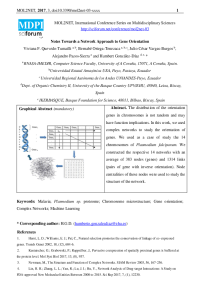
The distribution of the orientation genes in chromosomes is not random and may have function implications. In this work, we used complex networks to study the orientation of genes. We used as a case of study the 14 chromosomes of Plasmodium falciparum. We constructed the respective 14 networks with an average of 383 nodes (genes) and 1314 links (pairs of gene with inverse orientation). Node centralities of these nodes were used to study the structure of the network.
Keywords
Malaria
Plasmodium sp. proteome
Chromosome microstructure
Gene orientation
Complex Networks
Machine Learning
Poster
MOL2NET-2017-template 1.pdf
Efficient preparation of carboxylic acids from alkynes
Use of native microorganisms of the rhizophore of the amazon to accelerate the process of decomposition of organic agricultural residues