Event submissions
EventsMOL2NET'17, Conference on Molecular, Biomed., Comput. & Network Science and Engineering, 3rd ed.
Published

This submission belongs to the session 09. NATMODECO-02: Nat. Prod., Molec. Sci., Develop. Sust., Environ., Eco., and Econ. Congress, Puyo, Ecuador-Porto, Portugal, 2017. of the event MOL2NET'17, Conference on Molecular, Biomed., Comput. & Network Science and Engineering, 3rd ed.
Published date
20 Dec, 2017
Citation
Alexis Tapanes-Castillo, Dora P Maul, Luis C Fernandez-Torres, Maria D Pina, Vadym Trokhymchuk, Andrea Peterson, Carlos C Planchart, Evaluating medicinal plants for anticancer properties: testing plant extracts for cytotoxicity , in Proceedings of MOL2NET'17, Conference on Molecular, Biomed., Comput. & Network Science and Engineering, 3rd ed., 15 January–15 December 2017, MDPI: Basel, Switzerland, doi: 10.3390/mol2net-03-05095
Share
Email
Facebook
Twitter
LinkedIn
Evaluating medicinal plants for anticancer properties: testing plant extracts for cytotoxicity
'%3e%3cpath%20d='M12.6647%2010.9104C12.4176%2010.325%2012.0589%209.7933%2011.6088%209.34485C11.16%208.89511%2010.6283%208.53653%2010.0432%208.28891C10.038%208.28629%2010.0327%208.28498%2010.0275%208.28236C10.8437%207.69282%2011.3743%206.73252%2011.3743%205.64907C11.3743%203.85423%209.92005%202.40002%208.12522%202.40002C6.33038%202.40002%204.87618%203.85423%204.87618%205.64907C4.87618%206.73252%205.40677%207.69282%206.22296%208.28367C6.21772%208.28629%206.21248%208.2876%206.20724%208.29022C5.62031%208.53783%205.09365%208.89287%204.64167%209.34616C4.19192%209.79496%203.83334%2010.3266%203.58573%2010.9117C3.34247%2011.4846%203.21128%2012.0987%203.19925%2012.721C3.1989%2012.735%203.20135%2012.7489%203.20646%2012.7619C3.21157%2012.7749%203.21924%2012.7868%203.22901%2012.7968C3.23877%2012.8068%203.25045%2012.8148%203.26334%2012.8202C3.27623%2012.8256%203.29007%2012.8284%203.30406%2012.8284H4.09012C4.14776%2012.8284%204.19362%2012.7825%204.19493%2012.7262C4.22113%2011.7148%204.62726%2010.7676%205.34519%2010.0497C6.08802%209.30686%207.07452%208.89811%208.12522%208.89811C9.17592%208.89811%2010.1624%209.30686%2010.9052%2010.0497C11.6232%2010.7676%2012.0293%2011.7148%2012.0555%2012.7262C12.0568%2012.7839%2012.1027%2012.8284%2012.1603%2012.8284H12.9464C12.9604%2012.8284%2012.9742%2012.8256%2012.9871%2012.8202C13%2012.8148%2013.0117%2012.8068%2013.0214%2012.7968C13.0312%2012.7868%2013.0389%2012.7749%2013.044%2012.7619C13.0491%2012.7489%2013.0515%2012.735%2013.0512%2012.721C13.0381%2012.0947%2012.9084%2011.4856%2012.6647%2010.9104ZM8.12522%207.90243C7.52388%207.90243%206.95792%207.66793%206.53214%207.24215C6.10636%206.81636%205.87185%206.2504%205.87185%205.64907C5.87185%205.04773%206.10636%204.48177%206.53214%204.05599C6.95792%203.63021%207.52388%203.3957%208.12522%203.3957C8.72655%203.3957%209.29252%203.63021%209.7183%204.05599C10.1441%204.48177%2010.3786%205.04773%2010.3786%205.64907C10.3786%206.2504%2010.1441%206.81636%209.7183%207.24215C9.29252%207.66793%208.72655%207.90243%208.12522%207.90243Z'%20fill='%235D1EE1'/%3e%3c/g%3e%3c/svg%3e)
Alexis Tapanes-Castillo 1
Dora P Maul 1
Luis C Fernandez-Torres 1
Maria D Pina 1
Vadym Trokhymchuk 1
Andrea Peterson 1
Carlos C Planchart 1
1. School of Science, Technology and Engineering Management, St. Thomas University, Miami Gardens, FL 33054, USA
Abstract
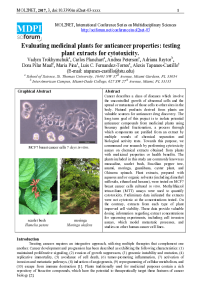
Cancer describes a category of diseases which involve the uncontrolled growth of abnormal cells and the spread or metastasis of those cells to other sites in the body. Natural products derived from plants have been shown to be valuable sources for anticancer drug discovery. The long term goal of this project is to isolate potential anticancer compounds from medicinal plants through bioassay guided fractionation. Towards this purpose, we commenced our research by performing cytotoxicity assays on chemical extracts obtained from plants with medicinal properties or health benefits. The plants included in this study are commonly known as muscadine, scarlet bush, Brazilian pepper, anamu, moringa, guanabana, oyster plant, and Okinawa spinach. Plant extracts, prepared with aqueous and/or organic solvents (including dimethyl sulfoxide, ethanol and hexane), were tested on MCF-7 breast cancer cells cultured in vitro. Methylthiazol tetrazolium (MTT) assays were used to quantify cytotoxicity. Preliminary data indicated the extracts were not cytotoxic at the concentrations tested. Indeed, extracts from each type of plant improved cell viability. These data provide valuable dosing information regarding extract concentrations for upcoming experiments. In the future, extracts will be tested on other human cancer cell lines, as well as in cell-invasion assays, which model metastatic processes.
Keywords
cancer
cytotoxicity
natural products
medicinal plants
dosing information
Poster
mol2net-03-ATapanes.pdf
Analysis of microbial communities reflect diel vertical migration in the Gulf of Mexico
Differential expression of native potatoes genes in response to drought conditions