Event submissions
EventsMOL2NET'17, Conference on Molecular, Biomed., Comput. & Network Science and Engineering, 3rd ed.
Published

This submission belongs to the session 09. NATMODECO-02: Nat. Prod., Molec. Sci., Develop. Sust., Environ., Eco., and Econ. Congress, Puyo, Ecuador-Porto, Portugal, 2017. of the event MOL2NET'17, Conference on Molecular, Biomed., Comput. & Network Science and Engineering, 3rd ed.
Published date
20 Dec, 2017
Citation
Diana Martinez, Dora P Maul, Laynet Cornelio, Olga P Ponce, Yanexis Zarut, Differential expression of native potatoes genes in response to drought conditions , in Proceedings of MOL2NET'17, Conference on Molecular, Biomed., Comput. & Network Science and Engineering, 3rd ed., 15 January–15 December 2017, MDPI: Basel, Switzerland, doi: 10.3390/mol2net-03-05096
Share
Email
Facebook
Twitter
LinkedIn
Differential expression of native potatoes genes in response to drought conditions
'%3e%3cpath%20d='M12.6647%2010.9104C12.4176%2010.325%2012.0589%209.7933%2011.6088%209.34485C11.16%208.89511%2010.6283%208.53653%2010.0432%208.28891C10.038%208.28629%2010.0327%208.28498%2010.0275%208.28236C10.8437%207.69282%2011.3743%206.73252%2011.3743%205.64907C11.3743%203.85423%209.92005%202.40002%208.12522%202.40002C6.33038%202.40002%204.87618%203.85423%204.87618%205.64907C4.87618%206.73252%205.40677%207.69282%206.22296%208.28367C6.21772%208.28629%206.21248%208.2876%206.20724%208.29022C5.62031%208.53783%205.09365%208.89287%204.64167%209.34616C4.19192%209.79496%203.83334%2010.3266%203.58573%2010.9117C3.34247%2011.4846%203.21128%2012.0987%203.19925%2012.721C3.1989%2012.735%203.20135%2012.7489%203.20646%2012.7619C3.21157%2012.7749%203.21924%2012.7868%203.22901%2012.7968C3.23877%2012.8068%203.25045%2012.8148%203.26334%2012.8202C3.27623%2012.8256%203.29007%2012.8284%203.30406%2012.8284H4.09012C4.14776%2012.8284%204.19362%2012.7825%204.19493%2012.7262C4.22113%2011.7148%204.62726%2010.7676%205.34519%2010.0497C6.08802%209.30686%207.07452%208.89811%208.12522%208.89811C9.17592%208.89811%2010.1624%209.30686%2010.9052%2010.0497C11.6232%2010.7676%2012.0293%2011.7148%2012.0555%2012.7262C12.0568%2012.7839%2012.1027%2012.8284%2012.1603%2012.8284H12.9464C12.9604%2012.8284%2012.9742%2012.8256%2012.9871%2012.8202C13%2012.8148%2013.0117%2012.8068%2013.0214%2012.7968C13.0312%2012.7868%2013.0389%2012.7749%2013.044%2012.7619C13.0491%2012.7489%2013.0515%2012.735%2013.0512%2012.721C13.0381%2012.0947%2012.9084%2011.4856%2012.6647%2010.9104ZM8.12522%207.90243C7.52388%207.90243%206.95792%207.66793%206.53214%207.24215C6.10636%206.81636%205.87185%206.2504%205.87185%205.64907C5.87185%205.04773%206.10636%204.48177%206.53214%204.05599C6.95792%203.63021%207.52388%203.3957%208.12522%203.3957C8.72655%203.3957%209.29252%203.63021%209.7183%204.05599C10.1441%204.48177%2010.3786%205.04773%2010.3786%205.64907C10.3786%206.2504%2010.1441%206.81636%209.7183%207.24215C9.29252%207.66793%208.72655%207.90243%208.12522%207.90243Z'%20fill='%235D1EE1'/%3e%3c/g%3e%3c/svg%3e)
Diana Martinez 1
Dora P Maul 2
Laynet Cornelio 2
Olga P Ponce 1
Yanexis Zarut 2
1. Universidad Peruana Cayetano Heredia, Unidad de Genomica, Lima Peru
2. School of Science, Technology and Engineering Management, St. Thomas University, Miami Gardens, FL 33054, USA
Abstract
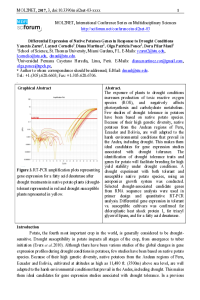
The exposure of plants to drought conditions inhibits shoot growth, increases production of toxic reactive oxygen species (ROS), and negatively affects photosynthesis and carbohydrate metabolism. Drought susceptibility in potato impacts all stages of the crop, from emergence to tuber initiation. Although there have been various studies of the global changes in gene expression profiles during drought conditions in potatoes, few studies have been based on native potato species. Because of their high genetic diversity, native potatoes from the Andean regions of Peru, Ecuador and Bolivia, are well adapted to the harsh environmental conditions that prevail in the Andes, including drought. This makes them ideal candidates for gene expression studies associated with drought tolerance. The identification of drought tolerance traits and genes for potato will facilitate breeding for high yield stability under drought conditions. The first phase of this study consisted on a comparative RNA sequencing analysis between drought-tolerant and drought-susceptible native potato cultivars. During the second phase, a drought experiment with both tolerant and susceptible native potato species, using an aeroponics growth system was conducted. Selected drought-associated candidate genes from the RNA sequence analysis were used in primer design and quantitative RT-PCR analysis. Differential gene expression in tolerant vs. susceptible cultivars has been confirmed for two heat shock proteins and for a triacyl glycerol lipase. Additional candidate genes are being tested. In conclusion, native potatoes are providing important information on genes affected by drought conditions.
Keywords
environmental stress
drought
salinity
reactive oxygen species
plants response
antioxidant enzymes
Poster
mol2net-03-DMaul2.pdf
Evaluating medicinal plants for anticancer properties: testing plant extracts for cytotoxicity
Twitter Data Mining and Predictive Modeling in R