Event submissions
EventsMOL2NET'17, Conference on Molecular, Biomed., Comput. & Network Science and Engineering, 3rd ed.
Published

This submission belongs to the session 05. NANOBIOMAT-03: Nanotechnology & Biomaterials Sci. Congress, Jackson & Fargo, USA, 2017 of the event MOL2NET'17, Conference on Molecular, Biomed., Comput. & Network Science and Engineering, 3rd ed.
Published date
20 Dec, 2017
Citation
David Quesada, Maria V Barreat, Biomedical modeling of Magnetic Nanoparticles Fluid Hyperthermia for Cancer treatment, in Proceedings of MOL2NET'17, Conference on Molecular, Biomed., Comput. & Network Science and Engineering, 3rd ed., 15 January–15 December 2017, MDPI: Basel, Switzerland, doi: 10.3390/mol2net-03-05100
Share
Email
Facebook
Twitter
LinkedIn
Biomedical modeling of Magnetic Nanoparticles Fluid Hyperthermia for Cancer treatment
'%3e%3cpath%20d='M12.6647%2010.9104C12.4176%2010.325%2012.0589%209.7933%2011.6088%209.34485C11.16%208.89511%2010.6283%208.53653%2010.0432%208.28891C10.038%208.28629%2010.0327%208.28498%2010.0275%208.28236C10.8437%207.69282%2011.3743%206.73252%2011.3743%205.64907C11.3743%203.85423%209.92005%202.40002%208.12522%202.40002C6.33038%202.40002%204.87618%203.85423%204.87618%205.64907C4.87618%206.73252%205.40677%207.69282%206.22296%208.28367C6.21772%208.28629%206.21248%208.2876%206.20724%208.29022C5.62031%208.53783%205.09365%208.89287%204.64167%209.34616C4.19192%209.79496%203.83334%2010.3266%203.58573%2010.9117C3.34247%2011.4846%203.21128%2012.0987%203.19925%2012.721C3.1989%2012.735%203.20135%2012.7489%203.20646%2012.7619C3.21157%2012.7749%203.21924%2012.7868%203.22901%2012.7968C3.23877%2012.8068%203.25045%2012.8148%203.26334%2012.8202C3.27623%2012.8256%203.29007%2012.8284%203.30406%2012.8284H4.09012C4.14776%2012.8284%204.19362%2012.7825%204.19493%2012.7262C4.22113%2011.7148%204.62726%2010.7676%205.34519%2010.0497C6.08802%209.30686%207.07452%208.89811%208.12522%208.89811C9.17592%208.89811%2010.1624%209.30686%2010.9052%2010.0497C11.6232%2010.7676%2012.0293%2011.7148%2012.0555%2012.7262C12.0568%2012.7839%2012.1027%2012.8284%2012.1603%2012.8284H12.9464C12.9604%2012.8284%2012.9742%2012.8256%2012.9871%2012.8202C13%2012.8148%2013.0117%2012.8068%2013.0214%2012.7968C13.0312%2012.7868%2013.0389%2012.7749%2013.044%2012.7619C13.0491%2012.7489%2013.0515%2012.735%2013.0512%2012.721C13.0381%2012.0947%2012.9084%2011.4856%2012.6647%2010.9104ZM8.12522%207.90243C7.52388%207.90243%206.95792%207.66793%206.53214%207.24215C6.10636%206.81636%205.87185%206.2504%205.87185%205.64907C5.87185%205.04773%206.10636%204.48177%206.53214%204.05599C6.95792%203.63021%207.52388%203.3957%208.12522%203.3957C8.72655%203.3957%209.29252%203.63021%209.7183%204.05599C10.1441%204.48177%2010.3786%205.04773%2010.3786%205.64907C10.3786%206.2504%2010.1441%206.81636%209.7183%207.24215C9.29252%207.66793%208.72655%207.90243%208.12522%207.90243Z'%20fill='%235D1EE1'/%3e%3c/g%3e%3c/svg%3e)
David Quesada 1
Maria V Barreat 1
1. School of Science, Technology and Engineering Management, St. Thomas University, Miami Gardens, FL 33054, USA
Abstract
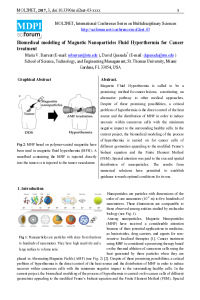
Magnetic Nanoparticles Fluid Hyperthermia is called to be a promising treatment method for cancer lesions, constituting an alternative pathway to other medical approaches, as for example, chemotherapy and radiotherapy. The large surface area to volume ratio of nanoparticles makes them a suitable element to amplify the effect of external fields, in particular, the heat generated by alternating magnetic fields. Despite of these promising possibilities, a critical problem of hyperthermia is the direct control of the heat source and the distribution of nanoparticles in order to induce necrosis within cancerous cells with the minimum negative impact to the surrounding healthy cells. In the current project, the biomedical modeling of the process of hyperthermia is carried on for cancer cells of different geometries appealing to the modified Penne’s bioheat equation and the Finite Element Method (FEM). Special attention was paid to the size and spatial distribution of nanoparticles. The results from numerical solutions have permitted to establish guidance towards optimal conditions for its use. Computations were performed either in Wolfram Mathematica and/or Octave/MATLAB.
Keywords
magnetic nanoparticles
hyperthermia
bioheat equation
cancer
numerical solutions
Mathematica
MATLAB
Poster
mol2net-03_Barreat-DQ.pdf
Analysis of the Gentrification Process in the City of Miami
Assessment of Microclimatic conditions of St. Thomas University forest