Event submissions
EventsMOL2NET'17, Conference on Molecular, Biomed., Comput. & Network Science and Engineering, 3rd ed.
Published

This submission belongs to the session 09. NATMODECO-02: Nat. Prod., Molec. Sci., Develop. Sust., Environ., Eco., and Econ. Congress, Puyo, Ecuador-Porto, Portugal, 2017. of the event MOL2NET'17, Conference on Molecular, Biomed., Comput. & Network Science and Engineering, 3rd ed.
Published date
22 Dec, 2017
Citation
Alexis Tapanes-Castillo, Cristina Balistreri, Daniel A Russo, Maria D Pina, Antioxidant properties of oyster plant (Tradescantia spathacea) extracts using different methods, in Proceedings of MOL2NET'17, Conference on Molecular, Biomed., Comput. & Network Science and Engineering, 3rd ed., 15 January–15 December 2017, MDPI: Basel, Switzerland, doi: 10.3390/mol2net-03-05109
Share
Email
Facebook
Twitter
LinkedIn
Antioxidant properties of oyster plant (Tradescantia spathacea) extracts using different methods
'%3e%3cpath%20d='M12.6647%2010.9104C12.4176%2010.325%2012.0589%209.7933%2011.6088%209.34485C11.16%208.89511%2010.6283%208.53653%2010.0432%208.28891C10.038%208.28629%2010.0327%208.28498%2010.0275%208.28236C10.8437%207.69282%2011.3743%206.73252%2011.3743%205.64907C11.3743%203.85423%209.92005%202.40002%208.12522%202.40002C6.33038%202.40002%204.87618%203.85423%204.87618%205.64907C4.87618%206.73252%205.40677%207.69282%206.22296%208.28367C6.21772%208.28629%206.21248%208.2876%206.20724%208.29022C5.62031%208.53783%205.09365%208.89287%204.64167%209.34616C4.19192%209.79496%203.83334%2010.3266%203.58573%2010.9117C3.34247%2011.4846%203.21128%2012.0987%203.19925%2012.721C3.1989%2012.735%203.20135%2012.7489%203.20646%2012.7619C3.21157%2012.7749%203.21924%2012.7868%203.22901%2012.7968C3.23877%2012.8068%203.25045%2012.8148%203.26334%2012.8202C3.27623%2012.8256%203.29007%2012.8284%203.30406%2012.8284H4.09012C4.14776%2012.8284%204.19362%2012.7825%204.19493%2012.7262C4.22113%2011.7148%204.62726%2010.7676%205.34519%2010.0497C6.08802%209.30686%207.07452%208.89811%208.12522%208.89811C9.17592%208.89811%2010.1624%209.30686%2010.9052%2010.0497C11.6232%2010.7676%2012.0293%2011.7148%2012.0555%2012.7262C12.0568%2012.7839%2012.1027%2012.8284%2012.1603%2012.8284H12.9464C12.9604%2012.8284%2012.9742%2012.8256%2012.9871%2012.8202C13%2012.8148%2013.0117%2012.8068%2013.0214%2012.7968C13.0312%2012.7868%2013.0389%2012.7749%2013.044%2012.7619C13.0491%2012.7489%2013.0515%2012.735%2013.0512%2012.721C13.0381%2012.0947%2012.9084%2011.4856%2012.6647%2010.9104ZM8.12522%207.90243C7.52388%207.90243%206.95792%207.66793%206.53214%207.24215C6.10636%206.81636%205.87185%206.2504%205.87185%205.64907C5.87185%205.04773%206.10636%204.48177%206.53214%204.05599C6.95792%203.63021%207.52388%203.3957%208.12522%203.3957C8.72655%203.3957%209.29252%203.63021%209.7183%204.05599C10.1441%204.48177%2010.3786%205.04773%2010.3786%205.64907C10.3786%206.2504%2010.1441%206.81636%209.7183%207.24215C9.29252%207.66793%208.72655%207.90243%208.12522%207.90243Z'%20fill='%235D1EE1'/%3e%3c/g%3e%3c/svg%3e)
Alexis Tapanes-Castillo 1
Cristina Balistreri 1
Daniel A Russo 1
Maria D Pina 1
1. School of Science, Technology and Engineering Management, St. Thomas University, Miami Gardens, FL 33054, USA
Abstract
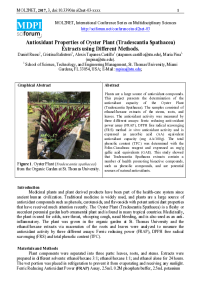
Medicinal plants have been part of the health-care system since ancient human civilization. Traditional medicine is widely used, and plants are a large source of antioxidant compounds such as phenols, carotenoids, and flavonoids with a potent antioxidant properties that have received much attention recently. The oyster plant (Tradescantia spathacea) is a fleshy or succulent perennial garden herb ornamental plant and. medicinally, it is used for colds, sore throat, whooping cough, nasal bleeding, and also as an anti-inflammatory. The plant was collected in the organic garden at St. Thomas University and the extracts were prepared by maceration of the stems, roots, leaves, and flowers in ethanol/hexane solvent mixtures. In this study, the antioxidant activity was measured by three different assays, using the UV-Visible spectrophotometer. Ferric reducing anti-oxidant power assay (FRAC) is based on the principle of increase in the absorbance of various concentrations of the plant extracts and the formation of colored complex with the antioxidant compounds at 700 nm. DPPH Free Radical Scavenging (FRS) assay in vitro antioxidant activity was determined at 517 and 520 nm of multiples samples in a plate reader. % of scavenging activity of the DPPH free radical is expressed as ascorbic acid (AA) equivalent antioxidant capacity (mg AA/100g). The Total Phenolic Content (TPC) in extracts was determined with the Folin-Ciocalteau reagent. Gallic acid was used as a standard, and the total phenolics were expressed as mg/g gallic acid equivalents (GAE). The plant extracts were evaluated for anticancer properties to quantify cytotoxicity. Preliminary data indicated the extracts were not cytotoxic at the concentrations tested.
Keywords
medicinal plants
antioxidant levels
chromatography
free radical scavenging
cytotoxicity
ultraviolet photometry
Poster
mol2net-03-MPina1.pdf
Preliminary antioxidant activity analysis of Brazilian pepper tree (Schinus terebinthifolius) extracts via TLC, FRAP, and DPPH
Preliminary study of the antioxidant activity of Vitis rotundifolia (muscadine grape) extracts using different methods