Event submissions
EventsMOL2NET'17, Conference on Molecular, Biomed., Comput. & Network Science and Engineering, 3rd ed.
Published

This submission belongs to the session 09. NATMODECO-02: Nat. Prod., Molec. Sci., Develop. Sust., Environ., Eco., and Econ. Congress, Puyo, Ecuador-Porto, Portugal, 2017. of the event MOL2NET'17, Conference on Molecular, Biomed., Comput. & Network Science and Engineering, 3rd ed.
Published date
22 Dec, 2017
Citation
David Quesada, Armando Rios, Assessment of the temperature comfort of a model house, in Proceedings of MOL2NET'17, Conference on Molecular, Biomed., Comput. & Network Science and Engineering, 3rd ed., 15 January–15 December 2017, MDPI: Basel, Switzerland, doi: 10.3390/mol2net-03-05111
Share
Email
Facebook
Twitter
LinkedIn
Assessment of the temperature comfort of a model house
'%3e%3cpath%20d='M12.6647%2010.9104C12.4176%2010.325%2012.0589%209.7933%2011.6088%209.34485C11.16%208.89511%2010.6283%208.53653%2010.0432%208.28891C10.038%208.28629%2010.0327%208.28498%2010.0275%208.28236C10.8437%207.69282%2011.3743%206.73252%2011.3743%205.64907C11.3743%203.85423%209.92005%202.40002%208.12522%202.40002C6.33038%202.40002%204.87618%203.85423%204.87618%205.64907C4.87618%206.73252%205.40677%207.69282%206.22296%208.28367C6.21772%208.28629%206.21248%208.2876%206.20724%208.29022C5.62031%208.53783%205.09365%208.89287%204.64167%209.34616C4.19192%209.79496%203.83334%2010.3266%203.58573%2010.9117C3.34247%2011.4846%203.21128%2012.0987%203.19925%2012.721C3.1989%2012.735%203.20135%2012.7489%203.20646%2012.7619C3.21157%2012.7749%203.21924%2012.7868%203.22901%2012.7968C3.23877%2012.8068%203.25045%2012.8148%203.26334%2012.8202C3.27623%2012.8256%203.29007%2012.8284%203.30406%2012.8284H4.09012C4.14776%2012.8284%204.19362%2012.7825%204.19493%2012.7262C4.22113%2011.7148%204.62726%2010.7676%205.34519%2010.0497C6.08802%209.30686%207.07452%208.89811%208.12522%208.89811C9.17592%208.89811%2010.1624%209.30686%2010.9052%2010.0497C11.6232%2010.7676%2012.0293%2011.7148%2012.0555%2012.7262C12.0568%2012.7839%2012.1027%2012.8284%2012.1603%2012.8284H12.9464C12.9604%2012.8284%2012.9742%2012.8256%2012.9871%2012.8202C13%2012.8148%2013.0117%2012.8068%2013.0214%2012.7968C13.0312%2012.7868%2013.0389%2012.7749%2013.044%2012.7619C13.0491%2012.7489%2013.0515%2012.735%2013.0512%2012.721C13.0381%2012.0947%2012.9084%2011.4856%2012.6647%2010.9104ZM8.12522%207.90243C7.52388%207.90243%206.95792%207.66793%206.53214%207.24215C6.10636%206.81636%205.87185%206.2504%205.87185%205.64907C5.87185%205.04773%206.10636%204.48177%206.53214%204.05599C6.95792%203.63021%207.52388%203.3957%208.12522%203.3957C8.72655%203.3957%209.29252%203.63021%209.7183%204.05599C10.1441%204.48177%2010.3786%205.04773%2010.3786%205.64907C10.3786%206.2504%2010.1441%206.81636%209.7183%207.24215C9.29252%207.66793%208.72655%207.90243%208.12522%207.90243Z'%20fill='%235D1EE1'/%3e%3c/g%3e%3c/svg%3e)
David Quesada 1
Armando Rios 2
1. School of Science, Technology and Engineering Management, St. Thomas University, Miami Gardens, FL 33054, USA
2. Miami Dade College, North Campus, Miami FL 33167, USA
Abstract
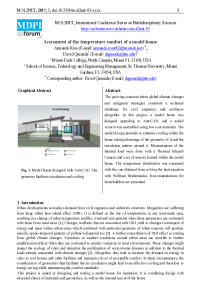
The growing concerns about global climate changes and the need to shift to more sustainable models of urban development create technical challenges for civil engineers and architectures altogether. In this project, a model house was designed appealing to AutoCAD, and scaled version was assembled using low cost materials. The design pretends to take advantage of the cooling ability of the circulating air around it. In order to assess how the thermal load is distributed around the house, a system of three spotlights is located at different angles and configurations, such that, the motion of the sun might be approximated. A Thermal Infrared Camera (TIC) was used to map the heat distribution around the house. Simultaneously, a group of temperature probe sensors were introduced inside the house in order to obtain the approximated heat distribution. Finally, the heat equation is solved appealing to the software Mathematica and using the Method of Finite Differences. This way the irregular geometry of the house could be mapped into a mesh of points and sole the problem numerically. Based on the obtained results, some recommendations are advanced which could be of great benefit for civil engineers and architectures.
Keywords
temperature comfort
infrared imaging
house model design
AUTOCAD
heat equation modeling
Poster
mol2net-03_ARios-DQ.pdf
Preliminary study of the antioxidant activity of Vitis rotundifolia (muscadine grape) extracts using different methods
Characterization of the membrane permeability of different proteasome inhibitors using molecular dynamics methods