Event submissions
EventsMOL2NET'18, Conference on Molecular, Biomed., Comput. & Network Science and Engineering, 4th ed.
Published

This submission belongs to the session 09. NICEXSM-04: North-Ibero-American Congress on Exp. and Simul. Methods., Valencia, Spain-Talca, Chile-Miami, USA, 2018-2019 of the event MOL2NET'18, Conference on Molecular, Biomed., Comput. & Network Science and Engineering, 4th ed.
Published date
01 Feb, 2018
Citation
Tania Churasacari, Daniela Zapata, Janny Maza, Alicia Arica, Roberto Pineda, Santiago Justo, Modeling and Analysis of AG:IGE Interface of House Dust Mite Allergens of Group 1, in Proceedings of MOL2NET'18, Conference on Molecular, Biomed., Comput. & Network Science and Engineering, 4th ed., 15 January 2018–20 January 2019, MDPI: Basel, Switzerland, doi: 10.3390/mol2net-04-05125
Share
Email
Facebook
Twitter
LinkedIn
Modeling and Analysis of AG:IGE Interface of House Dust Mite Allergens of Group 1
'%3e%3cpath%20d='M12.6647%2010.9104C12.4176%2010.325%2012.0589%209.7933%2011.6088%209.34485C11.16%208.89511%2010.6283%208.53653%2010.0432%208.28891C10.038%208.28629%2010.0327%208.28498%2010.0275%208.28236C10.8437%207.69282%2011.3743%206.73252%2011.3743%205.64907C11.3743%203.85423%209.92005%202.40002%208.12522%202.40002C6.33038%202.40002%204.87618%203.85423%204.87618%205.64907C4.87618%206.73252%205.40677%207.69282%206.22296%208.28367C6.21772%208.28629%206.21248%208.2876%206.20724%208.29022C5.62031%208.53783%205.09365%208.89287%204.64167%209.34616C4.19192%209.79496%203.83334%2010.3266%203.58573%2010.9117C3.34247%2011.4846%203.21128%2012.0987%203.19925%2012.721C3.1989%2012.735%203.20135%2012.7489%203.20646%2012.7619C3.21157%2012.7749%203.21924%2012.7868%203.22901%2012.7968C3.23877%2012.8068%203.25045%2012.8148%203.26334%2012.8202C3.27623%2012.8256%203.29007%2012.8284%203.30406%2012.8284H4.09012C4.14776%2012.8284%204.19362%2012.7825%204.19493%2012.7262C4.22113%2011.7148%204.62726%2010.7676%205.34519%2010.0497C6.08802%209.30686%207.07452%208.89811%208.12522%208.89811C9.17592%208.89811%2010.1624%209.30686%2010.9052%2010.0497C11.6232%2010.7676%2012.0293%2011.7148%2012.0555%2012.7262C12.0568%2012.7839%2012.1027%2012.8284%2012.1603%2012.8284H12.9464C12.9604%2012.8284%2012.9742%2012.8256%2012.9871%2012.8202C13%2012.8148%2013.0117%2012.8068%2013.0214%2012.7968C13.0312%2012.7868%2013.0389%2012.7749%2013.044%2012.7619C13.0491%2012.7489%2013.0515%2012.735%2013.0512%2012.721C13.0381%2012.0947%2012.9084%2011.4856%2012.6647%2010.9104ZM8.12522%207.90243C7.52388%207.90243%206.95792%207.66793%206.53214%207.24215C6.10636%206.81636%205.87185%206.2504%205.87185%205.64907C5.87185%205.04773%206.10636%204.48177%206.53214%204.05599C6.95792%203.63021%207.52388%203.3957%208.12522%203.3957C8.72655%203.3957%209.29252%203.63021%209.7183%204.05599C10.1441%204.48177%2010.3786%205.04773%2010.3786%205.64907C10.3786%206.2504%2010.1441%206.81636%209.7183%207.24215C9.29252%207.66793%208.72655%207.90243%208.12522%207.90243Z'%20fill='%235D1EE1'/%3e%3c/g%3e%3c/svg%3e)
Tania Churasacari 1
Daniela Zapata 1
Janny Maza 1
Alicia Arica 1
Roberto Pineda 1
Santiago Justo 1
1. Universidad Ricardo Palma
Abstract
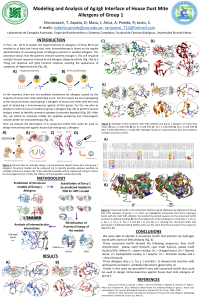
In Peru, 20-28% of people has hypersensitivity to allergens; of these 80% are sensible to at least one house dust mite. The immunotherapy is based on the administration of increasing doses of protein extracts or purified proteins of allergens. These treatments seem to be effective in some cases but still we do not have yet an equilibrium between stability, specificity and immunogenicity. This work analyzes in silico models of antigen-antibody of house dust mite allergens of group 1 of Acarus siro, Euroglyphus maynei, Sarcoptes scabiei y Tyrophagus putrescentiae. We obtained structural in silico models using I-tasser. The assymetric unit of 4PP1 is formed by two DerP1:Fab5H8 complexes; to generate interfaces models we replaced chain A by the allergen model in analysis. Then, we minimized the potential energy using the Steepest Descent algorithm and finally we analyzed the interactions in the allergen:IgE interface.
We were able to identify three antibody aminoacids interacting with the four allergens in study (Tyr32, Tyr50, Lys92), one that interacts with SarS1 and TyrP1 and others six that interact only with EurM1 and AcaS1. Our results show the identification of possible regions important in the recognition of group 1 allergens, also we show other aminoacids that could recognize specifically a subgroup of these allergens.
Keywords
house dust mite
allergy
Peru
Fab5H8
SarS1
TyrP1
EurM1
AcaS1
Poster
PanelAlrgenosICSBM2017Final.pdf
Molecular Dynamics and In Silico Analysis of Oligomerization Surfaces of CYND Enzymes