Event submissions
EventsMOL2NET'17, Conference on Molecular, Biomed., Comput. & Network Science and Engineering, 3rd ed.
Published

This submission belongs to the session 06. NICEXSM-03: North-Ibero-American Congress on Exp. & Simul. Methods, Valencia, Bilbao, Spain-Paraiba, Brasil-Miami, USA, 2017 of the event MOL2NET'17, Conference on Molecular, Biomed., Comput. & Network Science and Engineering, 3rd ed.
Published date
10 Feb, 2018
Citation
Amanda Patricia Solís Gutiérrez, Katherine Miranda Cadena, Iñigo De la fuente, Cristina Marcos Arias, Estibaliz Mateo, Andrea Guridi, Elena Sevillano, Lucila Madariaga, Elena Eraso, Guillermo Quindós, Study of microbiological laboratory techniques for the etiological diagnosis and guidance in the treatment of invasive candidiasis, in Proceedings of MOL2NET'17, Conference on Molecular, Biomed., Comput. & Network Science and Engineering, 3rd ed., 15 January–15 December 2017, MDPI: Basel, Switzerland, doi: 10.3390/mol2net-03-05128
Share
Email
Facebook
Twitter
LinkedIn
Study of microbiological laboratory techniques for the etiological diagnosis and guidance in the treatment of invasive candidiasis
'%3e%3cpath%20d='M12.6647%2010.9104C12.4176%2010.325%2012.0589%209.7933%2011.6088%209.34485C11.16%208.89511%2010.6283%208.53653%2010.0432%208.28891C10.038%208.28629%2010.0327%208.28498%2010.0275%208.28236C10.8437%207.69282%2011.3743%206.73252%2011.3743%205.64907C11.3743%203.85423%209.92005%202.40002%208.12522%202.40002C6.33038%202.40002%204.87618%203.85423%204.87618%205.64907C4.87618%206.73252%205.40677%207.69282%206.22296%208.28367C6.21772%208.28629%206.21248%208.2876%206.20724%208.29022C5.62031%208.53783%205.09365%208.89287%204.64167%209.34616C4.19192%209.79496%203.83334%2010.3266%203.58573%2010.9117C3.34247%2011.4846%203.21128%2012.0987%203.19925%2012.721C3.1989%2012.735%203.20135%2012.7489%203.20646%2012.7619C3.21157%2012.7749%203.21924%2012.7868%203.22901%2012.7968C3.23877%2012.8068%203.25045%2012.8148%203.26334%2012.8202C3.27623%2012.8256%203.29007%2012.8284%203.30406%2012.8284H4.09012C4.14776%2012.8284%204.19362%2012.7825%204.19493%2012.7262C4.22113%2011.7148%204.62726%2010.7676%205.34519%2010.0497C6.08802%209.30686%207.07452%208.89811%208.12522%208.89811C9.17592%208.89811%2010.1624%209.30686%2010.9052%2010.0497C11.6232%2010.7676%2012.0293%2011.7148%2012.0555%2012.7262C12.0568%2012.7839%2012.1027%2012.8284%2012.1603%2012.8284H12.9464C12.9604%2012.8284%2012.9742%2012.8256%2012.9871%2012.8202C13%2012.8148%2013.0117%2012.8068%2013.0214%2012.7968C13.0312%2012.7868%2013.0389%2012.7749%2013.044%2012.7619C13.0491%2012.7489%2013.0515%2012.735%2013.0512%2012.721C13.0381%2012.0947%2012.9084%2011.4856%2012.6647%2010.9104ZM8.12522%207.90243C7.52388%207.90243%206.95792%207.66793%206.53214%207.24215C6.10636%206.81636%205.87185%206.2504%205.87185%205.64907C5.87185%205.04773%206.10636%204.48177%206.53214%204.05599C6.95792%203.63021%207.52388%203.3957%208.12522%203.3957C8.72655%203.3957%209.29252%203.63021%209.7183%204.05599C10.1441%204.48177%2010.3786%205.04773%2010.3786%205.64907C10.3786%206.2504%2010.1441%206.81636%209.7183%207.24215C9.29252%207.66793%208.72655%207.90243%208.12522%207.90243Z'%20fill='%235D1EE1'/%3e%3c/g%3e%3c/svg%3e)
Amanda Patricia Solís Gutiérrez 1
Katherine Miranda Cadena 2
Iñigo De la fuente 2
Cristina Marcos Arias 2
Estibaliz Mateo 2
Andrea Guridi 2
Elena Sevillano 2
Lucila Madariaga 2
Elena Eraso 2

Guillermo Quindós 2
1. 1Universidad de Guanajuato, Guanajuato, México 2Departamento de Inmunología, Microbiología y Parasitología, Facultad de Medicina y Enfermería, Universidad del País Vasco/Euskal Herriko Unibertsitatea (UPV/EHU), Bilbao
2. Departamento de Inmunología, Microbiología y Parasitología, Facultad de Medicina y Enfermería, Universidad del País Vasco/Euskal Herriko Unibertsitatea (UPV/EHU), Bilbao
Abstract
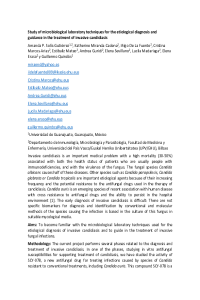
Invasive candidiasis is an important medical problem with a high mortality (30-50%) associated with both the health status of patients who are usually people with immunodeficiencies, and with the virulence of the fungus. The fungal species Candida albicans causes half of these diseases. Other species such as Candida parapsilosis, Candida glabrata or Candida tropicalis are important etiological agents because of their increasing frequency and the potential resistance to the antifungal drugs used in the therapy of candidiasis. Candida auris is an emerging species of recent association with human disease with cross resistance to antifungal drugs and the ability to persist in the hospital environment [1]. The early diagnosis of invasive candidiasis is difficult: There are not specific biomarkers for diagnosis and identification by conventional and molecular methods of the species causing the infection is based in the culture of this fungus in suitable mycological media.
Aims: To become familiar with the microbiological laboratory techniques used for the etiological diagnosis of invasive candidiasis and to guide in the treatment of invasive fungal infections.
Methodology: The current project performs several phases related to the diagnosis and treatment of invasive candidiasis. In one of the phases, studying in vitro antifungal susceptibilities for supporting treatment of candidiasis, we have studied the activity of SCY-078, a new antifungal drug for treating infections caused by species of Candida resistant to conventional treatments, including Candida auris. This compound SCY-078 is a
new oral and intravenous drug for the treatment. We have evaluated the in vitro action of this drug SCY-078 and other antifungal drugs (azoles and echinocandins) against isolates of different Candida species isolated from blood cultures, such as Candida albicans, Candida parapsilosis, Candida tropicalis, Candida auris or Candida glabrata using the EUCAST method [2]. This method is the European protocol for studying the in vitro activity of antifungal drugs. EUCAST is a microdilution method for determining the Minimum Inhibitory Concentration (MIC) of the different antifungal agents and their usefulness for the treatment of invasive mycoses.
Conclusion: The main action of azoles is to inhibit lanosterol 14-α-demethylase coupled to cytochrome P-450. This action causes an alteration of fungal cell membranes increasing permeability and producing inhibition of cell growth and cell replication. Echinocandins inhibit 1,3-β-D-glucan synthetase, the enzymatic complex that forms β-D-glucan polymers in the cell wall of the fungus. The cell wall provides rigidity to the cell and its rupture causes the cell death. The compound CSY-078 is derived from enfumafungin (formerly MK-3118) and it is an inhibitor of the 1,3-β-D-glucan synthesis. This drug is the first in its class: triterpenic antifungal drugs. SCY-078 has demonstrated in vitro activity against many Candida species and against the multidrug-resistant pathogen Candida auris, which has been classified by the Centers for Disease Control and Prevention (CDC) as a Serious Threatens a global level for health In clinical development to treat candidemia and candidiasis [1,3,4]. During my stay, we have verified the excellent in vitro efficacy of the echinocandins caspofungin and micafungin and the new drug SCY-078 against many of the clinical isolates of Candida that were resistant to fluconazole. Moreover, SCY-078 was active against many Candida blood isolates with decreased susceptibility to caspofungin and micafungin.
Keywords
Study of microbiology
laboratory
techniques
diagnosis
treatment
candidiasis
Poster
Amanda Solís Summary Delfín Program 28072017.pdf
Prediction of RIFIN proteins with gene orientation network indices
Ecotoxicological assessment of pharmaceuticals using computational toxicology approaches: QSTR and interspecies QTTR modelling