Event submissions
EventsMOL2NET'18, Conference on Molecular, Biomed., Comput. & Network Science and Engineering, 4th ed.
Published

This submission belongs to the session 05. MODEC-03: Workshop on Natural Products and Agro-Industrial Procesess in Amazon, UEA, Puyo, Ecuador, 2018 of the event MOL2NET'18, Conference on Molecular, Biomed., Comput. & Network Science and Engineering, 4th ed.
Published date
28 Mar, 2018
Citation
Jonathan Fabricio Villavicencio, Carmen Amelia Salvador, Layanis Mesa, Maira Rojas, Pablo Londoño, Obtaining microorganisms with cellulolytic activity in different regions of Ecuador, in Proceedings of MOL2NET'18, Conference on Molecular, Biomed., Comput. & Network Science and Engineering, 4th ed., 15 January 2018–20 January 2019, MDPI: Basel, Switzerland, doi: 10.3390/mol2net-04-05186
Share
Email
Facebook
Twitter
LinkedIn
Obtaining microorganisms with cellulolytic activity in different regions of Ecuador
'%3e%3cpath%20d='M12.6647%2010.9104C12.4176%2010.325%2012.0589%209.7933%2011.6088%209.34485C11.16%208.89511%2010.6283%208.53653%2010.0432%208.28891C10.038%208.28629%2010.0327%208.28498%2010.0275%208.28236C10.8437%207.69282%2011.3743%206.73252%2011.3743%205.64907C11.3743%203.85423%209.92005%202.40002%208.12522%202.40002C6.33038%202.40002%204.87618%203.85423%204.87618%205.64907C4.87618%206.73252%205.40677%207.69282%206.22296%208.28367C6.21772%208.28629%206.21248%208.2876%206.20724%208.29022C5.62031%208.53783%205.09365%208.89287%204.64167%209.34616C4.19192%209.79496%203.83334%2010.3266%203.58573%2010.9117C3.34247%2011.4846%203.21128%2012.0987%203.19925%2012.721C3.1989%2012.735%203.20135%2012.7489%203.20646%2012.7619C3.21157%2012.7749%203.21924%2012.7868%203.22901%2012.7968C3.23877%2012.8068%203.25045%2012.8148%203.26334%2012.8202C3.27623%2012.8256%203.29007%2012.8284%203.30406%2012.8284H4.09012C4.14776%2012.8284%204.19362%2012.7825%204.19493%2012.7262C4.22113%2011.7148%204.62726%2010.7676%205.34519%2010.0497C6.08802%209.30686%207.07452%208.89811%208.12522%208.89811C9.17592%208.89811%2010.1624%209.30686%2010.9052%2010.0497C11.6232%2010.7676%2012.0293%2011.7148%2012.0555%2012.7262C12.0568%2012.7839%2012.1027%2012.8284%2012.1603%2012.8284H12.9464C12.9604%2012.8284%2012.9742%2012.8256%2012.9871%2012.8202C13%2012.8148%2013.0117%2012.8068%2013.0214%2012.7968C13.0312%2012.7868%2013.0389%2012.7749%2013.044%2012.7619C13.0491%2012.7489%2013.0515%2012.735%2013.0512%2012.721C13.0381%2012.0947%2012.9084%2011.4856%2012.6647%2010.9104ZM8.12522%207.90243C7.52388%207.90243%206.95792%207.66793%206.53214%207.24215C6.10636%206.81636%205.87185%206.2504%205.87185%205.64907C5.87185%205.04773%206.10636%204.48177%206.53214%204.05599C6.95792%203.63021%207.52388%203.3957%208.12522%203.3957C8.72655%203.3957%209.29252%203.63021%209.7183%204.05599C10.1441%204.48177%2010.3786%205.04773%2010.3786%205.64907C10.3786%206.2504%2010.1441%206.81636%209.7183%207.24215C9.29252%207.66793%208.72655%207.90243%208.12522%207.90243Z'%20fill='%235D1EE1'/%3e%3c/g%3e%3c/svg%3e)
Jonathan Fabricio Villavicencio 1
Carmen Amelia Salvador 2
Layanis Mesa 1
Maira Rojas 3
Pablo Londoño 2
1. Universidad Central Marta Abreu de las Villas
2. Universidad Central del Ecuador
3. Universidad de Las Americas
Abstract
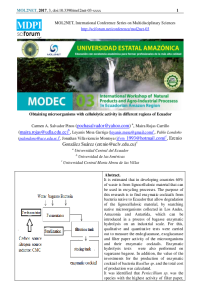
It is estimated that in developing countries, 60% or more of waste is lignocellulosic material that can be used in recycling processes. The purpose of this research has been aimed to find enzymatic cocktails from bacteria native to Ecuador that allow the degradation of lignocellulosic material, through the search of microorganisms collected in the Andean, Amazon and Antarctic regions, which can be introduced in a process of enzymatic hydrolysis of bagasse at industrial scale. For this, qualitative and quantitative assays were carried out to measure the endoglucanase, exoglucanase and filter paper activity of the microorganisms and their enzymatic cocktails, as well as assays of enzymatic hydrolysis of the sugarcane. In addition, the value of the investments for Bacillus sp bacterium enzymatic cocktail production, and the total production cost were calculated.
It was identified that Peniccillium sp., Was the species with the highest activity of filter paper, showing 0.0073 UPF and a glucose yield of 11.968 in 100 grams of bagasse, which opens up the possibility of its use, in industrial processes. From this best strain of microorganism, the equipment was sized on an industrial scale and it was concluded that the investment cost would benefit the country.
The study shows that it is possible to generate a proprietary technology for the production of cellulolytic enzyme crudes in Ecuador.
Keywords
Cellulases
Bacillus
cocktail
bagasse
sugarcane
Poster
Obtaining microorganisms with cellulolytic activity in different regions of Ecuador.pdf
Predicting Compound-Protein Interactions in GPCR Network
Molecular docking approach to identify potential anticancer compounds targeting ALOX5 for the treatment of Pancreatic Cancer